 You don't need to be an 'investor' to invest in Singletrack: 6 days left: 95% of target - Find out more
When you look south in the night sky ?
It seems to be usually slightly below the moon. Really bright.
Venus usually.
Right now it’s Jupiter. Closer to UK than it will ever be again in our lifetime apparently.
Venus is a planet, not a star 😉.
Sirius is the brightest star that I can occasionally see in the northern hemisphere.
🚀⭐✨
Download the free SkyView Lite app to your phone. Shows the name of whatever celestial object you point your phone at, all the constellations etc!
Jupiter
As above: you've almost certainly seen Jupiter (a planet).
Even with cheap binoculars - and in the back garden under street lights - you can see its moons.
Four faint dots to the either side of the disc (not a point because it's a planet and not a star).
Wow!
Even with cheap binoculars – and in the back garden under street lights – you can see its moons.
I tried last week when it was at it's brightest and couldn't. Pretty sure you'd need a tripod if you actually wanted to try this.
You can usually see 4 of Jupiter's many moons, depending on alignment, with your naked eye. Easier if it's dark and there isn't any other bright objects near by
I achieved it with small bins and by leaning against the wall. But a tripod would certainly help - in fact that's my project for today sorted 🙂
What was the bright object in the sky above the moon late last week?
Probably 9-10pm
Also, remember the chilfrens nursery rhyme, ‘twinkle twinkle little star’
Stars twinkle, planets don’t.
Easy way to decide which you’re looking at.
Well, with all of that, whats the brightest non Solar object in the night sky visible with the naked eye from the UK at this time of year and whats the best way of finding it? (Im guessing some sort of App?)
The sun?
Seriously, I was going to suggest as above - download an app. Personally I use Planets.
Non-solar object, try ISS - there is an app for passes. You can sometimes see Elon's 'string' of satelites for a few days after launch, but not spotted those yet as they aren't that bright. They start to separate after launch.
The sun?
Unless I have my terminology horribly mixed up, I have that as a Solar Object ...
NASA says it is a star 😉
The Sun is a star. There are lots of stars in the universe, but the Sun is the closest one to Earth, and it’s the only one in our solar system. It is the center of our solar system.
Deffo Jupiter. Moons with the naked eye is far fetched for mortals given it’s hard enough using resting binoculars.
Buy Skyguide for your phone. It works brilliantly and is beautiful.
https://apps.apple.com/gb/app/sky-guide/id576588894
NASA says it is a star 😉
In an effort to side step pedantry 🙃
Whats the brightest object outside the solar system visible from the UK?
Its probably just the (next) nearest star isnt it?
Easier if it’s dark
Blimey, Patrick Moore's turned up! 😆
Blimey, Patrick Moore’s turned up!
😂😂😂😂😂
Also, remember the chilfrens nursery rhyme, ‘twinkle twinkle little star’
Stars twinkle, planets don’t.
Easy way to decide which you’re looking at.
I used to think this also, but I don't believe it to be true. Twinkling is caused by our atmosphere. I think.
yes. interested in what other answer you might've been expecting!!Its probably just the (next) nearest star isnt it?
yes - fairly obviously 😃 (If stars twinkle, then why doesn't the sun?) More light comes from the planets, so less affected by our atmosphere than a faint star. Although he's probably saying that stars [I]appear[/I] to twinkle whereas planets don't, which is more correct.I used to think this also, but I don’t believe it to be true. Twinkling is caused by our atmosphere. I think.
yes. interested in what other answer you might’ve been expecting!!
Our nearest star (after Sol) is Proxima Centauri; the brightest is Sirius.
Although he’s probably saying that stars appear to twinkle whereas planets don’t, which is more correct.
Well, yes. Maybe it's fair to say that planets twinkle - appear to twinkle, Pedantipants - less than stars, rather than not at all.
It seems to be usually slightly below the moon. Really bright.
The moon moves through the sky at a different rate to the stars and planets, so nothing is 'usually slightly below the moon'. Or rather, it will be a slightly different skyscape every night. Jupiter was immediately above the moon a couple of nights ago, I seem to remember, and is normally the brightest object visible unless Venus is up. Venus tends to be the brightest thing in the night sky other than the moon, but is only visible for a short time just after sunset or just before sunrise, depending on where it is.
You can usually see 4 of Jupiter’s many moons, depending on alignment, with your naked eye. Easier if it’s dark and there isn’t any other bright objects near by
Unless you've got Steve Austin's Bionic Eyes, I doubt it very much. It's not easy with binoculars.
Actually, I've just googled it and technically it would be possible:
Yes. The moon Callisto can be seen by the naked eye, from Earth. But, to see it, you would need to obscure Jupiter. Jupiter is more than 200 times brighter than its moons. Jupiter's glare would prevent seeing Callisto. Callisto, by itself, has an apparent magnitude of about 5, making it 2.5 times brighter than the faintest stars the naked eye can see.
The angular resolution of the human eye is about 1 arc minute.
Now we need to figure out the angular distance between Jupiter and the moon in question. We will just consider the four Galilean moons. They are by far the largest of Jupiter's many moons.
The greatest angular distance between Jupiter and Callisto will occur when they are in a plane, such as the above diagram.A rule of thumb is that angular size of an object, in radians, is its diameter divided by the distance to it.
Callisto is 1,882,710 km from the center of Jupiter (at the most)
Jupiter is 628,743,036 km from Earth (at its closest)(1,882,710 km)/(628,743,036 km) = 0.0029944 radians.
There are 57.2977951 degrees in a radian. So, 0.0029944 radians equals 0.17156665 degrees.
There are 60 arc minutes in a degree, so 0.17156665 degrees equals 10.2939 arc minutes.
In a cruder but more visual way of putting it - if our eyes can see pixels that are 1 arc minute across as having size, Callisto and Jupiter would be about 10 pixels apart.
Let's put this into better size perspective. Our Moon is about half a degree in diameter. That's 30 arc minutes. So, the distance between Jupiter and Callisto, from our perspective, would be about 1/3 the diameter of the Moon.
Caveat: All of this of course depends on the observer having excellent eyesight and the observation being done somewhere with cool, dark, and clear skies. The Moon is in the above picture to illustrate scale. If the Moon is actually in the sky, its brightness will render Callisto invisible.
My eyesight is pretty good. I've seen the 4 big visible moons of Jupiter with my eyes.
Took me a while once upon a long time ago before app internet sky mapping (but there were books!) to workout that there was an unusual dot of light that wasn't normally there amongst the regular stars, I got my telescope out investigated further and it was Saturn. Saw the dust rings. Not seen it since. That was the limit of my telescope and it's been cloudy ever since 😉🤣
🤔 been googling it & nothing I've read suggests that anyone thinks it's possible to see all 4 moons distinctly with the naked eye! The main reason being that Jupiter itself is too bright and therefore obscures the moons with its glare.My eyesight is pretty good. I’ve seen the 4 big visible moons of Jupiter with my eyes.
I was going to add - Saturn is up at a decent time at the moment and if you can get access to a telescope, you can get a good view of the rings.
Had a fun evening the other day when the phone reckoned some dull looking dot was Saturn. Unconvinced, we pointed the telescope at it and, largely by sheer luck, had Saturn with its rings visible right in the centre of the eyepiece. Stunning.
that's cool! What scope have you got? Something I've always thought about getting, but doubt I could really justify the cost of something decent/worthwhile for the actual use it would probably get!!Unconvinced, we pointed the telescope at it and, largely by sheer luck, had Saturn with its rings visible right in the centre of the eyepiece. Stunning.
It's a 6" reflector (Skywatcher Explorer 150P). Not sure I can justify it but bought it about 10 years ago when I changed jobs and felt like treating myself (it was also half the price I see it for now).
Every winter, I promise myself to use it properly but not really done that much with it yet. You can see the stripes (and I think I convinced myself the red spot) on Jupiter on a good night. Stunning views of the moon and some deep-space objects and, for the first time last week, Saturn's rings.
Edit - and crescent Venus. That was quite cool to see. OK, don't use it that much but I think it was worth it. 🙂
£500 ish? Not an impulse buy, but certainly not ridiculous, if you can afford it & enjoy using it (occasionally!!)It’s a 6″ reflector (Skywatcher Explorer 150P)
I was using a skywatcher Newtonian refractor telescope when I looks at Saturn's rings. Paid around £200 for it over 20 years ago. The eyepieces weren't great. I never got around to upgrading them. I recently gave the telescope away as it was a pain to drag out of the house I the few occasions the night sky was clear and it had to cool down to outdoor temp I winter, etc. I just now use my binoculars instead.
The visible moons of Jupiter to the naked eye need to be at the right position to see them, spaced apart and hopefully 2 to the left and 2 to the right. Doesn't happen that often like must astronomical events so it is worth keeping track of when it is predicted to happen.
You will see none of Jupiters moons if 2 are hidden and 2 are directly in front if viewing from earth!
It’s a 6″ reflector (Skywatcher Explorer 150P)
£500 ish? Not an impulse buy, but certainly not ridiculous, if you can afford it & enjoy using it (occasionally!!)
Have a look at these:
https://www.firstlightoptics.com/beginner-telescopes/skywatcher-heritage-130p-flextube.html
£190, small enough to stick in a cupboard when not in use, but with enough light gathering to make it worthwhile.
What was the bright object in the sky above the moon late last week?
Jupiter. Saturn also visible to the right. Mars was visible a bit later in the evening to the east.
Unconvinced, we pointed the telescope at it and, largely by sheer luck, had Saturn with its rings visible right in the centre of the eyepiece. Stunning.
that’s cool! What scope have you got?
Saturn, in a decent scope, is one of the best things to view. I could look at it for hours. Jupiter is great, but when you can see the Cassini Division, and a cloud of Saturn's moons - that's something else. Even when it's a dull dot for the naked eye you see an item in the scope which is incredibly bright, and pin sharp, albeit small compared to Jupiter.
I'm wondering idly now what I can get out of the long lens on my camera. Might have to have a play.
This is what I got with my camera a week or so ago...
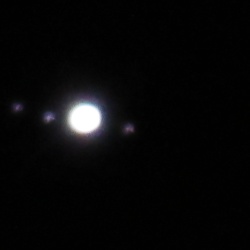
Dang it. A fourth moon is visible on the actual image on the far right. It's just much less bright.
Fun read. Got all this stuff out of my system as a member of the junior astronomical society before puberty hit hard. You can see lots of the flashy stuff with binoculars - crescent venus, disc and moons of Jupiter, Saturn's rings, Andromeda nebula (galaxy and most distant thing you can see with the naked eye) and in winter Orion's belt (nebula), loads of Pleiades. Not that I had binocs, I made a telescope with lenses I got from the optician (can you believe I wore glasses?) and dunno what I used as concave. An old glass vase at one stage I think.
Thank goodness my kids had GameCube and the internet, and a know-all dad to cure them of any interest... Sorry. Dunno where that came from 🙂
That little telescope looks ace, I had a reasonably good scope for a while but it was just so bloody massive. If I left it assembled, it instantly became a clothes horse, if I wanted to look at stuff through it, it was always either in a box or covered in clothes.
Star apps are a wonderful thing tbh. So much skygazing stuff seems to be written in code to me, so the ability to just wave a phone at the sky and then take that and apply it was a total gamechanger. Satellites too. A lovely combination of learning/knowing, and also having a little scifi gadget in your pocket that has all of that learning in it on demand.
Bought skyguide for my iPhone after reading this thread, what a great 15 minutes outside. Fascinating
Might take a look at that scope mentioned above.
I tried last week when it was at it’s brightest and couldn’t. Pretty sure you’d need a tripod if you actually wanted to try this.
Nah, I’ve seen the Galilean moons with an ordinary hand-held pair of binoculars, but it’s worth pointing out that the higher the magnification, the more difficult it is to see them hand-held, because the angle of view gets narrower. I used a pair of 10x50’s, which have the best light gathering power.
Whats the brightest object outside the solar system visible from the UK?
Its probably just the (next) nearest star isnt it?
Not necessarily, depends where on earth you are - two of the brightest are visible in the northern hemisphere, but one of those two is only visible during the winter. Arcturus is visible all year round.
Arcturus of the constellation Boötes is the brightest star in the northern celestial hemisphere. It is the brightest star in the constellation of Boötes, the fourth-brightest in the night sky, and the brightest in the northern celestial hemisphere. With an apparent magnitude of −0.04, it is the fourth brightest star in the night sky, after −1.46 magnitude Sirius, −0.86 magnitude Canopus, and −0.27 magnitude Alpha Centauri. Astronomers say Arcturus will end up as a white dwarf at the end of its life.
Arcturus is an orange giant star located 37 light-years away in the Boötes constellation, with its apparent magnitude of -0.05 making it the 4th brightest star in the night sky.
It’s less than 37 light-years away and appears as the brightest star north of the celestial equator. It is a relatively close star at only 36.7 light-years from Earth, and, together with Vega and Sirius, one of the most luminous stars in the Sun’s neighborhood. When viewed from Earth, it appears to be positioned almost at the north galactic pole of the Milky Way.
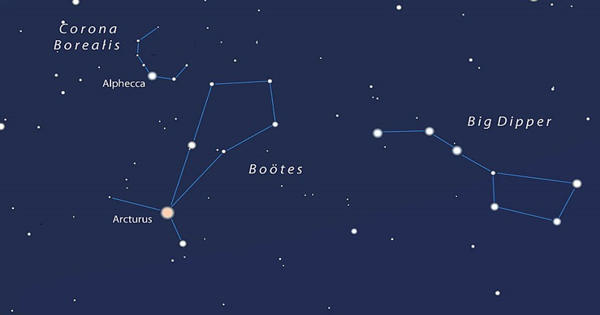
There you go.