 You don't need to be an 'investor' to invest in Singletrack: 6 days left: 95% of target - Find out more
When mobile phones first came out we were told not to leave the chargers plugged in.
Can you just leave your phone cable in the usb socket or do you have to take it out when not in use?
Yes
Electricity only flows if there is a device on the other end of the wire. Nothing bad can happen if you leave things plugged in.
Early phone chargers were transformers and used power all the time. They feel heavy as they have a lot of metal inside. Modern chargers and usb sockets are switch mode and only use power when there is demand. You can leave the cable in, it'll make no difference.
How come i can feel tingling when leaning on the end of my iphone charger?
Make sure you have the end higher than the plug, or electrons will spill out.
DrP
Ooh, cheers for that. Gotta watch the pennies with the cozzy livs la
*tapes iphone charger to wall
How come i can feel tingling when leaning on the end of my iphone charger?
Depends where you've inserted it before leaning on it...
Electricity only flows if there is a device on the other end of the wire. Nothing bad can happen if you leave things plugged in.
I thought that but Google seems to think otherwise mainly.
That power is used.
There’s still a transformer in the back of the socket so it’ll use some energy whether something is plugged in or not.
I got a job to change 7 of them back to normal sockets after the home owner heard Martin Lewis call them ‘power vampires’
The invoice cost didn’t seem to bother her as much as losing a couple of watts a day
These will indeed be modern switch mode power supplies (SMPS) rather than traditional transformers.
But that doesn’t mean zero power draw when nothings plugged in. But a well designed one should be less than 0.1W. So, about 1kwh a year, or 30p a year.
Still makes no difference whether a leads plugged in or not.
(Interesting side note for the slightly learned: SMPS often actually incorporate a transformer, albeit a very small one, to provide galvanic isolation and act as the switching inductor).
How come i can feel tingling when licking the end of my iphone charger?
FTFY
Not me but from another fourm, there are other reasons to disconnect the cable.
[img] 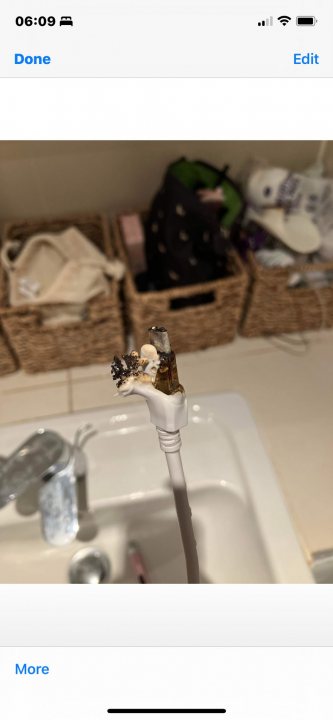 [/img]
https://www.pistonheads.com/gassing/topic.asp?h=0&f=95&t=2024647
Fitted a few when we did up the kitchen but don't use them as much as I thought as they're just slow (2 Amps?) vs 4-5 Amp for a plug charger) so never seems to get much charge in before I have to unplug again. Maybe better for overnight locations.
But that picture is in a bathroom?! Maybe another reason for the problem.
Yeah but I don't think the cable is plugged into anything at the other end as it's in the sink - maybe they took the burning cable to the bathroom sink to put out the fire?
they’re just slow (2 Amps?) vs 4-5 Amp for a plug charger
Possibly a consequence of them being USB A sockets. We have one that has a USB-C socket as well as a USB A and can supply 4A, albeit shared between the 2 so if you want 4A you can't plug 2 things in at once.
Whilst I guess the known brands are ok (MK etc) I've always been a bit suspicious of sockets with built in USB as there are some pretty shonky USB power adapters around and you never know what's built into the socket and you can't exactly unplug it if it seems to be burning the house down.
We've got around 10 of them in the house, they consume about 1.5-2w per socket with nothing plugged in. You can feel a slight tingle/itch on an iphone lightning cable (nothing on USB mini, c micro, etc) if it touches sensitive bare skin. I'd imagine if you complete the circuit, you might get more than a tingle.
We've been using them here for about 6 years, always leave cable plugged in, never had a problem. They're used to charge everything from bike lights to large iPads. Never had any issues with them at all.
you can’t exactly unplug it if it seems to be burning the house down.
But you can flip the breaker.
But you can flip the breaker.
Not ideal if, for example, the faulty socket's in the kitchen and you can't have the fridge on until it's replaced. Just did a bit of googling about this which didn't do much to allay my concerns. See e.g. https://www.electricalsafetyfirst.org.uk/professional-resources/technical-e-news/investigation-into-uk-socket-outlets-incorporating-usb-charging-points/
I’ve several - find them really useful for things like the Nest thermostat or USB lights… can leave them plugged in all the time, and they’re fine on the ‘slow’ power..
DrP
There’s still a transformer in the back of the socket so it’ll use some energy whether something is plugged in or not.
They don't use transformers any more, all switched mode converters which can just switch themselves off when not in use. EU directives mean that the stand by power for nearly all electrical devices is very low now.
Are they ok to use for things that use the usb for power rather than just charging. So like a Roku stick that could be on for a good few hours during the day?
Are they ok to use for things that use the usb for power rather than just charging.
I suspect that depends on the quality of the DC-DC converter which will vary a lot between makes. Some cheap USB supplies are pretty noisy, which might upset some devices.
Quite interesting to see how much they vary: This is a breakdown of a load of plug type ones: https://www.righto.com/2012/10/a-dozen-usb-chargers-in-lab-apple-is.html
The answer is probably...
Just get one like this 🙂
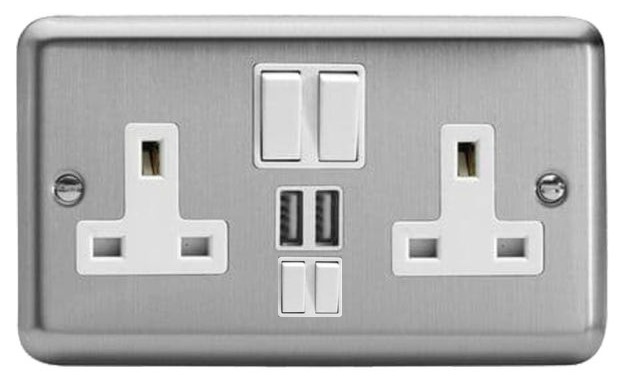
snip...they consume about 1.5-2w per socket with nothing plugged in
MK consume 0.05W and they have both USB A and C sockets
If you're buying this type of socket then get a decent brand and look at where the USB socket is positioned; some of the not so well thought out designs cover the USB when a bulky 3-pin plug-transformer is in
The first ones I had used to hum when you plugged them in, was very annoying by my bed.
So replaced them, no more hum during use, and the Sparkie mentioned these ones only turn on when plugged in so the transformer is only active when charging. They are MK, can't remember what the old ones were.
We've got loads in our house, mostly just for charging stuff like game controllers, bike lights, etc. Or running Chromecast sticks etc.
Never leave the cables plugged in when not in use though as the charger doesn't know the difference between a phone and a spilt coffee/overwatered plant/your tongue. Won't normally burn the house down but you do end up with a puddle of blue gunk where all the copper rapidly leaches out by electrolysis.
Possibly a consequence of them being USB A sockets. We have one that has a USB-C socket as well as a USB A and can supply 4A, albeit shared between the 2 so if you want 4A you can’t plug 2 things in at once.
You can run higher powered devices from a USB-A port, just like a USB-C port can be only able deliver low power.
E.g. a 100W laptop can run off USB-C, but not off your USB-C phone charger.
USB-A/B/C are plug/socket standards. USB 1.0, 2.0, 3.0, 3.2 Gen2x2, QC3.0 etc are all protocols.
I've even got a few USB-C cables, that won't run USB 3.0 because they lack the extra pins as they're just there to deliver 500mA.
USB-A/B/C are plug/socket standards. USB 1.0, 2.0, 3.0, 3.2 Gen2x2, QC3.0 etc are all protocols.
I think USB-PD is the protocol you’re looking for, and it would be a brave manufacturer that let more than 2A 5V out of a generic USB-A port. Although some of the dodgier socket vendors probable are pretty brave.
I’ve even got a few USB-C cables, that won’t run USB 3.0 because they lack the extra pins as they’re just there to deliver 500mA.
I’ve seen a few tech articles trolling Apple over reports about MFi USB-C cables, whining that it’s just an excuse to make more money.
No, it’s so that anyone buying one knows it’s going to actually work properly, carry all the power necessary, and carry data.
I bought several Lightning cables when the format first came out, and was very annoyed that while they’d charge my phone, they wouldn’t carry data. USB-C is a can of worms in that respect, as there are multiple versions that don’t all do the things people expect them to - MFi certification guarantees they’ll do what you need.
Won't anyone think of the cables!?
If left plugged in you might snag the cable on something yanking it causing the cable undue stress.
I think USB-PD is the protocol you’re looking for, and it would be a brave manufacturer that let more than 2A 5V out of a generic USB-A port. Although some of the dodgier socket vendors probable are pretty brave.
Nope, just for example my phone is currently charging off a Samsung USB-A charger that will deliver 12V and 1.5A. The QC standard which most manufacturers now use and re-brand as something else, is agnostic of the connector. USB-PD is subtly different, but can still supply 21V.
This is probably a bit off-topic, but I do like a bit of nerdy tech discussion;
The QC standard which most manufacturers now use and re-brand as something else
was a bit of proprietary Qualcomm technology that’s unlikely to have found its way into a USB wall socket. Later versions are compatible with USB-PD so I’m not sure why Qualcomm perseveres with it.
Just get one like this 🙂
Indeed 🙂