 You don't need to be an 'investor' to invest in Singletrack: 6 days left: 95% of target - Find out more
There's gonna be some extra demanding Porsche buyers in the US as if they won't act entitled enough already.
A burning container ship carrying almost 4,000 cars – including 1,100 Porsches – has been drifting in the mid-Atlantic after the vessel’s 22 crew members were evacuated, the Portuguese navy has said.
An internal email from Volkswagen US said the ship was carrying 3,965 vehicles of the VW, Porsche, Audi and Lamborghini brands, the German newspaper Handelsblatt reported.
Maybe it'll wash ashore in Dorset and we can all go nuts trying to get a Lambo through the surf.
Maybe Huracan Eunice will blow it ashore
Although if its on fire maybe all we'll be able to do is count ash
They’re now even more polluting
A burning container ship carrying almost 4,000 cars – including 1,100 Porsches – has been drifting in the mid-Atlantic after the vessel’s 22 crew members were evacuated, the Portuguese navy has said.
Point of note, that's not a container ship, it's a RoRo car transporter ship.
A better beachcombing find than a lego dragon.
Bravo Andrew, bravo
Maybe Huracan Eunice will blow it ashore
Although if its on fire maybe all we’ll be able to do is count ash
Needed some credit...
Maybe it'll add to the Caymen Islands.
The ship will be a silhouette in the distance now, could maybe drift to Jalpanese shores given enough time.
It's going to be a very big bill whoever ends up paying it
https://www.reinsurancene.ws/burning-car-carrier-felicity-ace-could-be-500m-cargo-loss-says-skytek/
I Cayenne see this ending badly.
sure they'll be taycan up somewhere
Must not have called 911 quick enough when the fire started.
The Lambo's make me sad though.
My dream car.
Reminds me, must do the lottery.
Must be bad if they had to evacuate the ship, glad everyone got off safely.
It's not got open decks, which just feed oxygen into the fires on deck, so I guess the abandonment was due to the intensity of the fire. The fire suppressant system can probably cope with normal cars (if working) but I'll wager it's full of hybrids and lithium batteries thus creating an intense fire.
I’ll wager it’s full of hybrids and lithium batteries thus creating an intense fire.
But surely they should take the batteries out and transport them separately?
But surely they should take the batteries out and transport them separately?
How the hell do you take battery out of a car without dismantling the car? Another reason why EV’s are not eco friendly
But surely they should take the batteries out and transport them separately?
How the hell do you take battery out of a car without dismantling the car? Another reason why EV’s are not eco friendly
Just hook up a 200V DC battery with flying leads and croc clips just to move the car.
What could go wrong?
But surely they should take the batteries out and transport them separately?
Very good!
The fire suppressant system can probably cope with normal cars (if working) but I’ll wager it’s full of hybrids and lithium batteries thus creating an intense fire
I suppose it depends where the fire is.
The galley may or may not have an R102 system, kitchen fires can be catastrophic as the fire spreads via the grease in the ductwork.
The engine room, some sort of local Application, C02 is popular on land based engine stuff.
I don't do marine but I'm not sure how you're going to protect the entire cargo. Foam I assume.
Slightly disconcerting that my new car is on a boat, I think it's in docks awaiting unloading but still not great, aargh.
Yes, halon, co2 all good but what you need is a truck load of salt water to put out lithium batteries. Although where you are supposed to find enough sea water to put out a few hundred burning cars i have no idea
Not really my field. All the lithium battery stores I've dealt with have been on land and use gas. Not really an option on a cargo ship obviously.
Yes, halon, co2 all good but what you need is a truck load of salt water to put out lithium batteries. Although where you are supposed to find enough sea water to put out a few hundred burning cars i have no idea
I'd be genuinely interested to know the specifics of using seawater vs staying afloat and knocking down a big fire.
I've played with the foam monitors (great fun), powered/mixed by water pressure but that's about it for my experience.
I’ll wager it’s full of hybrids and lithium batteries thus creating an intense fire
As opposed to the inert fuel they usually use? 😁
Joking aside, I've seen a phone LiPo go up and it was a) dramatically sudden and b) dramatically impressive. If hybrid vehicle technology is even remotely similar (I've no idea), that's gonna be a big one.
Engine room would be protected with a CO2 suppression system, that should kill any fire as long as the ventilation system got shut down correctly.
No idea what they would use on cargo decks, a normal fire main or high fog sprinkler system would be my guess. If they were capable of fighting the fire I have no doubt they would, evacuation is very much a last option.
It would seem that batteries are speculatively being blamed for the fire, if not the source then certainly the intensity. Everything above the water line appears to be burnt out.
The car carrier industry has been focusing on the dangers of the batteries used in electric cars with some questioning if they could be the source of the fire. Experts noted even if the batteries had not caused the fire, that they are highly explosive and likely contributed to the spread of the fire on the vessel.
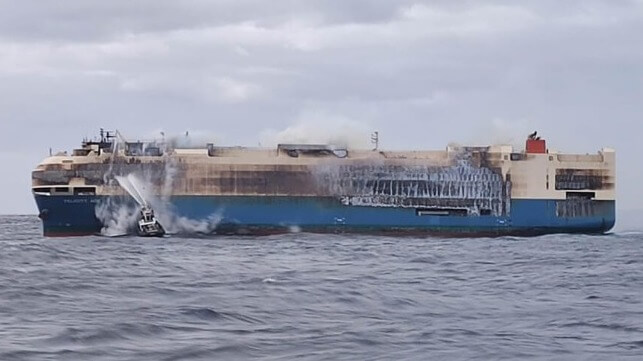
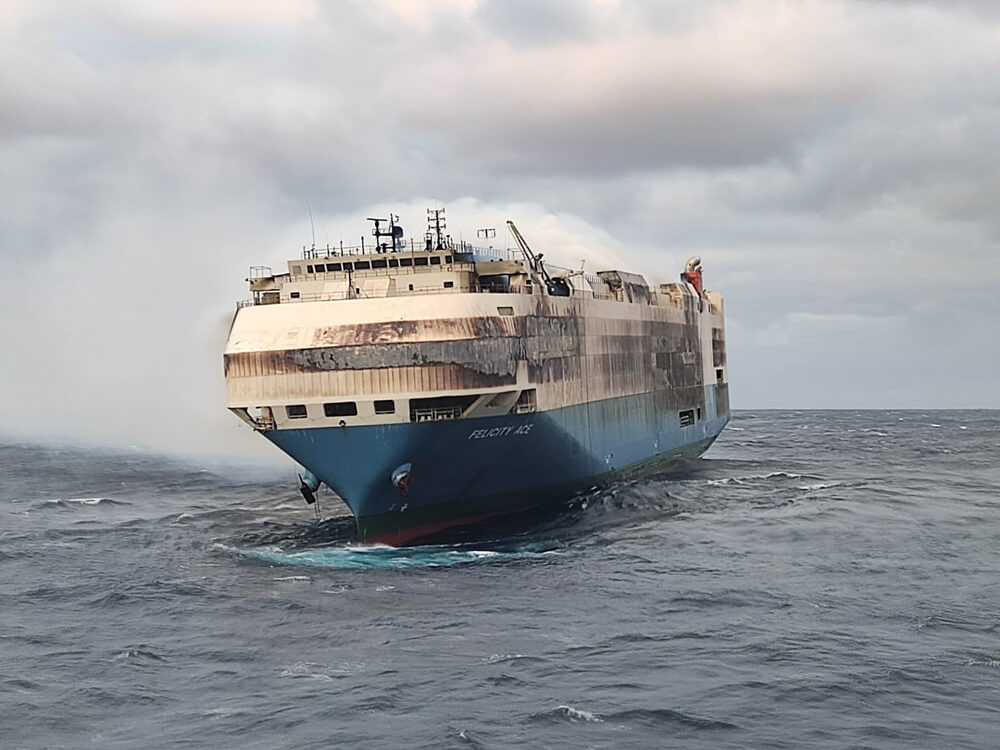
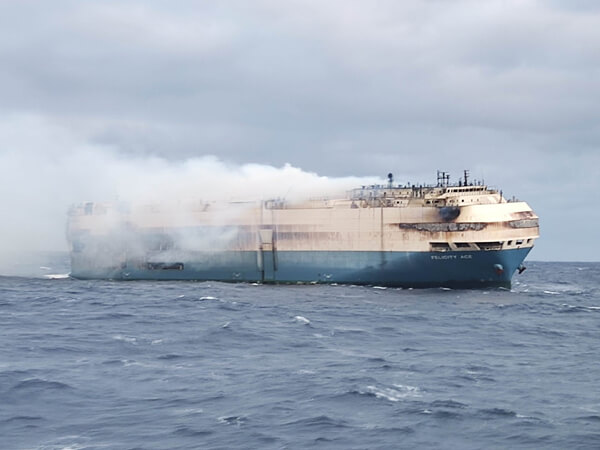
https://www.maritime-executive.com/article/photos-fire-ravaged-felicity-ace-adrift-off-the-azores
Better call 911.
Igmc
Mattbee already took it
Porsche
In STW parlance the wife's little runaround.
Mattbee already took it
Allroad's lead to the same flat (four) joke.
Surely Porsche is the name of Flashy's mistress/secretary?
😜
Any rules for electric cars on ferries? They get a bit funny if I have a can of diesel in the back!
I suspect that thermal runaway on EV is going to become a real issue for operators of fleets, transporters, general public users and owners/ operators of multi storey (both above and below ground) parking.
We've been doing some work on sites for charging 250+ large EV and the fire in Stuttgart last year has caused a massive reappraisal of stand off distances, fire compartmentation, quarantine areas and vehicle separation.
I suspect that thermal runaway on EV is going to become a real issue for operators of fleets, transporters, general public users and owners/ operators of multi storey (both above and below ground) parking.
Yup, dread to think what the outcome could have been if that was a ferry.
The world really does need to catch up.
The fire suppression systems are C02 across the car decks. The decks are compartmentalised with curtains. Batteries are disconnected (or at least they should be). Thermal runaway on EVs and Hybrids are likely at fault here.
If hybrid vehicle technology is even remotely similar (I’ve no idea), that’s gonna be a big one.
Have you seen the aftermath of Hammond's Rimac crash?
Batteries still going pop the following day.
The fire suppression systems are C02 across the car decks. The decks are compartmentalised with curtains. Batteries are disconnected (or at least they should be). Thermal runaway on EVs and Hybrids are likely at fault here
Are they sealed for total flood? Would be fun doing an integrity test (air tightness) on a car deck.
Are they sealed for total flood? Would be fun doing an integrity test (air tightness) on a car deck.
Firstly I’m an interested layman with a long interest in the sea and shipping but I am not an expert.
My understanding is that the cargo decks are sealed from the accommodation and machine rooms and the outside if needed. The curtains contain rather then seal. Basically the car carriers are still built to operate as carriers for internal combustion engines and the safety features have not caught up. Decks are interlinked and effective suppression of lithium battery fires is hard to impossible unless the ship can be towed to port.
With this ship they have the added problem that the engines have been shut down and so pumping water onboard to cool decks is very difficult. You have to be able to get alongside which you can’t do that until in sheltered waters.
Ah, I see. CO2 is used a lot stii. It's very effective, but much more effective if the compartment with the fire is a sealed box so the gas doesn't just bugger off or reignition will happen.
On some industrial friers they have CO2 as the first stage and if that doesn't do the job and the temperature keeps rising wet Chemical is discharged, which causes huge mess and down time but is effective.
Maybe a similar system but dry powder as the last resort or flooding small sections.
Or all EVs will have to have on board Suppression.
Or all EVs will have to have on board Suppression
As range extends and the potential energy stored increases this would seem to be prudent. Having said that it’s my understanding the cars are loaded with only a part charge (enough to get on board and move around the doc). This is the same with hydrocarbon furled cars.
The other issue is that the majority of crews on the cargo carriers are not taught how to fight battery fires which is a specialised skill.
Very good!
Glad someone saw my attempt at a subtle joke!
I suspect that thermal runaway on EV is going to become a real issue for operators of fleets, transporters, general public users and owners/ operators of multi storey (both above and below ground) parking.
As car repairers and refurbishers, we’re getting more and more EV and hybrid cars in to do work on, and in future there will be more mechanical work undertaken, so while we on logistics have had some training on EV/hybrid cars, it’s more of an issue for the workshop staff. We do have charging points installed, and three more have just been added, but they’re all outside and away from where most other vehicles are parked or stored.
I would guess that an EV fire is something that’s always at the back of the mind of management, while hoping it never happens.
Having said that it’s my understanding the cars are loaded with only a part charge (enough to get on board and move around the doc). This is the same with hydrocarbon furled cars.
Discharging or part charging the batteries makes no difference to the intensity with which they burn, unlike emptying the tank of an ICE vehicle. Likewise disconnecting the batteries doesn't help.
Would discharging make a difference to the likelihood of a battery being the cause of a fire in the event of a fault?
disconnecting the batteries doesn’t help.
Apologies, it’s the ICE cars that have the battery disconnected.
Discharging or part charging the batteries makes no difference to the intensity with which they burn
I did not know that! Ta.
GCaptain are reporting that the ship is still drifting and the fire is now spreading downward towards the fuel stores and engines. A specialist firefighting team is apparently on the way.
No need to apologise! Every day is a school day, and my school day with lithium batteries was about 10 years ago when we had a fairly substantial fire at work caused by a few dozen coin cells.
I was the Health and safety manager...
We all learnt quite a lot about lithium fires that day. Especially the night shift supervisor who tried to put out the fire with a water extinguisher 😂
A report today indicates that the fire is now diminishing, basically because there’s very little left to burn!
I would imagine that there’s a bunch of insurance underwriters walking around in tight little circles talking to themselves!
RRro car carriers like this have the vehicle decks protected with water sprinkler systems normally.
CO2 is virtually useless as the spaces are too big, and very difficult to seal up.
For CO2 you hit the space and.... wait... wait and wait. It takes hours, if not days for the fire to cool enough to enter the space again.
That said, lithium battery fires can't be extinguished with CO2 or water. You need graphite low pressure extinguishers, but these are too small for putting out something the size of a car power cell.
Fire brigades are now using huge fire blanket, common on ferries, but I doubt they'd be useful with the number of cars on a Car Carrier.
Bridgehead fire blanket
There were $401Mn worth of German cars on that vessel
Fire brigades are now using huge fire blanket
Loving that fireblanket.
Quick, easy, effective and reusable.
Discharging or part charging the batteries makes no difference to the intensity with which they burn, unlike emptying the tank of an ICE vehicle. Likewise disconnecting the batteries doesn’t help.
Yeah, we've had quite a few incidents over the years, even an effectively flat battery might still contain 15-20% of the total energy that the battery is capable of carrying, depending on chemistry and battery management strategy.
The quoted capacity, e.g. 80kWh is only the extractable energy, the total energy might be in the 100kWh range. Added to that, the actual material of the battery cells themselves is extremely flammable and over discharging is (almost) as high risk as over charging/overheating for damaging the battery.
Once it starts burning different chemistry happens. I imagine that even the Li in its discharged state (lithium cobalt oxide according to Wikipedia) will oxidise further to lithium oxide, releasing more energy. Plus all the other stuff burning such as the carbon electrodes.
Discharging or part charging the batteries makes no difference to the intensity with which they burn
I did not know that! Ta.
I rather like the idea of electricity being flammable 😀
Once it's in thermal runaway, a lithium ion battery produces the oxygen needed to self-sustain the fire. CO2 can't do much to stop that
I read this the other week, it's an interesting explanation of electric car fire issues:
Autocar - How much of a fire risk are electric vehicles?
I rather like the idea of electricity being flammable
😅So do I! I think my thinking was in terms of energy stored rather then electricity being flammable. Funnily enough I have a basic understanding of thermal runaway so should really understand what’s happening with a battery fire but uhm… clearly not.
The Autocar article is informative. Raw
Ultimately I suppose you'd want gas detection, thermal imaging and a way of keeping the vehicle cool while the battery pack burns.
Maybe in the future the batteries will be shipped separately.
Or the cars have their own fire detection with a water hook up/somewhere to aim a hose to constantly cool the battery pack with a ceramic housing and try to stop the fire spreading to the rest of the vehicle/surroundings.
, and my school day with lithium batteries was about 10 years ago when we had a fairly substantial fire at work caused by a few dozen coin cells.
I’ve always wondered about this. The number of old coin cells, and devices like mobile phones I have lying around my house and garage is fairly large. And that’s before we even get on to things like bike lights etc. Should they all be considered a a fire hazard?
Should they all be considered a a fire hazard?
E scooters and derivations are banned from carriage on the London Underground, presumably as a fire risk rather than just because they are used by tossers.
Once it’s in thermal runaway, a lithium ion battery produces the oxygen needed to self-sustain the fire.
That’s interesting, I’m not sure I’ve ever seen that mentioned in articles I’ve read about Li-ion battery fires, explains a lot.
Maybe in the future the batteries will be shipped separately.
I mentioned that as a joke - it’s not feasible in cars, especially ones like Teslas, particularly the latest Y-model; the entire chassis is a block of alloy with a honeycomb of holes, into which the individual cells are placed, and then thin metal connectors are fixed in place on top of the cells. The cells used to be 18650’s, because of their energy density, but Tesla have developed a new type, called something like 4258 or something, it relates to the height and diameter of the individual cell. Huge castings are then bolted to the ends which carry the drivetrain.
Volvo are going to do the same, the castings are the largest injection-mouldings ever made, I believe the machines used to make them weigh something like 6000 tonnes.
The number of old coin cells, and devices like mobile phones I have lying around my house and garage is fairly large.
Most coin cells are alkaline, there are lithium versions of some I think.
The phone batteries have an anti-short device (a fuse, I guess) that means they can't self discharge and overheat if shorted. However if the battery is damaged some other way e.g. punctured then it could burn I suppose.
Well, it appears to be a total loss, then!