 You don't need to be an 'investor' to invest in Singletrack: 6 days left: 95% of target - Find out more
I was listening to a podcast today discussing self driving cars and how difficult it is for them to work safely in complex urban environments.
I do not understand why work on this technology is starting in the most complex environment.
Why not automate motorway driving first as that must be easier.
When I replace my campervan I want to join the Edinburgh bypass and have the new van take me to Inverness!
Am I missing something obvious here?
This is quite long but I think is worth a watch…
I imagine, in large cities, once people realise self driving cars will stop automatically if a pedestrian wanders into the road not much will move.
Active cruise control is already pretty good, combined with lane assist, although there is a section of the M4, where my van reads the speed limit as 100mph. It also doesn’t understand van speed limits.
If you really wanted to start with the easy bits it would be trains...
Wasn't there an example recently of someone in a Waymo in SF who had some ne'er do well try to break in?
With a human the driver would just floor the accelerator to get away but instead you're at the mercy of whatever the driving software decides, eg just remaining stationary.
I do not understand why work on this technology is starting in the most complex environment.
Why not automate motorway driving first as that must be easier.
I think you need to divide it into what the likes of Weymo are doing in just small areas of san fran/phoenix and what the car manufacturers are doing, which is what we'll get in small increments. In the short term at least we are just looking at one step on ADAS to hands off eyes off and it'll just probably be certified for motorway use. Is it ford and Mercedes who currently have certification in the uk for hands off eyes off on motorways, possibly just hands off. For you and me over the next 10-15yrs it's probably just better ADAS. If you want something that sort of gives the experience right now, then buy a vehicle with lane centring rather than lane keep.
There was some suggestion that pedestrians/cyclists would have to wear beacons so self-driving cars could see them, which wouldn’t be open to abuse in any way, shape or form.
If they have a place, it’s as above, on motorways or equivalent. In urban areas it’s hard to shake the notion that it’s a combo of Musk hype machine and public transport spoiler.
If they have a place, it’s as above, on motorways or equivalent. In urban areas it’s hard to shake the notion that it’s a combo of Musk hype machine and public transport spoiler.
This ^^. It's a bullshit notion that we can all just carry on as we are, no need to minimise driving or stop building roads cos "any day now" we'll have self-driving electric/hydrogen/fairy dust powered cars.
In fact in some respects it takes some of the focus off public transport and active travel, delays implementation of any sort of mass transit because everyone is going "ooh, AI / self-driving / "technology" will solve all our problems..."
Meanwhile the simple cheap Stuff That Works like trams and buses gets ignored.
Watch the video… some of this stuff is covered.
I for one would rather not let the genie out of the bottle… although I fear that it may already have happened. I think self driving cars are going to be as bad as the cars we all drive… which, unfortunately, we can’t un-invent.
Meanwhile the simple cheap Stuff That Works like trams and buses gets ignored
I don't think those things are being ignored, more a case of overlooked as the big financial wins for the transport industry are still centered on personal cars.
The above video is very long but I watched it on my commute and agree with most of the points.
I worked in the industry and I used to think it's great, but watching how lots of other bigtech ideas have turned out I've massively changed my mind.
In answer to the OP, the goal here is to make money. Since they are basically autonomous taxis, there are more people in towns needing lifts so thats where the autonomous car companies (uber, lyft, wayve) are focusing their efforts. They have had billions poured into them by investors who will want to see a return.
It's different for legacy car makers like General Motors etc who are focusing on motorways.
We are bascially handing control of our transport over to a few rich private companies who will lobby governments to bring it in, replace bus lanes with autonomous only car lanes, they'll start blaming pedestrians and cyclists for being hit so they'll be banned from crossing, it'll be very space inefficient, it'll start off cheap, then they'll ramp up the cost once capturing the market and removing the comptition, just like with uber, airbnb, netflix, AI and all the other mass user, high investment services.
It will become a necessary monthly subscription. You pay more money and but don't own anything.
There was some suggestion that pedestrians/cyclists would have to wear beacons so self-driving cars could see them, which wouldn’t be open to abuse in any way, shape or form.
IIRC that was something originally posted on a rabid anti transport/hippie/anti technology blog a few years ago.
IIRC that was something originally posted on a rabid anti transport/hippie/anti technology blog a few years ago.
It may have been posted on such a blog, but the technology is real and being considered. The protocol is called Vehicle-to-everything "V2X". Could be used for pedestrian beacons (V2P), but could also be used for cars sharing information about where they've seen pedestrians.
We are bascially handing control of our transport over to a few rich private companies who will lobby governments
That’s been the case for about 100 years - Ford, GM, etc.
The difference now is that the technology is changing and one or two companies might drop out or get established.
It may have been posted on such a blog, but the technology is real and being considered. The protocol is called Vehicle-to-everything “V2X”. Could be used for pedestrian beacons (V2P), but could also be used for cars sharing information about where they’ve seen pedestrians.
As noted above, autonomous vehicles don't like unpredictable things (like cyclists/pedestrians), they don't always recognise them for what they are and can't effectively anticipate their moves so the options are either everything being equipped with beacons (what could possibly go wrong there...?) or simply banning pedestrians and cyclists. Cos the option to simply run out in front of the car and watch it slam the brakes on is the other outcome and no car company wants that.
Cyclists saying "ooh, I can't wait for autonomous cars, they won't run me over!" are missing the point. You just won't be allowed on the roads with them!
How come Tesla's currently do a pretty good job of spotting pedestrians, cyclists, cones etc? What do you mean they don't like unpredictable things? How do they deal with buses pullng in and out , or other cars (both of which they do)? Some of the comments above are a bit 'Facebook' and detached from the current reality
The protocol is called Vehicle-to-everything “V2X”. Could be used for pedestrian beacons (V2P), but could also be used for cars sharing information about where they’ve seen pedestrians.
Yeah, i work with V2X. The only V2P stuff that i've seen has been exactly that, vehicles sharing data about VRUs they've spotted using onboard sensors, location, speed, direction, ped crossings etc. We already have shared data available (but not for pedestrian movement, yet).
Nothing about "beacons" though, other than a couple of papers about using phones to identify the existence of a VRU, which was fairly roundly dismissed as an evolutionary dead end as you can't rely on something like that. Everything is either not directional enough, or too short range, or easy to obscure (or switch off). Needs a complete technology rethink and some frankly horrific legislation to be put in place first.
Yeah, it (the thing about beacons) did get picked up by various media outlets and run in various different ways.
There's a new Integrated Transport Policy on the way from DfT to replace most of the nonsense from the previous Government, I know some of it is including autonomous considerations.
As noted above, autonomous vehicles don’t like unpredictable things (like cyclists/pedestrians), they don’t always recognise them for what they are and can’t effectively anticipate their moves
You could write exactly the same thing about a lot of drivers in conventional cars (and a small number of people even suggest banning cyclists from the roads as a solution).
Cos the option to simply run out in front of the car and watch it slam the brakes on is the other outcome
Self driving cars cannot circumvent the laws of physics. They will be capable of reacting faster than a human driver and stopping in a shorter distance, but if a pedestrian jumps in front of a self driving car that can't stop in time, they're still going to get hurt. I'm puzzled why some people think pedestrians will start throwing themselves in front of moving vehicles en masse.
I think it's a valid concern. The cars will stop and won't move again until the object dissappears. This is already happening (according to above video) with people placing cones in front of unoccupied autonomous cars.
How come Tesla’s currently do a pretty good job of spotting pedestrians, cyclists, cones etc?How do they deal with buses pullng in and out , or other cars (both of which they do)?
They slow down or slam the brakes on and then you intervene to deal with it, that's not autonomy (or at best levels 1/2) it's just glorified ADAS in your case adaptive cruise control with lane centring and pictures on the screen that show you bins and cones. There's been a few deaths in Tesla s where people have presumably thought it's more than just that, Tesla are currently under investigation in the states for their whole full self drive / city streets claims or whatever it's called. I think this is particularly following a few emergency service vehicles being collided with.
How come Tesla’s currently do a pretty good job of spotting pedestrians, cyclists, cones etc?
They do a reasonable job but still make lots of mistakes. However, it's a tech company, and as such it is all about creating a buzz over new features to increase its profile and keep investors excited. However, where safety is concerned car manufacturers need to be better than 'reasonable', they need to be absolutely spot on. And - surprise! - the last bit going from 'reasonable' to 'spot on' is really very difficult indeed.
Mercedes have taken on this challenge and their system is far more robust because it relies on the entire city having already been mapped in 3D beforehand.
What happens today if a pedestrian wanders onto a road?
I think the point is, a pedestrian is less likely to wander into traffic randomly when there’s a fair chance of the human driver not reacting in time, seeing them or something daft.
If you know the cars will stop, you don’t need a pedestrian crossing, which sounds awesome, but actually as mentioned I’d have thought we’d end up with Jaywalking rules like the US or Australia. Which is worse.
What happens today if a pedestrian wanders onto a road?
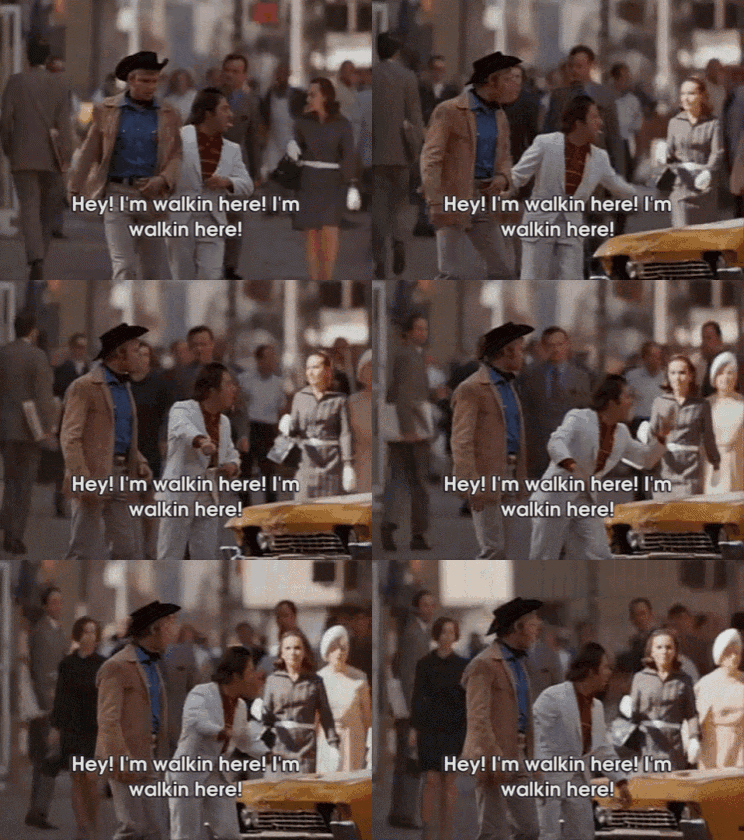
The driver winds down their window and tells them to get out of their way – “You got a problem? Do you know who I am?”
But an autonomous vehicle can’t do that.
Why do you think an autonomous vehicle without passengers wouldn't be able to shout at a pedestrian (if that's the solution)? For vehicles with passengers, I suspect windable window technology will still be available. Unless large numbers of pedestrians start standing in the middle of the road, this doesn't sound like it would be a regular problem anyway.
I think the point is, a pedestrian is less likely to wander into traffic randomly when there’s a fair chance of the human driver not reacting in time, seeing them or something daft.
Autonomous vehicles won't be able to stop instantaneously, so wandering randomly into the road in a busy city will still be hazardous, and for that reason, I don't think people are going to start obstructing the roads in large numbers if autonomous vehicles are introduced.
There are many practical issues to overcome before autonomous vehicles become common technology, but I don't think pedestrians creating grid lock is anywhere near the top of the list. We'll adjust our behaviour slightly as the technology changes, and life will carry on. In any case, worrying about pedestrians obstructing cars is looking at the whole thing back to front. Cities where pedestrian traffic has priority would be much nicer places to visit or to live and work in.
If you know the cars will stop, you don’t need a pedestrian crossing, which sounds awesome, but actually as mentioned I’d have thought we’d end up with Jaywalking rules like the US or Australia. Which is worse.
TBH, with a proper integrated transport policy, you'd ban the cars from areas where pedestrians are going to be.
And there seems to be the idea that self driving cars will drive round exactly like humans, 20kph over the speed limit, tapping away on their phones and generally oblivious to whats going on. They won't be.
Some of the comments above are a bit ‘Facebook’ and detached from the current reality
Nope its more you buying into the detached from reality hype. Just look at teslas habit of parking in emergency vehicles.
As with many problems the first 80 % is "easy" but its the last 20% of edge cases which is really hard.
My boss spent last week in San Francisco - every taxi journey he took was via a service called Waymo - autonomous taxis, no driver. Despite initial concerns, he was amazed and convinced with how good an experience it was.
given how far technology has come in the last 30 years I have no reason to doubt self driving cars will be safer than people driven ones in time to come. I welcome it. along with electric vehicle tech it will make personal car ownership obsolete and vastly improve cities. No need to own a car - just call one up on your phone. No more drunk drivers, no more road rage, whats not to like?
no more road rage, whats not to like?
People like road rage through. I think the biggest bar to wide spread adoption of self driving cars is they require you to abandon your sense of entitlement. All those micro aggressions- not letting someone else pull out or change lane, Over taking some one just in time for your both to stop at the traffic lights - all that shit. People love it and the love to be seen to do it.
Self driving cars, all working together with a common goal so we all get where where going easier, safer and quicker - thats practically communism. Thats what fungus does. We're better than that. Well I am. People don't want something thats fair, they want something thats advantageous to them- they want to get where they are going at the expense of someone else, even if it means their own journey taking longer - they still win and are seen to be the winner.
TBH, with a proper integrated transport policy, you’d ban the cars from areas where pedestrians are going to be
Obviously, but on a week day in central London for example, the vehicles are mostly Busses, taxis and service vehicles. Which are essential and there are pedestrians, cyclists etc everywhere. I’d love to see how an autonomous vehicle would get on.
I have the pleasure of driving into London on a regular basis. Public transport would be nice, I could be there in 1 hour vs 2 but the equipment is too bulky.
A self driving company van would be an awesome upgrade. Just like a decent automatic and active cruise control, that only took 30 years.
I’ll probably be retired or dead from the stress of London driving by then.
That’s pretty impressive to be fair.
Interesting take on where it 'could' be going:
Another advantage will be massively reduced congestion once all cars are self driving as they will co operate, not block junctions and improve traffic flow by not concertinaing ( as properly introduced 20mph zones do)
As I say… watch the video. Summary below. It’s only one guy’s view and obviously he has an agenda but on the whole he is spot on in most of his videos. I have been thinking many of the things he raises for a while and was interested when this popped up.
0:00 Intro
1:17 Reasons for optimism & skepticism
2:33 Moving fast and breaking people
8:50 Fatal Uber Crash
10:34 The Real Road Safety Issue
14:27 Promoting car-centric cities
17:03 Cheaper taxis (yay?)
21:07 Traffic congestion will be even worse
25:19 The promised future (past and present)
28:04 How AVs will destroy cities
29:56 Eliminating public transit
32:37 Consuming all streets
34:02 Eliminating pedestrians
36:05 Eliminating speed limits
38:05 Pollution and noise
39:41 Eliminating traffic lights
42:16 Do we actually need AVs?
43:28 Utrecht vs Fake London
48:33 What should we do about it? (Hard infrastructure and time-based road pricing)
51:53 Where to learn more
I know it’s coming and resistance may well be futile but I can only see autonomous vehicles as a step in the wrong direction. The motor industry screwed us all but suppressing public transport and active travel and making everywhere a worse place to be. Self driving cars are the second wave and whilst they will bring some benefits to some people, they will make things even worse in so many ways.
Self-driving cars. Thoughtful emoji. PMSL emoji x 3
Another advantage will be massively reduced congestion once all cars are self driving as they will co operate, not block junctions and improve traffic flow
Some way to go yet....
To me fully autonomous self driving cars feel further away now than when this thread started.
Maybe because both me and Mrs OD have new vehicles with lots of driver aides but it's obviously how massively far these are from door to door full automation - not least how buggy fairly basic (compared with a smart phone) infotainment systems can be
It's the odd thing, I've blown hot and cold on Autonomous cars over the last few years.
But lets be honest, There's a fundamental dichotomy at the heart of the bastard things; They're selling everyone an, as yet unrealised, future version of the car as the solution to problems created almost entirely by cars. People are bloody addicted to Cars, to "Tech" to convenience, to overt displays of wealth. None of it's doing us any good.
How often is the solution to a problem, to acquire more of the thing causing the problem?
not least how buggy fairly basic (compared with a smart phone) infotainment systems can be
Qualcomm?, Snapdragon Ride Platform or whatever. In theory it should be an easy transition to provide a package based on smart phone experience/technology, but I don't expect it's as straightforward as it might appear and still plenty of opportunity for VW to cock the user interface up
For starters, in order for autonomous vehicles to work, they have to have an extraordinarily sophisticated sensor array, using LIDAR, IR cameras, and an AI system along with GPS that is capable of identifying and anticipating an almost infinite range of possible scenarios in cities and other built-up areas, as well as on non-urban roads - like several deer suddenly appearing through a gap in a hedge ten feet in front of a vehicle in the dark.
That isn’t hypothetical, it’s happened to me, the only reason I didn’t have a roe deer through my windscreen was the fact that my headlights were reflected back from their eyes as I passed another small break in the hedge as they ran across the field towards the road I was driving along, giving me time to slow right down from the 40 mph I was doing.
I’m prepared to put money on the fact that no autonomous system could have picked up and identified the brief flash of light I caught out of the corner of my eye.
I also know the road well, and anticipate something being in the road at some point, usually a hare, but I’ve had a deer come through an almost invisible break in a ten foot tall hedge further on, again, experience makes me wary, there’s no autonomous system I’d ever be prepared to trust with my safety.
In the deer scenario, surely you would just hit the override to take control or stop the autonomous vehicle?
There’s a fundamental dichotomy at the heart of the bastard things; They’re selling everyone an, as yet unrealised, future version of the car as the solution to problems created almost entirely by cars. People are bloody addicted to Cars, to “<em style="box-sizing: border-box; --tw-border-spacing-x: 0; --tw-border-spacing-y: 0; --tw-translate-x: 0; --tw-translate-y: 0; --tw-rotate: 0; --tw-skew-x: 0; --tw-skew-y: 0; --tw-scale-x: 1; --tw-scale-y: 1; --tw-scroll-snap-strictness: proximity; --tw-ring-offset-width: 0px; --tw-ring-offset-color: #fff; --tw-ring-color: rgb(59 130 246/0.5); --tw-ring-offset-shadow: 0 0 #0000; --tw-ring-shadow: 0 0 #0000; --tw-shadow: 0 0 #0000; --tw-shadow-colored: 0 0 #0000; color: #000000; font-family: Roboto, 'Helvetica Neue', Arial, 'Noto Sans', sans-serif, -apple-system, BlinkMacSystemFont, 'Segoe UI', 'Apple Color Emoji', 'Segoe UI Emoji', 'Segoe UI Symbol', 'Noto Color Emoji'; background-color: #eeeeee;">Tech” to convenience, to overt displays of wealth. None of it’s doing us any good
Hang on, there's two things in play here. One is the luxury feature of having your car drive itself, which is fun and all but no big deal. The other is having fully autonomous cars that can take you around the place, and you don't need to own it. But, you'll say, silly billy - that's just a taxi - well kind of, but taxis need to be driven by drivers who have families to feed and so on, which means it is prohibitively expensive to use them all the time. There is the possibility of fully autonomous cars improving personal transport and linking it better with mass transit. Now this needs a lot more than just self-driving car tech, but it won't happen without it so someone's got to develop it.
Plus when self driving works properly, lives will be saved, so there's that.
* Obviously some will say that we need humans to drive taxis so that they won't end up unemployed, but that's not really a risk as long as it happens relatively slowly - there are plenty of other jobs that need doing. We won't run out. Paying people to do a job that can be done by a computer just for the sake of paying them isn't a great way to run a productive economy IMO.
Maybe because both me and Mrs OD have new vehicles with lots of driver aides but it’s obviously how massively far these are from door to door full automation – not least how buggy fairly basic (compared with a smart phone) infotainment systems can be
There's a massive difference between proper safety critical systems and consumer level software. It's a bit like the difference between how you maintain your bike and how airlines maintain their planes.
In the deer scenario, surely you would just hit the override to take control or stop the autonomous vehicle?
There's no way someone riding in a fully autonomous car would be paying enough attention to react in time. Even if they're watching out and on the alert as opposed to reading a book or something, reactions will be much slower than if they were actively driving.
Insurance costs will also drive the adoption of autonomous vehicles. Insurance companies are only interested in stats, so once there is evidence that autonomous vehicles are performing better than human drivers, the relative insurance cost for human drivers will rise.
There’s no way someone riding in a fully autonomous car would be paying enough attention to react in time. Even if they’re watching out and on the alert as opposed to reading a book or something, reactions will be much slower than if they were actively driving.
The post that I was replying to described a situation where the driver saw approaching deer at some distance in an adjoining field through a gap in a hedge and did have time to react and slow down before they crossed the road. This was used this an example of why the poster would not entrust their safety to an autonomous vehicle (because the autonomous vehicle would not have spotted the approaching deer).
I'm suggesting this specific scenario does not actually make sense as a reason to reject autonomous vehicles, because if you were in an autonomous vehicle in that situation, you could still observe the approaching deer through the gap in the hedge and then manually override the vehicle. Of course, in all the other situations where deer jump across the road without no warning, the autonomous vehicle is going to react and slow the vehicle faster than a human driver, increasing the probability of a better outcome. Using an autonomous vehicle does not prevent a driver from observing, if they choose to do so, and in the scenario described it would provide an extra layer of security, rather than reducing the driver's safety.
As with many problems the first 80 % is “easy” but its the last 20% of edge cases which is really hard.
Except Tesla haven't even got 80% done yet, they just tell everyone they have...
I’m prepared to put money on the fact that no autonomous system could have picked up and identified the brief flash of light I caught out of the corner of my eye.
Oh, they'd 100% have picked it up. Cameras and computers don't have corners to their eyes (lenses?).
What do to with the information is the tricky thing.
Using an autonomous vehicle does not prevent a driver from observing, if they choose to do so, and in the scenario described it would provide an extra layer of security, rather than reducing the driver’s safety.
IMO, if a car is truly autonomous, then the occupant could be asleep in the back seat.
If they need to be sat at the controls, sober, paying attention at all times and prepared to override the car at a second's notice, then it's not an autonomous car, it's just got good Driver Assistance stuff.
The hard part of driving isn't the controls: it's the constant observation and vigilance required to avoid dangerous situations. If an autonomous car requires constant observation and vigilance and second-guessing what the automation is going to do next in order to step in at any moment then it's arguably going to make things more dangerous than just having the occupant work the controls themselves.
The deer example above is terrible. You're assuming you're better than a LIDAR system at spotting marginal stuff in the dark. I doubt that you are, and the example of whether it's deer, dogs, small children on space hoppers or drunk cyclists isn't relevant.
This is a conspiracy theory/technology fear thread. People in general like to laugh at such threads, forums, but here we are
The deer example above is terrible
It's a good example of the double standards being applied to vehicle safety. There's somehow an expectation that any autonomous system has to be perfectly safe before it can be adopted, but the truth is that if every vehicle was autonomous they could injure hundreds of people a month and still be better than the current situation. But if they did there would be an outcry about "killer machines on the road" and we're back at square one.
Maybe because both me and Mrs OD have new vehicles with lots of driver aides but it’s obviously how massively far these are from door to door full automation – not least how buggy fairly basic (compared with a smart phone) infotainment systems can be
Wait? What?
You think the autonomous driving software runs on the same hardware as current infotainment systems?
Wait? What?
You think the autonomous driving software runs on the same hardware as current infotainment systems?
Which bit of hardware does which function isn't really relevant to the public though.
To someone who doesn't work in the industry, it's simply 'a car', which is controlled by 'a computer'. If 'the car' throws an error when changing the radio station, is an average consumer going to trust it with the lives of their children?
If ‘the car’ throws an error when changing the radio station, is an average consumer going to trust it with the lives of their children?
Ever got onto a plane to be told there's a problem with the in flight entertainment system? I've not seen anyone demand to get off because they no longer trust that the avionics will work properly. I reckon most people would make the same distinction for a car.
Are pilots using the in flight entertainment touch screen to control flight functions now? I didn't think aeroplane manufacturers worked in the same kind of regulatory landscape as that which has allowed car manufacturers to strip the switchgear off their dashboards and make drivers use touchscreens and other touch interfaces while travelling at speed.
It’s a good example of the double standards being applied to vehicle safety. There’s somehow an expectation that any autonomous system has to be perfectly safe before it can be adopted, but the truth is that if every vehicle was autonomous they could injure hundreds of people a month and still be better than the current situation. But if they did there would be an outcry about “killer machines on the road” and we’re back at square one.
To some extent it transfers the burden of responsibility (ethically, even if governments legislate so that it is not legally transferred) from the driver to the OEM though. Release too early to cash in, and the OEM risks getting a name for causing deaths on the road.
That said, Tesla do seem to be getting away with it so far, apparently people value convenience more.
It’s not confirmed if FSD was on or not. If it was not FSD the reaction time of the driver is extraordinary.
Obviously, this will need regulatory approval. Remind me who runs Tesla?
That said, Tesla do seem to be getting away with it so far, apparently people value convenience more.
It's probably worth pointing out that automobile regulation in the USA is nothing like automobile regulation in EU/UK. In the EU/UK you have to put everything new thru safety regulation first (NCAP?) to be allowed on the road. In USA you do what you want until people start dying and then NHTSA might step in at some point to regulate it. Hence why Tesla can get away with all sorts of shizzle in the US that would never be allowed on the road here without certification.
Must admit I don't know if the likes of Weymo etc are NHTSA regulated (or some other gov dept) in the US or whether they are self regulating.
Release too early to cash in, and the OEM risks getting a name for causing deaths on the road.
. . . and risks a big expensive multi billion law suit with punitive damages, whereas the deaths caused by individual drivers “just” incur relatively low payouts from the vehicle insurance industry.
I was nearly in a nasty accident today - caused by driver inattention and that would 100% have not even been a near miss with a fully autonomous car. I spotted a police car with blues and twos on 3 cars behind. there was a truck roadside parked ahead of me. I signaled left and pulled in - fairly sharply. The car behind me started to follow me then without indication pulled out to overtake me into the path of the police car. Good anticipation and reflexes from the police driver prevented what would have been a 3 car smash
This morning a ratchet strap hit the (two week old) windscreen of my van. I saw it coming and moved myself in the cab rather than try and brake or avoid, due to the lack of time, space and danger of anchoring up on the motorway. The adaptive cruise didn’t flinch, but I wouldn’t expect it to.
My colleagues van braked for a bin liner a while back.
I assume AI would be able to work it out. With a greater array of sensors , It’ll be interesting to see how they cope and what decisions they make for strangely shaped road debris.
Wait? What?
You think the autonomous driving software runs on the same hardware as current infotainment systems
Nope - I question car manufacturers ability to implement systems when something as simple as infotainment systems are so buggy. Given how complicated safe fully autonomous driving systems need to be I doubt the ability of car manufacturers to develop and implement such complex systems when they can't get a basic, media player, map, AC system working. Let alone establishing cross manufacturer compatibility so different makes of cars communicate properly.
Part of the problem seems to be that they are developing their own solutions rather buying in something from Google or similar.
With the aircraft example - surely a much simpler environment in some respects, in a vastly more expensive vehicle constantly monitored by two professionally qualified humans moving on preselected and predictable routes and remotely monitored by other humans in air traffic control
I really want autonomous vehicles, I dislike driving and believe it would be hugely safer. It just seems a very long way from were we are now
Ever got onto a plane to be told there’s a problem with the in flight entertainment system?
No, if I fly it's normally budget, but even then - on planes, we know there's a pilot and indeed a co-pilot to take control if neccessary. If it was some futuristic 'cockpitless plane' with no pilots and some of the tech appeared to be going wrong, I suspect people might be a bit more nervous.
If it was some futuristic ‘cockpitless plane’ with no pilots and some of the tech appeared to be going wrong, I suspect people might be a bit more nervous.
That is - by a country mile - the biggest hurdle in getting autonomous control in trains, planes etc. The fact that the public just do not trust it.
There's a secondary psychological thing in that "the public" in trains, planes etc are not in control whereas in their own private car they believe themselves to be in control (and most people believe themselves to be above average drivers) so they're usually more accommodating of autonomy/AI in their own car than they would be if it were in a plane.
That's in spite of the fact that a modern airliner can, with the appropriate programming, land itself perfectly fine.
Given how complicated safe fully autonomous driving systems need to be I doubt the ability of car manufacturers to develop and implement such complex systems when they can’t get a basic, media player, map, AC system working
They're car manufacturers, they'll buy the platform in from the likes of waymo (AV) or Seeing Machines (ADAS/DMS).
Human driven cars are pretty safe. Obviously, one death caused by a motor vehicle is one too many, but, according to the internet, there were 332 billion miles driven last year in the UK.
And it's only going to get safer. I think DMS will shortly (if it isn't already) become mandatory in the EU for new cars, certainly if you want any sort of hands off eyes off on the road and/or a 5star NCAP rating.
(And not the current Tesla cabin camera bollox, infra red that 100% works in both bright direct sunlight and at night)
something that kills 1600 people a year directly and more than that indirectly I do not think of as safe.
For what it's worth, I've been in the industry since 2015 and had a ride in a Wayve car in the summer. It was very impressive. The tech has certainly moved on in that time despite it maybe not looking that way to the casual observer. Deployments like the Waymo SF taxis are really paving the way for broader, real world deployments. It's not on a rapid curve like some had believed, but it progress is being made.
something that kills 1600 people a year directly and more than that indirectly I do not think of as safe
Something that directly accounts for only about 13% of accidental deaths, and a tiny proportion of total deaths, seems relatively safe to me. Especially when a very disproportionate amount of those deaths are 15-25 year olds, meaning for the rest of us driving accounts for well under 10% of accidental deaths.
What does account for most accidental deaths is falls, "poisioning" ( drink and drug deaths), and suicide.
So lets keep the actual risk of driving in proportion, and not let it divert finite resources away from other, arguably more important programs, for reductions in drug deaths, suicides, and dangerous work practices.
I'm in Scottsdale at the moment and waymo driverless cars are everywhere. Some of you need to change the way you think about them as they are brilliant. They are based on a jaguar I pace with spinning radars on the roof,rear and front bumpers and the side doors
We were outside our hotel when one came to drop a passenger off and we stood Infront of the car to see what happened and it would not drive off untill we moved.