 You don't need to be an 'investor' to invest in Singletrack: 6 days left: 95% of target - Find out more
I have a piece of electical kit that has a harness connected to it using, what I think is, a fairly poor choice of electrical connector (Molex Micro-Fit).

It's on a boat exposed to a a fairly salty environment and one connector has already got problems after a couple of years with a bit of corrosion from the damp salty air.
I had a spare harness - which is good as a replacement one is £125! - so I'm OK for this summer and I will repair the old harness even though the manufacturers say it can't be repaired.
But, how can I protect the new harness/connectors from moisture ..... WD40? Servisol switch cleaner?
electrician mate put an electric pump in his sea kayak. He set his connectors in a block of resin. Worked nicely
I'd put the whole connector in a waterproof junction box if it were me. You'd have to try and find something with a gland that goes in the split line of the housing because presumably the connectors won't go through a normal gland.
Some photos would probably help.
You need to enclose it in something waterproof. Or move it somewhere drier…
IP67 enclosure? Couple of bags of silica gel that you can swop every few months?
Does it need to be unplugged regularly? Can you just wrap it in tape or enclose it in a weatherproof junction box?
You need to enclose it in something waterproof. Or move it somewhere drier…
Can't really move it as it's connected to the control box for the trim tabs which is located next to the TT hydraulic pump. I 'may' be able to put the control box into another box but it would never be waterproof due to the harness coming in as well as power and signal cables.
Plus there's not a huge about of room in the compartment where it's located - but I could probably sort something.
No suitable spray for 'temporary' protection then?
(The boat is on a mooring for 3-4 months of the year and spends the rest of the time in a covered barn)
@Cougar - doesn't need unplugging unless there's a dodgy connection!
ACF 50.
I use on my outboard.
Does leave a bit of a residue.
https://www.mandp.co.uk/products/acf-50-anti-corrosion-formula-1-litre-bottle-k-547736
Deffo waterproof box would be the best option if at all possible then. Vaseline also works sometimes…
Never actually used it but I've seen Wago do a junction box filled with some kind of gel, so something like that?
https://cpc.farnell.com/wago/207-1331/gel-box-221-2273-series-size-1/dp/CN22653
ACF 50.
I use on my outboard.
Ahhh..... sounds pretty perfect and definitely for the immediate term. I could spray the whole engine as it's got connections all over the place.
https://youtube.com/shorts/975rCT_qDs4?feature=share
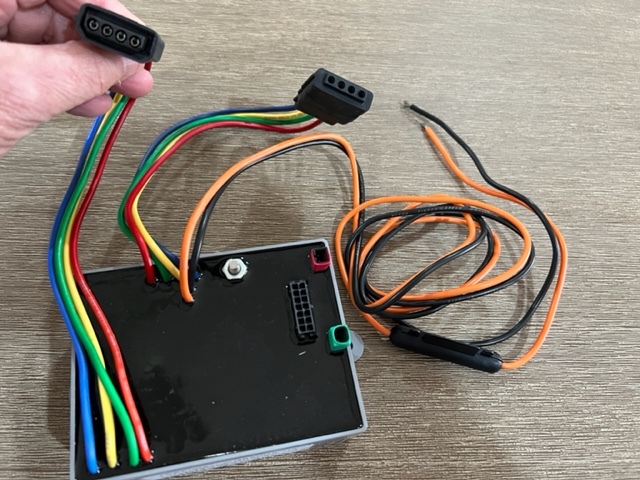
This is the control box showing some of the other cables and sockets for the harness in question plus the two sensor cables
Ahhh….. sounds pretty perfect and definitely for the immediate term. I could spray the whole engine as it’s got connections all over the place.
That's what I do. Don't get too much on it as it can attract a bit of grime.
Lovely engine that Honda!
Take your spare harness, and the item, and repin it all into TE Superseal connectors.
Lovely engine that Honda!
It's a great engine but has an appetite for O2 [lambda] sensors which Honda used to charge about £300 for - I can get 3rd party for £100 max now, but still should be much cheaper.
Have you tried sourcing from the USA?
I have a Yamaha and when I was working in the US I bought 3 service kits as they were half the price.
I know lads who have ordered from the UK and still saved money.
Take your spare harness, and the item, and repin it all into TE Superseal connectors.
I wish I could but the other part of the plug is embedded into the control box (which is sealed) and probably soldered onto the PCB. No idea why the manufacturers didn't use a better connector in the first place seeing as their stuff is generally very well made.
I have a Yamaha and when I was working in the US I bought 3 service kits as they were half the price.
I know lads who have ordered from the UK and still saved money.
Yep.... I've used boats.net a fair bit but the timescale and shipping costs can be an issue. This year I've started using 3rd party fuel and oil filters as they only need to work for about 5 months and a single high pressure fuel filter can cost about £50 now (as you probably know!).
Could you coat the whole thing in some kind of non-conductive di-electric grease, then seal it with a flexible covering - something like a strip of inner tube with a cable tie at each end to fix it in place?
Some info on non-conductive grease here:
https://www.thedrive.com/maintenance-repair/39173/dielectric-grease
EDIT - just seen your pic - not so easy to implement.
Silicone grease. aka plumbers grease, dielectric grease.
Sounds counter intuitive using something that's designed to be an insulator but it works, almost any grease will lower the resistance of a connector as it promotes the two parts being able to slide into position. And unlike hydrocarbon based products is really resistant to water. ACF-50 may also work, but silicone grease is the right tool for the job. I've used it for everything from low-voltage power supply in vehicles to RF transmission connectors (anything higher voltage/current obviously you'd want an actual waterproof connector).
Potting compound (resin) could work, but is better used for circuit boards. It'd be overkill for just a connector.
IP rated enclosures, I'd avoid those as unless you do it properly with glands, strain relief and the cabling secured, it'll just chafe through the cables if it's just a box dangling in free space with loose wires.
Otherwise make it permeant with either solder and heat shrink, or those low temp solder connections that combine both steps in one.
No idea why the manufacturers didn’t use a better connector in the first place
Or think about where they site things. I inherited a RIB at my last place of work - with a box of connectors basically on the inner transom, a cm above the floor. I was told the boat/motor was endless problems electrically - funny that mounting cheap electrical connections in a cheap box in a place which every journey or rain episode got wet caused problems
I moved the box to the front compartment under the wheel with the battery, used good connectors slathered in silicone grease and had 'solid' connection wires from battery and control box to inside the motor casing - and never had another issue again.
ACF-50 may also work, but silicone grease is the right tool for the job.
I'm sure I've got some somewhere - I'll have to have a dig around when I next go home. Would I just put it into the [black] socket on the control box (see picture above) and then push the harness connector in or just use it around the edge to create a seal?
I inherited a RIB at my last place of work – with a box of connectors basically on the inner transom, a cm above the floor.
Literally the wettest place on a RIB!!
Literally the wettest place on a RIB!!
Indeed. And this was a) an install by a big Scottish boat place who should have known better and b) not been questioned or changed by any of the previous incumbents of my job, who had endured 6 years of electrical issues with the boat.
Agree with thisisnotaspoon.
I’ve had a few years experience of trying to protect electrical connections in crappy environments .
Potting it in resin is overkill and a pain if you need to disconnect in the future.
Junction boxes are very good at filling with water through wicking, glands or not.
You’ll end up drilling holes to let moisture out.
I used to work offshore, and we terminated electrical connections for deep sea (3-4km) sensors. We generally used scotch 23 with an overlayer of adhesive lined heat shrink. Probably won't work very well in that application as the wires don't have an outer cover. I'd chop the plug off and reconnect with a proper connector if I were you.
I’m sure I’ve got some somewhere – I’ll have to have a dig around when I next go home. Would I just put it into the [black] socket on the control box (see picture above) and then push the harness connector in or just use it around the edge to create a seal?
Liberally over all the pins/sockets, press it together and release a few times to make sure all the copper gets coated.
It's not conductive any any excess will squeeze out so it's hard to overdo it.
Great, thanks!
In my ROV pilot/tech days we’d use molykot 111 on all our electrical connections which worked quite well.
Wylex do gel capsule connection boxes.
You make the connection inside the case then fill in the void with the supplied gel
Ypu can also buy the gel separately at screwfix