 You don't need to be an 'investor' to invest in Singletrack: 6 days left: 95% of target - Find out more
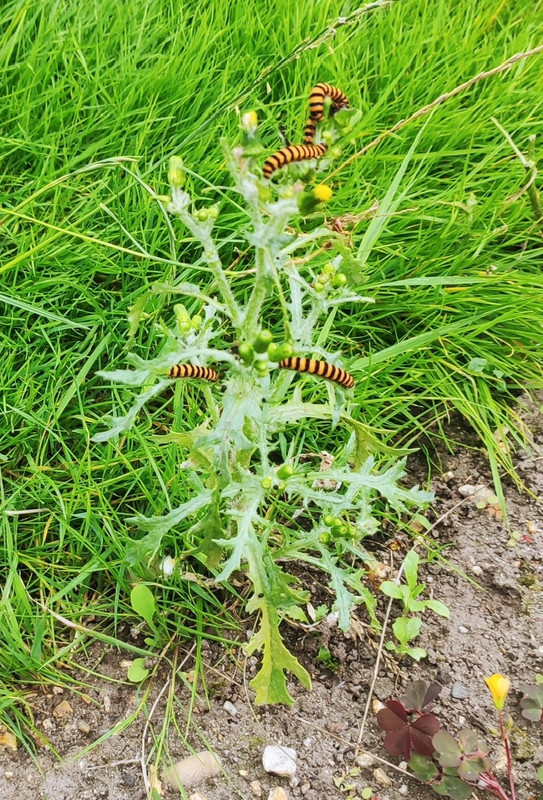
Mongolian death caterpillars
Edit. Sorry misread the question.
Mongolian death moths
I think they are going to be cinabaar moths.
We've got loads in our garden at the moment.
I used the Seek app to identify them.
They look like the common bee stripe caterpillar. After metamorphosis you’ll have the Mothra moth the only natural predator of the Godzilla lizard. Garden may get messy
Aliens
Murder Moths.. similar to murder Hornets but will stealithly kill you under the cover of darkness..
Yes, cinnabar moths.
Just slice and dice. We've got a few like that that have nearly killer a tree we have. They eat everything.....
Last year we had loads.
Got enough buggers that are eating the same bush, cut them all off on their branches, into recycling, so they still have lunch, the buggers are crawling over the drive.
It's a fly larve...

Definitely cinnabar moth caterpillars, and they only eat ragwort, which is that plant they are on. I believe they contain a small amount of cyanide(or some other poison) which they get from eating the plant.
The moths are ace... They look almost totally black until they fly where you see the vivid red from there wings.
They certainly won't eat up the whole garden...
As above the moths are beautiful.
I've been growing ragwort for the last 2 years to encourage them.
yep cinnabar moths look epic in both forms.
nice things to have in your garden unless you have cows and horses and possibly labradors.
Ragwort is evil. These guys are on our side.
If you have anything that might eat either the moths or the ragwort, then remove them.
If not..leave them they look nice as caterpillars and moths
That's not ragwort its groundsel.
Not my lawn – what are these beasties going to be when they grow up?
Lunch in Thailand.
I'm not sure if its ragwort or groundsel, but definitely cinnabar moth caterpillars. Incidentally, ragwort is nowhere near as poisonous as the scare stories make out.
ragwort is nowhere near as poisonous
Unless you're a horse when it plays merry hell with the liver.
The same for cows.
Unless you’re a horse when it plays merry hell with the liver.
Unlikely to be reading this tho...hooves are rubbish for typing
I’m not sure if its ragwort or groundsel
I thought cinnibar larvae only ate ragwort but I’ve just learned they also eat groundsel (but nothing else). Thanks.
They eat everything…..
Last year we had loads.
Got enough buggers that are eating the same bush, cut them all off on their branches, into recycling, so they still have lunch, the buggers are crawling over the drive.
It’s a fly larve…
That sounds more like a description of sawfly larvae. Voracious beasties, nearly stripped a young birch here.
But the OP has cinnibars, wonderful little moths.
Thank you, they shall live and be welcome in our neighbourhhod. From Butterfly Conservation website:
Cinnabar
Tyria jacobaeae
This species is so named due to the colour of the hindwings and the markings on the forewings which make it unmistakeable. There is little variation although on rare occasions the pinkish markings are replaced with yellow, or the forewing is red with a black border or the wings are completely black. Easily disturbed by day and flies in sunshine. Also flies after dark.
Size and Family
Family – Tigers, Ermines, Footmen and allies (Arctiids)
Medium Sized
Wingspan Range – 34-46mm
Conservation status
UK BAP: Priority species (Research only)
Common
Caterpillar Food Plants
Feeds on the leaves and flowers of Common Ragwort (Senecio jacobaea). Occasionally found on other ragworts and groundsels.
Habitat
Frequent in open grassy habitats including waste ground, railway banks, gardens and woodland rides but perhaps most frequent on well drained rabbit-grazed grassland, mature sand-dunes and heathland.
Distribution
Countries – England, Wales, Scotland, Ireland
Common and well distributed throughout most of England, Wales and Ireland, the Isle of Man and the Channel Islands. More confined to predominantly coastal habitats in northern England and Scotland.
ragwort is listed by defra as an injurious weed, if you have it on your land and it spreads to argrucltural land or if you allow it to grow on your own agricultural land, you can be prosecuted, it's poisonous to horses and cattle.
A horse would have to eat an awful lot of ragwort to cause trouble. However when I had a horse we dug the ragwort and dock up as it took over.
Fish Disco auditions
Ragwort and grounsel are closely related so makes sense they eat both. That was always my favourite caterpillar as a kid. You would see dozens of them on one plant.
I think ragwort that gets into hay is the bigger issue isn't it?
That's a leech I think Jimmy.
It's giving me the heebygeebies.
Leech
I thought it looked like a leech, but that's to my uneducated eye. It was quite fascinating but not very pleasant.
Yeah they're grim.
The worst thing you ca do before swimming in a river though is Google lampreys.
Unless you’re a horse when it plays merry hell with the liver.
But horses don't eat it as it doesn't taste good to them. It is only an issue if it gets dried and mixed in with hay. The Daily Mail (where else) ran ragwort scare stories which have led to a lot of myths.
See https://www.ragwortfacts.com/ragwort-myths.html
you can be prosecuted,
- no you can't, that's just another myth.......
My first job as a FC volunteer was to weed Hicks Lodge of ragwort before it got grazed, cut and baled or, more importantly, went to seed.
I hope a horse doesn't eat that leech.
Is it a good idea/practical to grow ragwort if you’re nowhere near agricultural land to attract insects?
If you’re more than 100m away from agricultural land, you can grow it to your hearts content. Why not grow something else that attracts insects though?
no you can’t, that’s just another myth
Yes you can. No it isn’t.
Anyway…
https://www.gov.uk/guidance/stop-ragwort-and-other-harmful-weeds-from-spreading
Why not grow something else that attracts insects though?
Because other insects aren't cinnabar's?
Anything we can do to help insects is a great idea.
Just for Kelvin:
From: https://www.ragwortfacts.com/ragwort-myths.html
MYTH: Under the Ragwort Control Act 2003 landowners must by law control Ragwort on their land.
FALSE. This act provides for the government to produce a guide to ragwort control. It places no obligation on landowners at all. See Ragwort Control Act 2003.
MYTH: Under the Town and Country Planning Act Section 215 landowners must by law control on their land.
FALSE. This act provides for powers for councils to order landowners to tidy up unkempt areas. This isn't meant to cover ragwort and doesn't create any automatic liability anyway. See Town and Country Planning Act Section 215
MYTH: The law says that government departments or local councils must control ragwort.
FALSE. There is no obligation in any of the legislation. There is no obligation on local councils and the powers granted to DEFRA and its equivalent bodies are discretionary.
MYTH: It's not an offence for ragwort to grow in certain areas, but spread of ragwort onto high-risk land is an offence.
FALSE. This is a direct quote from The British Horse Society's Ragwort Toolkit. but as all the other myths about the law it is false.
MYTH: Ragwort is a "Notifiable Weed"
FALSE. There is no such thing as a notifiable weed under UK law. There is no obligation to tell anyone about Ragwort . See Ragwort the Notifiable weed falsehood
That’s all very interesting, but irrelevant.
As mentioned above, I've been growing ragwort and nettles for a few years now (in the lawn and wild parts of our garden). The rise in insect/moth numbers is noticeable).
Also wilding our garden has brought in more birds, bats and even a hedgehog.
That’s all very interesting, but irrelevant.
So show me where it says that you can be prosecuted for letting ragwort grow on your land.................
ratherbeintobago - It was always in our garden, but before I would weed it out, or cut back, now I just let it grow.
On this mornings ride there was a field not far from us, with cattle in, where the farmer has made little effort to remove a lot of ragwort.
I’d recommend a trip to the knepp rewilding project if you really want to learn something. Loads of ragwort and loads of cinnibars. And the longhorn cattle freely graze around it and have no issue. Nor the horses, hogs.
I have plenty of ragwort in my garden. I haven’t seen it spread to the wheat field over my fence, because the wheat is drenched in chemicals.
Re wilding by Isabella Tree is a great read.
Its the story of her family farm Nepp and how they started in 2000 taking it back to how it would have been hundreds of years ago.
It started because the rare turtle dove was spotted on their land, they wanted to make sure this once common bird was brought back from the brink of extinction.
They have purple emperor butterflies and many other species back in abundance.
Problem now is a housing estate is planned and this will break the wild areas up.
Continuation of areas is an absolute must.
If we lose places like Nepp, then quite frankly there's no hope for nature.
@Bunnyhop Is the housing estate near Knepp not the council being deliberately awkward about meeting government house building targets by planning it somewhere they know will generate a huge outcry?
ratherbeintobago - I know little about the housing that might be built (or who is responsible for giving permission), only the fact it will fracture the wild areas.