 You don't need to be an 'investor' to invest in Singletrack: 6 days left: 95% of target - Find out more
Does there seem to be a weather warning every other week now? It's probably just a signal of impending "grumpy old man" syndrome, but slightly colder than usual? Yellow weather warning for Cold, slightly rainier than usual; Yellow weather warning for rain....etc etc. It might sner on Tuesday, perhaps a much as 5mm, currently at my location there's a yellow weather warning on Tuesday and Wednesday and Thursday for Snow and Ice, and yet the headline weather forecast for both Wednesday and Thursday is "Sunny with a Gentle Breeze" 🤷♀️
Getting so frequent, I kind of just ignore them, which defeats the purpose, Shirley?
Yup, I'm the same, constantly getting put up and cancelled.
They need to ditch the yellow tbh as for most people it serves no practical purpose, even just not putting it as an active alert would probably be better.
I don't mind them...and I'm thinking given our ageing population, it probably makes a bit of sense to have warnings so older people can be better prepared - younger ones don't seem to be quite so badly impacted by the bad weather.
I take it all with a pinch of salt as generally the weather where I am is never as bad as it is forecast, but it gives me a decent indication of how cold and wet I'll be getting.
I'd suggest they keep them going...but I don't tend to be too bothered by them myself.
They need to ditch the yellow tbh as for most people it serves no practical purpose, even just not putting it as an active alert would probably be better.
It is that eternal balance of this really helps some stupid/unawares folk vs those of us with common sense...
It's good for the ageing population and the young daffodils. The amount of people that moan it's cold and wet, when they have just walked 200 yards from the car park. I'm sat there with a glow having just cycled 10 miles in it.
It's going to be cold this week, the spiked ice tyres went on last weekend as it was a bit too close to zero for my liking with normal tyres. They are about 3-5 minutes slower. It's actually quite refreshing cycling in very cold conditions - wrap up properly and it's fine.
OK don't go out in ice if you don't have spiked tyres. I passed a guy stupidly trying to cycle up a local farm track in November, that was covered in ice. He was spinning out going no-where. Really dangerous for him. Me, I just pedalled straight up the middle of the sheet ice and was off.
Still useful for folk who are impaired in their mobility. A bit of ice on the ground might not mean much to the average STWer but there's plenty of folks who find the warnings useful. Just a small example - my mum's COPD means that when the temps are low she'll struggle to make it to the shops and back. The weather warning helps her plan ahead for that.
Yellow - Fine to ignore, useful for some people and does no harm as will not result in meaningful change for most people
Amber - Pay attention, probably going to impact you.
Red - Stop what you are doing as its quite a big deal and likely to change your plans for the day.
All seems harmless enough to me.
Yellows are a bit daft. Ok young people might never have seen snow before but its not like a sprinkling of snow is the end of the world.
Weirdly they always appear to miss the real events around here.
Yeah weather warnings... We keep getting them. Ooh it's gonna be hot (well, it's freakin summer, that's what happens).
40+ in the day. Dipped down to 28 overnight. No air. Lovely. Some big bushfires north of the river - nothing major down here yet.
We have a yellow warning at the moment. My Mrs took our Yeti 4x4 rather than her supplied work car to do her rounds today, mostly because the NHS won't fit full winter tyres to it.
Even a yellow warning can be useful for planning food, fuel etc in remote locations. I have noticed that we seem to be getting them more regularly and that sometimes the subsequent weather event seems pretty much normal. OTOH the most significant storm we've had recently was very localised, devastated much of the forestry in lower Glen Feshie, and yet didn't seem to foster any warning at all. I tend to go with the predicting the weather is hard line
I find it useful as I will consider adjusting my behaviour to suit weather warnings. An obvious example is to not plan doing a road bike ride if there are high wind weather warnings. Sure you can check the weather forecast yourself but I don't bother checking wind speed as a matter of course.
Obviously they don't always get right as the infamous case of the female news anchor who, the day after it was supposed to have snowed and didn't, turned to the weatherman and asked,
'So Bob, where's that eight inches you promised me last night?' proves.
It might sner on Tuesday, perhaps a much as 5mm,
Handy if you’re in Hull though 🤣
1
franksinatra
Full Member
Yellow – Fine to ignore, useful for some people and does no harm as will not result in meaningful change for most peopleAmber – Pay attention, probably going to impact you.
Red – Stop what you are doing as its quite a big deal and likely to change your plans for the day.
All seems harmless enough to me.
This
Obviously they don’t always get right
1987:
When they come as smartphone alerts they are definitely distracting, and I've never found them to be useful. If I can be bothered I'll figure how to disable them on my phone, I glance at the forecast anyway. Last summer I got an earthquake alert literally at the same millisecond as I felt the tremors.. impressive technology but again, not very useful
Yellow warnings main purpose are for scenarios which dont impact most people. Its for those who are vulnerable to pay attention and also for their support network.
Perhaps it would be useful to allow them to be suppressed on apps etc but the other use of them is where things might be more serious but its too early to tell.
They have recently extended the warning period to seven days which might account for seeing more of them. Plus thunder and lightning got added as categories.
Keep them coming, the warnings mean I get the outdoor pool to myself at lunchtimes.
Yellow warnings main purpose are for scenarios which dont impact most people. Its for those who are vulnerable to pay attention and also for their support network.
Indeed. Old people living on their own in an area that's had repeated flooding in recent years being a key one. See also those with less usual heating systems that have to plan ahead of severe cold snaps. "I don't need to know about yellow warnings with my housing and lifestyle"... good for you, ignore them and move on.
I agree that Yellow can be useful to plan and perhaps take practical action.
This morning I picked up an extra bag of grit, last night we bought one more milk and loaf for the freezer.
My dad, 80 and vulnerable living alone, also made sure he's enough food in and has turned up the storage heaters for the next day or so.
One of my team was due in FtWilliam from Stirling tomorrow - now postponed to Thursday.
All depends on personal circumstances.
Does there seem to be a weather warning every other week now?
Climate change. We've had a lot of moderately severe weather. It's so that you know not to take that road down by the river that often floods cos it'll be flooded.
The snow ones are so that you can plan ahead. The cold ones - not sure but I could guess that people who struggle to heat their homes could perhaps go and stay with someone else, or you might need to plan to go and visit your old mum to make sure she's not freezing to death etc.
currently at my location there’s a yellow weather warning on Tuesday and Wednesday and Thursday for Snow and Ice, and yet the headline weather forecast for both Wednesday and Thursday is “Sunny with a Gentle Breeze”
That means that some snow is moving through and there's a chance it will hit you, or a chance it won't. The forecast is the most likely option, but the warning is when there's a reasonable chance it might happen. For example, there may be a huge snowstorm moving through east to west - but the track is uncertain and it might pass 20 miles either way. If it's 20 miles to the south, you get a foot of snow, if it's 20 miles north you get nothing. They estimate a 70% chance it moves north - but that still means a significant chance you get snowed in. Don't you think you might want to know? If they said nothing, and you did get snowed in unprepared, you'd be complaining just as much.
They are a bit pointless in my opinion but I'll happily keep them if we could ban all the click bait weather stories on the local news websites. Exact date Met offer predicts snow bomb and artic blast will hit your town, ie. there's a dusting of snow and it's going to be a bit nippy. Or Met office verdict on snowmagedon near your, when the Met office verdict is there won't be any snow.
On the other hand..
Two weeks ago, we had a yellow warning for heavy rain, here at the western end of Angus. A few hours later, every road barring the A94 was completely blocked (it was passable but very inadvisable), including the main A90 dual carriageway to Aberdeen; dozens of houses, farms and rural communities cut off. A few houses flooded locally that have either rarely, or in some cases, never flooded before. Fast flowing field wash off threatened to inundate our house, for a combination of reasons and the Mrs was sent home early from work at the vets as no-one could get around. She had to leave her car in a safe place, a mile away and wade through 2 feet of water to get home, supported by me for the flowing sections. Our farm track is washed out and has needed a lot of reworking to allow the cars to get in and out again. So yeah, just ignore the Yellow warnings.
.............So yeah, just ignore the Yellow warnings.
I'd suggest that you've described is arguably an amber warning that people actively need to make alternative arrangements for, and may cause harm.
Yellow Warning: Yellow warnings can be issued for a range of weather situations. Many are issued when it is likely that the weather will cause some low level impacts, including some disruption to travel in a few places. Many people may be able to continue with their daily routine, but there will be some that will be directly impacted and so it is important to assess if you could be affected. Other yellow warnings are issued when the weather could bring much more severe impacts to the majority of people but the certainty of those impacts occurring is much lower. It is important to read the content of yellow warnings to determine which weather situation is being covered by the yellow warning.
Amber Warning: There is an increased likelihood of impacts from severe weather, which could potentially disrupt your plans. This means there is the possibility of travel delays, road and rail closures, power cuts and the potential risk to life and property. You should think about changing your plans and taking action to protect yourself and your property. You may want to consider the impact of the weather on your family and your community and whether there is anything you need to do ahead of the severe weather to minimise the impact.
The warnings can also go on county, so I’m currently In South Staffordshire which has a warning, but this also covers the Staffordshire moorlands which is an area more likely to see worse weather.
If they said nothing, and you did get snowed in unprepared, you’d be complaining just as much.
Nah, its not the forecasting of it that makes me irritated, it's warning me about it as well. I think its infantilising. It essentially tells me that I'm incapable of deciding whether weather will effect me or no.
This morning I picked up an extra bag of grit, last night we bought one more milk and loaf for the freezer.
My dad, 80 and vulnerable living alone, also made sure he’s enough food in and has turned up the storage heaters for the next day or so.One of my team was due in FtWilliam from Stirling tomorrow – now postponed to Thursday.
You would have done these things if a yellow warning hadn't been issued, though?
but slightly colder than usual? Yellow weather warning for Cold, slightly rainier than usual; Yellow weather warning for rain….etc etc
Except that's not what they warn about.
The current yellow warnings are not because its cold, it's because there is a potential for disruptive ice and snow. So i know to make sure i check my trains are running later this week.
Yellow rain warnings are not just because it's raining, it's because there is a risk that rain will be severe enough to cause some travel disruption.
, it’s warning me about it as well. I think its infantilising. It essentially tells me that I’m incapable of deciding whether weather will effect me or no.
That may say more about you than the Met Office.
Funny how the 1987 myth continues - yes it was a communications failure there being no actual hurricane, but look at that chart!
The event was forecast from almost a week before - at the last minute it became clear that the worst impact would be in France. Presumably this gave an expectation of a free pass for southeast England. Just because somewhere had slightly stronger winds does not mean you were forecast not to have a gale at all. This event is a very good argument for the often daft sounding storm naming,
Then there was the more destructive and wide ranging storm of January 1990. Almost forgotten even though it too had a big impact in southeast England.
I've had 3 yellow weather warnings in the last hour for Wednesday night. Odd thing is their own forecast says its going to be clear skys for the next few days - no sign of snow.
Does there seem to be a weather warning every other week now? It’s probably just a signal of impending “grumpy old man” syndrome, but slightly colder than usual? Yellow weather warning for Cold, slightly rainier than usual; Yellow weather warning for rain….etc etc. It might sner on Tuesday, perhaps a much as 5mm, currently at my location there’s a yellow weather warning on Tuesday and Wednesday and Thursday for Snow and Ice, and yet the headline weather forecast for both Wednesday and Thursday is “Sunny with a Gentle Breeze” 🤷♀️
Getting so frequent, I kind of just ignore them, which defeats the purpose, Shirley?
“Today I’m mostly annoyed that there’s a warning on a website that some people may find useful.” 😉
The current yellow warnings are not because its cold, it’s because there is a potential for disruptive ice and snow. So i know to make sure i check my trains are running later this week.
It's mid-January, the temperature is hovering around freezing, even here in the balmy Welsh Riviera, as it does most years in mid-January. Do you need a weather warning to tell you it might be worth checking for disruption? Or, to put it another way, if there wasn't a weather warning would you just be toddling off to the station every day anyway?
Yeah I agree actually, I thought it was just me. I'm in my early thirties too so definitely no fogie.
Remember being a kid and in my teens when you were told there was a Storm it usually meant thunder and lightning or rain and gale force winds, now I get metoffice storm alerts on my phone and my Garmin even bleeps and tells me theres a storm alert, 7 times out of 10 nothing really changes in regards to weather maybe a little bit more windier than usual, 2 out of 10 times is actually high winds and on the very odd 1 out 10 its gale force knocking bins over and garden funiture around type wind.
As a result I tend to just ignore most weather warnings, that being said though, I did think it was something to do with the fact I now live on the coast where wind is usually frequently higher as a constant and more temperate year round with less extremes.
Odd thing is their own forecast says its going to be clear skys for the next few days – no sign of snow.
Is it "snow" or "snow and ice". It might be the area has some risk of snow but the primary problem will be ice.
So yeah, just ignore the Yellow warnings.
As an Aberdeen resident that one really should have been an amber. I mean we were fine but only because we weren't going anywhere for a few days. That one also shut the A9
I think its infantilising.
So on the one hand, people are idiots, but not when they're intelligent capable people. Ok, got it.
Do you need a weather warning to tell you it might be worth checking for disruption?
Disruption, yes. Normal cold weather, no.
now I get metoffice storm alerts on my phone and my Garmin even bleeps and tells me theres a storm alert,
The garmin alerts are based on rapid changes in barometric pressure. You can adjust the sensitivity of it or just turn it off.
I disabled mine after it only ever seemed to go off when getting confused about me being in water.
As a result I tend to just ignore most weather warnings
Which if it is a yellow alert is the expectation of the people producing them.
Yellow is fairly pointless as a warning, but can serve as a "this could turn into an amber if we've misjudged it a bit" and also gives a baseline so when you do see an amber you know that its going to be notably worse than that yellow one last week.
Here in the soft south east, away from the coast etc I'm sure I saw our first ever amber (for wind) last year.
Yellow Warning: Yellow warnings can be issued for a range of weather situations. Many are issued when it is likely that the weather will cause some low level impacts, including some disruption to travel in a few places.
Many people may be able to continue with their daily routine, but there will be some that will be directly impacted and so it is important to assess if you could be affected. Other yellow warnings are issued when the weather could bring much more severe impacts to the majority of people but the certainty of those impacts occurring is much lower.
It is important to read the content of yellow warnings to determine which weather situation is being covered by the yellow warning.
So yes, if you live next to the supermarket in a town with few hills and generally settled weather, are confident you can work from home or walk home at worst then ignore and crack on.
If however your work involves rural travel in more remote, hilly, exposed or liable to floods, then do take care, pack a blanket, spade and food in the boot.
(FWIW, I bet most folk on here do not have a car with all-seasons, in the boot a spade, lumi jacket and waterproof trousers, fleece blanket and some choccy bars stashed in the boot for the winter like we do. But then most folk are not travelling rurally around schools in Stirling, including places like Crianlarich, Kippen or Aberfoyle day in day out. The difference in snow and ice between Stirling/BofA and Dunblane some days is amazing - even more so if you totter up the way over Glen Ogle in the dark etc. And for those asking, I have used the spade a few times to help get trucks or vans stuck moving again so I could then get moving, mrs_oab has sat in the car a couple of times for a couple of hours while snow is cleared or fallen trees moved out the way...and we don't even live *that* remotely...But you cannot compare Oxford with Penrith or Aviemore....)
And for those asking, I have used the spade a few times to help get trucks or vans stuck moving again so I could then get moving
But also, that's not really "Yellow Warning for Snow and Ice" is it? That's Amber or more likely Red, which to be clear, no issue with, it's just the Yellow stuff that seems to have no real purpose above "it's going to be rainy, maybe a bit hard" It's like the old M-Way signals that said "FOG" in broad daylight becasue they needed a copper or Highway Womble to confirm that conditions had changed before they get turned off, and that could be hours...So folks ignored them becasue they were almost invariably wrong.
If you keep warning folks about the weather, it stops being a warning about the weather, and just becomes "The Weather"
Come on Nick... if these weather warnings are useful to others, but not you, just ignore them.
Don't complain about the high UV warnings, just because you're not a redhead and work indoors.
Don't complain about the high pollen warnings, just because you don't suffer from hey fever.
Etc... etc....
Don’t complain about the high UV warnings, just because you’re not a redhead and work indoors.
Wouldn't that more likely be an amber or red warning?
Don’t complain about the high pollen warnings, just because you don’t suffer from hey fever.
Wouldn't that more likely be an amber or red warning?
What benefit is a yellow pollen warning that there's pollen present through spring/summer?
Don’t complain about the high pollen warnings, just because you don’t suffer from hey fever
I suffer from hay-fever, trust me when I say that I (along with every one that suffers from hay-fever) don't need the Met office to tell me if it's going to be a bad day for pollen...
But also, that’s not really “Yellow Warning for Snow and Ice” is it? That’s Amber or more likely Red,
No.
Yellow, or even no warning at all.
Amber or red I don't go.
Don’t complain about the high UV warnings, just because you’re not a redhead and work indoors.
Don’t complain about the high pollen warnings, just because you don’t suffer from hey fever.
Etc… etc….
to my interpretation, the weather warnings should be for local population level/general area - i.e. will the roads be ok/public transport running; will the schools be open; will the shops be open; might there be a powercut.
If you are an outlier to the population, whether that's being elderly with difficulty walking in icy conditions, have extremely bad hayfever, got to drive over a mountain pass with summer tyres, or have a precarious dead tree overhanging your conservatory then you should be paying attention to the relevant aspect of the weather forecast applicable to your situation
I can't believe you haven't all developed your own weather model anyway.
We've moved on from old men shouting at clouds... to old men shouting at people that report on clouds.
That's genius 🤣🤣
to old men shouting at people that report on clouds.
What, there's a cloud? Better issue a warning!
I suffer from hay-fever, trust me when I say that I (along with every one that suffers from hay-fever) don’t need the Met office to tell me if it’s going to be a bad day for pollen…
You do need them to tell you that it's going to be a bad day in three days' time though, don't you?
Just as a counterpoint - there are plenty of people who get caught out in bad weather thinking that they won't be affected. You only need to go as far back as 27th December, when there was miles of stuck cars on the A9 in a snow closure - with all other roads to the north of Scotland closed. If a yellow weather warning for cold weather and snow means people might think twice about their journey or even their tire choice on their car it is better safe than sorry.
You do need them to tell you that it’s going to be a bad day in three days’ time though, don’t you?
No, not really. Like most people who suffer from hayfever I start taking a daily anti-histamine from about late April/early May onwards to some point in mid/late August. The Met office can tell me as much as it likes how far ahead it will be a bad pollen day, it's completely irrelevant
It's just tricky isn't it. Yellow is a level of weather that some people need to know about, and lots of people want to know about. But at the same time, it's unsevere enough that lots of people don't really care, and that goes up for people that don't use it as a "might get worse" And that in turn probably devalues all weather warnings a bit. I'm in the camp that I only want to see a weather warning when there's a risk of proper madness, I probably want it to be right up in a pretty high percentile of risk of disruption, floods or snow or risky winds or such. And the yellow ones just distract from that, so I don't like em, it's a case of being warned too often.
But with a lot of hard work I've come to understand that other people are real too and they have opinions that might be different to mine and not stupid and might even be as important, so there's that.
There is a definite ‘cry wolf’ risk with the yellow warnings I reckon. Case in point, tomorrow here in hilly south Lanarkshire we are in the fairly large blanket yellow snow warning, which most folk are ignoring. I do however predict mayhem on the roads in the morning and it’ll be headlines on BBC Scotland all day…. I may be wrong …
Maybe it would work better if there were different levels of weather warning according to expected disruption/danger levels. That way, the more knowledgeable/prepared could choose to ignore the less extreme warnings,
If they said nothing, and you did get snowed in unprepared, you’d be complaining just as much.<br />Nah, its not the forecasting of it that makes me irritated, it’s warning me about it as well. I think its infantilising. It essentially tells me that I’m incapable of deciding whether weather will effect me or no.<br /><br />Today I’m mostly annoyed that there’s a warning on a website that some people may find useful.”
“Someone somewhere is cross about something on the internet”
I get weather alerts from my Apple Weather app, I’ve deleted WeatherPro because I have to pay a subscription to get what the free one does. Now, quite often I’m doing something, hear the alert, and carry on, checking later on. Like most sensible people do…
Each of those alerts by itself might not mean very much, however, it might have come to the notice of a few people that we’ve have had waves of quite heavy rain for what seems like months, and that means groundwater levels are pretty high. The main GWR line has flooded several times in a number of places, stopping trains between London, Bristol and Bristol Parkway, part of Melksham flooded which doesn’t happen often, whereas other local roads stayed dry. <br />As for “Nah, it’s not the forecasting of it that makes me irritated, it’s warning me about it as well. I think its infantilising. It essentially tells me that I’m incapable of deciding whether weather will effect me or no.”, well, I hate to break it to you, but astonishingly modern smart devices do actually allow those alerts to be turned off! <br />Just saying, like… *rollseyes*
Presumably the demographic on here is more towards the outdoor enthusiasts and by default more weather aware that the average. I guess that’s why we find it a bit infantile.
There's plenty of documentation for the National Severe Weather Warning Service. Here's a description of what NSWWS is meant to achieve and here's a page describing the impact tables used when warnings are created. Finally here is another page describing how to access the warnings in various levels of detail.
I've embedded the nice warnings matrix below showing the relationship between likelihood and impact that denotes what level a warning is produced at. You'll note that yellow warnings are made primarily for higher impact low likelihood OR low impact higher likelihood events so it is not that surprising that they are quite common, especially over winter when there is more difficult weather about. If you match this matrix up with the different levels of impact for different warning types in the impact tables linked above there's quite a range of conditions that could be problematic or even dangerous for a whole range of individuals or businesses throughout the UK hence the prevalence of yellow warnings in particular.
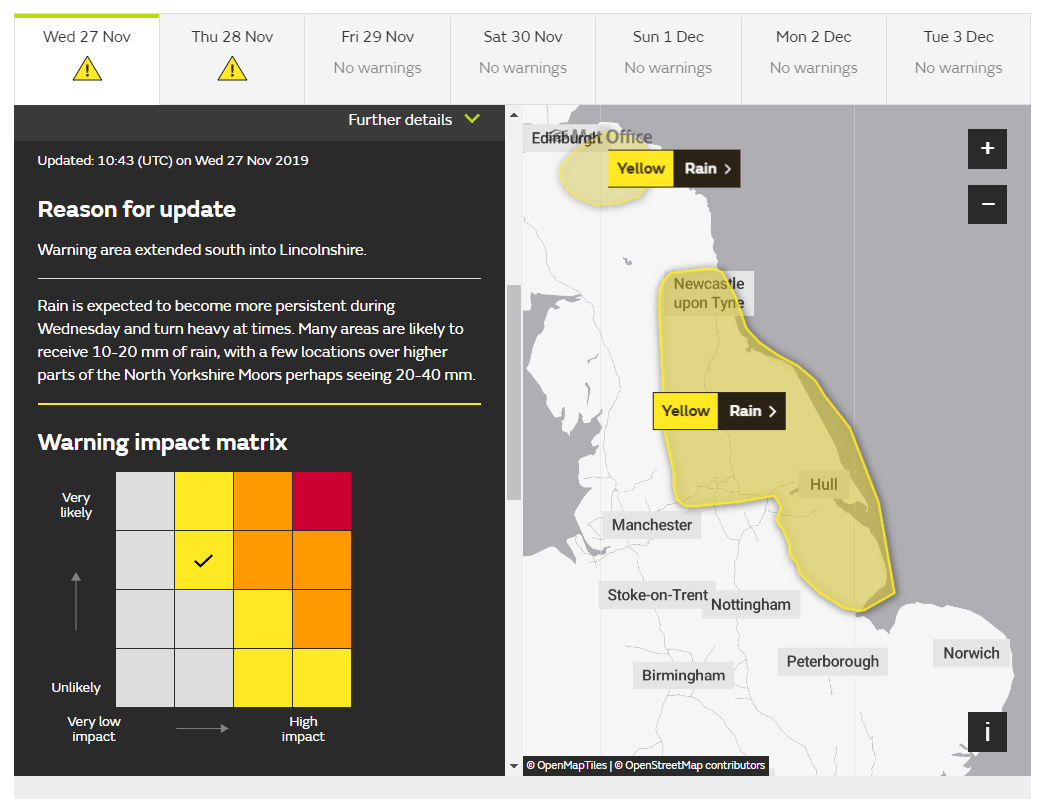
I've got 2 simultaneous weather warnings for snow and ice tomorrow. K then...
Just as a counterpoint – there are plenty of people who get caught out in bad weather thinking that they won’t be affected. You only need to go as far back as 27th December, when there was miles of stuck cars on the A9 in a snow closure – with all other roads to the north of Scotland closed. If a yellow weather warning for cold weather and snow means people might think twice about their journey or even their tire choice on their car it is better safe than sorry.
Or, alternative theory, a lot of those people underestimated the severity because they get bombarded with weather warnings that ultimately mean very little.
As per others, it devalues actual warnings, just like covering a workplace or road system in signs means people just tune them out and miss the really important ones.
It's the nanny state gone mad!
Britain’s nanny state has decided we can’t be trusted with the weather
https://www.telegraph.co.uk/columnists/2023/06/02/uk-hot-weather-alert/
For those who can't go pass the Telegraph paywall:
Britain’s nanny state has decided we can’t be trusted with the weather
I expect we’re paying handsomely for the privilege of being told that it’s really, really hot, actually
Call Mrs Doubtfire! Summon Mary Poppins! Scramble Emma Thompson’s formidable McPhee! Out nanny state has gone loco. Lost it. Reached the bossy tipping point beyond which Britain might well be mistaken for a basket case. Oh, too late.
Just days ago a report by the Institute of Economic Affairs think tank revealed the UK government is “becoming more meddlesome in people’s lifestyles” leaving us among the most authoritarian countries for food and soft drink, tobacco, and alcohol regulation. What next?
I’ll tell you what – our esteemed leaders have decided in their great and infallible wisdom we can’t be trusted with the weather. And so, to counter our collective helplessness a new alert system will warn us when high temperatures could damage our health this very summer, indeed this very minute.
Run by the UK Health Security Agency and the Met Office, it is aimed at reducing illness and deaths among the most vulnerable in England.
Apparently, the Welsh, the Scots and the Northern Irish will just have to go it alone when it comes to taking off their jackets and putting on a pair of shorts. Windows open or windows closed? Oh the jeopardy of it! But rest assured, England is in the hands of The Heat Health Alert system which has just been launched and will run from today until September 30.
I gather in winter it will also nag us to just put on another sweater for heaven’s sake and wear a proper coat outside, but for now it’s all about keeping cool.
The system will offer “regional information and advice to the public and send guidance direct to NHS England, the government and healthcare professionals”. I have no idea what that means but I expect we’re paying handsomely for the privilege of being told that it’s really, really hot, actually.
Nobody disputes the terrible toll climate change exacts on people vulnerable to the effects of spiralling temperatures. Last year records were broken when some parts of the country reached 40 degrees C.
Figures for excess mortality rates compiled by the UK Health Security Agency and the Office for National Statistics show that during one four-day heatwave in July last year 253 more people than usual were dying every day. Across the summer, a total of 2,803 people over the age of 65 perished during five distinct heatwaves. Deaths in people aged 70 years and over were 5,017 above average.
Of course, the elderly and the frail need to be protected and supported – but that is surely down to us, their loved ones?
A traffic light system warning of danger is no substitute for the personal responsibility of family, friends and carers. My concern is that state nannying, however well-intentioned, at some level removes the onus on ordinary people to reach out to one another in extraordinary weather. It doesn’t empower, it enfeebles and arguably creates a false sense of security.
Of course, we need to adapt. I will admit that last year I was astonished to discover that closing the windows and curtains all day would keep rooms cooler. Who knew? Apart from everyone on mainland Europe and beyond.
In our defence, here in Blighty we’re just not accustomed, never mind acclimatised to soaring mercury and our homes aren’t built to keep heat out – which is ironic, really, as they sure as heck aren’t built to keep heat in either.
My great bedtime godsend is a microfibre cooling towel which I soak and drape over my shoulders or anywhere else the fancy takes me. I bought mine on Amazon but any wet cloth or garment will do the trick.
I gave one to my elderly neighbour who was equally impressed and I will remind her it’s time to track it down ready to be deployed; not when the state sounds a health alert but when she feels too hot. Crazy, but I have a hunch it might just work. Don’t tell Mrs Doubtfire but sometimes nanny doesn’t know best.
There is a definite ‘cry wolf’ risk with the yellow warnings I reckon. Case in point, tomorrow here in hilly south Lanarkshire we are in the fairly large blanket yellow snow warning, which most folk are ignoring.
Perhaps if the school trip a decade ago had been postponed in light of a yellow warning, the schoolgirl who died as the school bus slid off the road and into a river would still be here.
I think I'm right in saying this was one of the incidents which led to a 'simplification' of weather warnings.
https://www.google.com/amp/s/amp.theguardian.com/uk/2010/mar/31/school-bus-crash-kills-girl
^^^^ exactly what I mean about the cry wolf bit. Had it been taken seriously tragedy may been avoided.
We're not in a warning area, but you could tell from the range of outfits being modelled on the station platform in the light snow just now why some people may need help figuring things out....
Weather impacts can be location dependent. Out in the sticks yellow rain leads to surface flooding and roads blocked. Wind its trees down (chap killed in his car by fallen tree up the road last week during an active amber warning for wind) and snow and ice is skidding on untreated roads. Maybe not such an issue in towns and cities where infrastructure is better maintained but useful none the less in rural locations.
I came on to say what sboardman did - the yellow warnings are NOT about severity of event on its own. In the top left of the warning impact matrix they do mean a very high likelihood of moderate disruption. But in the bottom right they mean a low likelihood of severe disruption (usually the forecast is a few days away). These bottom right events are usually upgraded to amber (and possibly red) if the forecast becomes more certain in location and timing, as well as severity. But if the forecast location is still uncertain the warning stays yellow. So "You do need them to tell you that it’s going to be a bad day in three days’ time though, don’t you?" Yes, yes you do, that's the point of the bottom right of the matrix, that a yellow warning for potentially severe disruption is given when the exact details are uncertain but there is a chance of a major event.
I would really emphasise to those of you saying you don't like the alerts - they are your personal devices, so it is for you to turn the alerts off. There are no alerts that are forced on to your phone except for the Gov warning (for e.g. terrorist attacks, and severe flood warnings which pose an immediate risk to life) and even those you can find the 'app' and delete it if you wish.
There are some focused systems out there in areas with larger populations, I know schemes in European cities that created an app for certain respiratory disease sufferers to get air pollution and heat/cold warnings, organised through their hospital. But it (1) costs a lot of money to run the service and (2) it would be much more difficult to make accurate in rural areas, and we know that 'false alerts' make people ignore the warnings, which is the last thing we want.
It's interesting the number of examples in this thread that either something/disruption/loss of life happened (and very sadly we have had a lot of fatalities this year) or where there weren't 'newsworthy' impacts - but at one day ahead the planners and forecasters would have had similar information and certainty / uncertainty in the forecasts and had to make the call based on that information. I do appreciate that people fatigue from warnings and we know 'false alerts' are very bad, but when you are one day ahead looking at a forecast, we have to have consistent processes and thresholds to make an alert, so in all those events (whether they had 'impacts' or didn't make the headlines), at one day ahead they met the same level of concern. We can't differentiate ahead of time which of those events will be perceived as 'crying wolf' and which are the ones that - very sadly - result in fatalities.
I am interested in how we improve these systems so people don't think 'crying wolf' and ignore it completely. I think the idea is people see an alert then watch a video forecast or google it. Then the text / narrative from the Met Office will explain if it's a potentially big event in a few days with uncertainty in the forecast - so telling you to keep an eye on the forecast - or if it's a moderate severity event so you can make your own mind up on the level of disruption or health impacts you individually might get. If you aren't doing that, how can we improve the system / warning colours / levels?
I would really emphasise to those of you saying you don’t like the alerts – they are your personal devices, so it is for you to turn the alerts off
I use the BBC weather App, it has the alerts embedded in them, it's not my phone that's telling me there's a weather warning. I wouldn't mind the warning impact matrix, but that's not I get, I get this which is essentially a warning about yellow snow, which I definitely don't need

The forecast was accurate. We had snow when it said it would and chaos for travel this morning. Didn't affect my commute as the Snow stud shod wheels went on last week as its been bloody freezing.
Same as nick, it's embedded in my Met Office app so the only way I get rid of them is to turn alerts off completely which is less than useful.
I understand how risk matrices work, maybe holding off putting an actual alert out until it's 24h out for low certainty events may help but keeping a visible warning.
iainc
Full Member
There is a definite ‘cry wolf’ risk with the yellow warnings I reckon. Case in point, tomorrow here in hilly south Lanarkshire we are in the fairly large blanket yellow snow warning, which most folk are ignoring. I do however predict mayhem on the roads in the morning and it’ll be headlines on BBC Scotland all day…. I may be wrong
so, I was complete wrong, sunny blue skies, no snow in this area of Central Belt, Traffic Scotland telling folks to work from home and avoid travel. Roads are clear and dry, yes, I suspect it will snow later, but loads of people no doubt thinking yet another cry wolf.
Not sure what best approach is, but this doesn’t seem hugely effective.
I used to travel for work each week - a train or car journey of 2-4 hours or so, leave on Monday come back Thursday or Friday. A yellow warning of snow on say, Wednesday night would have prompted me not to travel as it would have been a pain in the arse coming back even with a small amount of snow - or come home on Tuesday or whatever.
As it happens, I'm in the habit of checking weather constantly, but not everyone is.
Sure, but the actual weather forecast serves exactly the same purpose, if there wasn't the yellow warning, you'd still read or watch the forecast and you'd come to the same conclusion, "Oh look" you'll think, "snow. I'll come back a day early". I'm not convinced the Yellow actually achieves anything beyond; "Look, we told you" for the forecasters. Given that years after the event folks are still digging out the 1980's storm cock-up It's even on the first page of this thread, I'm entirely not surprised
Sure, but the actual weather forecast serves exactly the same purpose
It does it you check it, but the point about alerts is that they notify you - or should - in a way that normal weather does not. I don't get an alert to say that it's going to be light cloud and 9C on Friday or whatever.
Not sure what best approach is, but this doesn’t seem hugely effective.
The approach of not treating people as idiots (ie issue warnings based on likelihood and possible impact... and then leave them to read what the warning says, check the more detailed forecast, decide for themselves whether they need to change plans accordingly based on their own situation) seems fine to me. If people want the word "yellow" to do all the work for them, that's on them.
Today's warning? Me? Bought some wood and milk yesterday. Made sure there's blankets in the car etc. Nothing more. Others will change routes, or have their office based meeting tomorrow, or make no preparation whatsoever, based on what they've read after being prompted by the yellow warning covering their area.
It does it you check it, but the point about alerts is that they notify you – or should – in a way that normal weather does not.
But see my complaint right from the get-go , if you treat so much weather as needing a yellow alert, then eventually all/no weather needs a yellow alert, and it looses its impact. I'm happy for folks to make the argument that todays sner deserves a yellow warning, but it's come on the heels of weather warnings about the cold and the wind in the last few days and weeks, or in other words: Winter.
Sigh. Again - just because you don't need warning, doesn't mean no-one else appreciates it. People don't usually just make this stuff up for no reason. Time to move on I think.
Although I feel I must point out that right now it is quite cold in Cardiff, colder than usual but normal - and there are no weather warnings.
Although I feel I must point out that right now it is quite cold in Cardiff, colder than usual but normal – and there are no weather warnings.
My plan is proceeding as I foresaw it...Come to the dark side.