 You don't need to be an 'investor' to invest in Singletrack: 6 days left: 95% of target - Find out more
Regrettably, there are canoeing fatalities, especially when people venture onto the open seas.
Wouldn’t it be safer if their canoes were fitted with ‘outriggers’?
Boats capsize in heavy seas too. Catamarans even.
Chances of rolling back up in a kayak with an outrigger = 0
Outriggers would reduce manoeuvrability and could cause a capsize if side on to waves. Rolling and other rescue methods would be much harder. It would be better if people understood the risks, learnt the skills and carried the safety gear.
Essentially, outriggers would destroy the point. It would be a bit like making bikes twice as long to avoid riders going over the bars, or putting training wheels on mountain bikes.
Most incidents occur where paddlers are unprepared for the condition E.g. taking an inflatable out in windy conditions or over-estimating their capabilities. Relatively far fewer incidents involve experienced paddlers. Capsizing is a bigger worry for inexperienced paddlers - once you get more proficient with support strokes etc it becomes more instinctive and being aware of the types of conditions/locations where capsizing is more likely.
As above, your suggested solution creates more issues than it solves, and it doesn't solve all the issues in the first place.
As kayak23 said, a capsize with outriggers is unrecoverable plus I often use the 'wobbliness' of my boat to reduce waves coming in by lifting a gunwhale or edging to turn, to avoid being side on to waves. Both of which I can't do with an outrigger.
Users are the main issue. Not boat stability.
It would be better to offer more training for people.
I appreciate your question is a "noob" one, so not having a dig. But it's like saying "shouldn't all bikes have stabilisers so they don't fall over", for the reasons given above.
A sincere thanks for all the replies.
I just figured that if it’s how Hawaiians and Indonesian fisherman have got around for millennia…
Could I please ask a kayak question whilst everyone's assembled?
As far as speed and manoeuvrability is concerned is it best to have a bigger boat relative to your weight that sits higher in the water, or a smaller boat which would sit lower in the water. (I think).
Reason I ask is that I'm a kayaking beginner, I was given a decent plastic boat that I use on the canal. I've probably not yet nailed my technique but I notice that even when I'm gunning it I'll barely be going faster than a person walking on the towpath. Is that right? Wondering if I'm too fat for the boat?
I used to race K1 kayak, race boats are very unstable - you have to keep the paddle in the water most of the time to ‘brace’ and you’ll fall out if you capsize. Outriggers are used for para-canoeing though.
Regrettably, there are canoeing fatalities, especially when people venture onto the open seas.
I wonder if your opening premise is correct? Certainly there are fatalities, including those at sea but I wonder - per miles paddled - if the sea is particularly bad compared to lochs/lakes/rivers etc. Perhaps that is because people have more respect/fear of the sea and so avoid it (or better rescue services, less likely to drown through entanglement so time for help to arrive etc?).
I just figured that if it’s how Hawaiians and Indonesian fisherman have got around for millennia…
I think that might be a slightly different question. What design benefits do outriggers seen on traditional fishing craft bring? e.g. do they let you rest for long periods? do they let you deal with your catch rather than paddle etc. Do they make its easier to erect a small sail? Of course I think you can be pretty sure that no every hawaiin or Indonesian came back safely.
jambourgie - with boats length matters - long boats go faster than short boats. Skinny boats are easier to make go faster than fat boats. Short boats are generally more manouverable.
Jambourgie
Less about how heavy you are and more about what the boat is designed for. Short and wide = stable and turns easily. Long and narrow with a pointy front end = faster and less stable.
My sea kayak will easily hold 5-6mph. My plastic playboat can't keep up with a walker either. Usually the best thing to do is wander along to a club, most of which have a range of boats, and try out some alternatives to see what best suits what you want to use it for.
Thank you.
Main impact of riding high/low would be on how it handles since you have the hull rails/shape designed to be a certain height above/below the waterline. Go to far either way and it will handle badly.
If you are too heavy it will definitely be slower. Lighter most likely slightly faster but minimal control.
In terms of maximum speed as others have said it depends on what that "decent plastic boat" is. My zen white water boat is nice and pretty quick for a white water boat but it still has a fairly slow top speed. You hit the bow/stern wave effect and simply dont have the strength to beat it.
Is there a good course for a wannabe sea-kayaking noob to do? Or just book a session with a guided tour and they'll show the basics?
Depends where in the country you are and how far you want to travel.
Many good places will have options from taster sessions to longer courses depending on how seriously you want to take it.
While we're asking noob questions...
Is there any point in me getting a rash vest when I could just wear one of my baselayers? They seem very similar in material and design.
In terms of maximum speed as others have said it depends on what that “decent plastic boat” is.
It's a Dagger Katana. I think I need to adjust my expectations of how fast kayaks go 🙂 I suppose as I only ever use it on the canal (flat) I'm not being helped along by the flow of a river, tide of the sea etc. Might fit an engine.
Your local canoe / kayak club will be able to give you the cheapest start.
After that there are various providers of training, you will want your coach to hold British Canoe Union (BCU) coaching qualifications.
If you just want to see if sea kayaking is for you then book a tour.
Is there any point in me getting a rash vest when I could just wear one of my baselayers? They seem very similar in material and design.
They aren't. My rash vest is made of the same stuff swimming costumes are made of and it's different and dries much more quickly than a base layer because it's made of a coarse thread to dry fast. Base layers are made of fine fibres to improve wicking.
Is there a good course for a wannabe sea-kayaking noob to do?
Loads of sea kayaking introductory courses/star awards etc from clubs or commercial providers.. In my view, sea and whitewater has a very steep initial learning curve and there is no substitute for a qualified coach and a structured course.
Where are you based, perhaps we can recommend someone?
Great, thanks - fairly regular visitor to Cardigan, nothing adventurous but I quite like the idea of going for a paddle on a calm day. 🙂
Is there any point in me getting a rash vest when I could just wear one of my baselayers?
Depends on the material. I have a couple of RAB baselayers I use under a wetsuit. However they are ultrafine and not now available.
I did Google ‘Outrigger canoe’.
Not many downsides on the wiki page.
Good stuff👍
Is there any point in me getting a rash vest when I could just wear one of my baselayers?
only if its a smelly helly..
I did Google ‘Outrigger canoe’.
Not many downsides on the wiki page.
I think you're just winding us up, but "Are there situations for which an outrigger canoe is the best solution?" is not the same question as "Would putting outriggers on canoes for inexperienced recreational use on open water make them safer?" It's horses for courses and more complicated that it might look on first sight. Mountain bikes have suspension, does that mean road bikes should have suspension?
Great, thanks – fairly regular visitor to Cardigan, nothing adventurous but I quite like the idea of going for a paddle on a calm day.
Be very careful in Cardigan bay, very powerful tidal currents in the sea. According to one local, 5-6kts past where we were near Fishguard and you could see it boiling away from the cliff tops. Might be less at Cardigan but do check!
I think you’re just winding us up, but “Are there situations for which an outrigger canoe is the best solution?” is not the same question as “Would putting outriggers on canoes for inexperienced recreational use on open water make them safer?”
Indeed.
Downsides for me:
- encourages going out in marginal or poorer conditions through false sense of security (see next point).
- easier for inexperienced paddlers to make it further out to sea in bumpy conditions. It would arguably get them into deeper water (see what I did there) before trouble occurs - so when it does, they are in bigger trouble.
- less manoeuvrable - arguably the best thing you can do is to be able to manoeuvre easily and quickly out of trouble. I often find in bigger waves my course in a kayak or canoe is a gentle slalom, so that the boat faces best direction as a wave builds or exits. You cannot edge one way, and harder the other way, outrigger in way of the paddles or sweeps etc etc.
- more area for wind and wave to act upon - and hung out to one side so not always balanced or the optimum side. Try catching a wave with the outrigger on the wave side...you are edged down the wave, your underwater edge catching with any sideways movement....
- harder to self rescue, particularly in deep water.
- it does nothing to increase judgement and skill, arguably *the* way to stay safe out there.
- another thing to fail.
Let us not forget, Wiki pages are written usually by fans of a particular thing or with an agenda. They are not always the most balance.
If however, as a paddler with some experience, you decide that an outrigger canoe works for you, then go ahead, fill your boots. There are many that are use for ocean crossing, surfing and competition.
There is a damn good reason that the majority of canoes/kayaks are seen without outriggers.
(Yes i have messed with them on open canoes, for the record).
Harder to put on your roof rack too... 😉
Might fit an engine
Is there any such thing as an e-kayak yet? And don't say it's a pointless idea, no more daft than e-bikes!
And don’t say it’s a pointless idea, no more daft than e-bikes!
There are motor kayaks. Generally sit on tops intended for fishing. I would expect some of them have switched from petrol to electric engines.
Is there any such thing as an e-kayak yet?
Many canoes and kayaks are available with motor mounts, many now use electric trolling motors and more powerful...
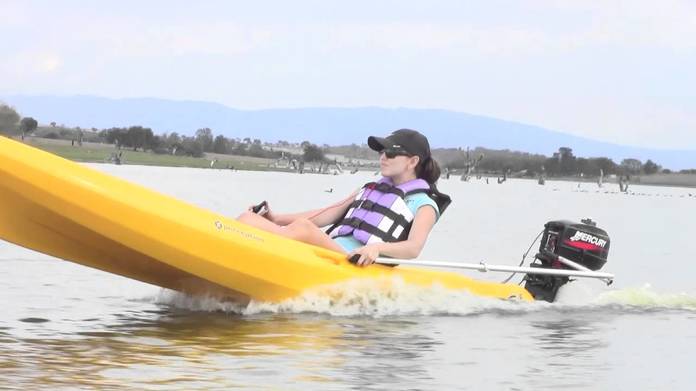
Shame, I thought my idea might make me a millionaire.

Is there any such thing as an e-kayak yet?
You can also get a motor for your SUP too, looks like it fits into where the skeg goes.
You can also get a motor for your SUP too
What you need is the e-surfer for full insta-brags.

Apparently so, if you own 2 beer chillers. Mounted thus;

^^^coming soon, to your local surf spot^^^😜😜