 You don't need to be an 'investor' to invest in Singletrack: 6 days left: 95% of target - Find out more
I have found that over the last week my HRV is coming right down tracking with Garmin watch, i know these things aren't 100% accurate, but presume that if you take it as a trend over weeks it is worth looking at?
I have a habit of overdoing things, mostly because i use exercise not only to hopefully get fitter, but control Type 2 diabetes without medication.
Training for my first half marathon in April, so mileage has been creeping up, with longest run to date last weekend, so running 3 times a week, trying to fit in one "classic" old fashioned weight training session and one more running orientated light weight session in the hope of warding off injuries, plus get out on bike once or twice, so exercising 5-6 days a week.
But HRV increased through out January, but last 2 weeks, has come right down, baseline for me is 51-65, and it is sat in low-mid 40's.
I know it can be a sign of illness, over-doing it etc. Bit i don't feel ill, I feel like i am able to complete the runs or strength sessions ok, but my concern is burning out before April and just getting slower and ill?
Do i have a 3-4 days complete rest or best to just have a week of reduced miles and stay in zone?
Some things i read seem to say it is expected as you increase workload and is natural?
I observe mine but don't change behaviour. If it drops then about 2-3 data later I tend to be very tired/on the verge of illness.
Since starting the 100 day challenge last year I've noticed if I exercise every day then it stays green.
Have got to say, alcohol (too much) has the biggest effect on mine.
Thanks Reeksy..
Used to notice it dropped like a stone with alcohol or in the days leading up to COVID, but i did dry january and carried on really, had 3 beers since start of year in total..
I think i will back off a little and keep to lower HR stuff but keep some daily exercise. Just conscious of wanting to improve before April, but not arrive knackered, especially as i have Paris-Roubaix sportive week after half marathon!
I treat it a bit like reeksy, watching it but not usually acting on it.
A drop usually comes before feeling bad/tired. Usually I rest then.
But, it also can drop before a bug hits, so if there's any other symptoms like sore throat or headache then I rest earlier.
Alcohol affects my hr but not the v for some reason.
Like you, it's the COVID bug that causes the big drop for me. It's exercising into it that I really try to avoid, don't want to do anything to make it worse. I've had it a good few times so I'm getting an idea of the early symptoms, but it does change -last one was more flu-like- but everybody's different.
In my experience a dropping HRV trend signals the onset of some illness, usually a few days later. It's been a very good predictor. I therefore tend to dial back the cardio for a while.
I'll see one-off drops if I've had a particularly heavy "training" day but I don't do those back-to-back so that doesn't affect the overall trend much
Of course, it also plummets due to alcohol, but that will be for the one night per week that I actually consume any so is easily monitored and discounted in terms of training load.

Same as @scotroutes - dry jan it was consistent in a similar range to OP. A few beers and it's down 10%-15% and HR goes up 5%-10%.
Sometimes after a tough evening ride even without a beer, it takes a dive. But when it does drop and it's none of those things, it's a good marker for taking it easy/getting ready to deal with a cold or similar.
After 100 days as well, I find even light exercise (eg hour walking the dogs) or Yoga "rest days" really seems to help keeping it consistent.
As others have said, I can definitely pick up illness/alcohol with HRV. However my natural reading is pretty low (20-25) so I’m not sure what to make of it. Does it mean I am naturally unfit or have an unhealthy heart? Don’t think I can do much about it so I pretty much ignore the issue. 🤷
It does drop with age. Are you about 120?
Like other I noticed it tracked illness quite accurately.
So I do use it now in that if I feel a bit tired and run down, and my HRV is low, then I can back off any exercise as I am probably coming down with something or have over done it. However if I am feeling a bit tired and don't feel like doing anything but my HRV is around normal readings, then I assume I am just a bit mentally fatigued so do try to get some activity in as that will likely help.
It does drop with age. Are you about 120?
I hit 50 in May, that was the challenge really, i have always avoided running since leaving army with dislocated knee and buggered back, so thought i'd enter a half marathon!
But very conscious of not overdoing it, and i always said that if the running and injuries, which seem to path of the course, with middle age and running, get in the way of cycling i'd back off.
This post made me check mine. Garmin watch user here (ForeRunner235) and used to have data from it going way back to my running/Crossfit days in 2016/7. Right now though I am just doing indoor cycling (1 hour+ three/four times a week for about 1000+ kCal a hit). Resting HR is sitting anywhere between 50 and 55, but jumps to about 62-ish if I have had a couple of beers.
The old Crossfit/half-marathon/triathlon days of no drinking and a 45bpm resting HR are behind me I fear, but that's not a bad thing.
My significant dip on here was a Wednesday night. I only drink on weekends. And there was a decent afternoon session on a Saturday there too. 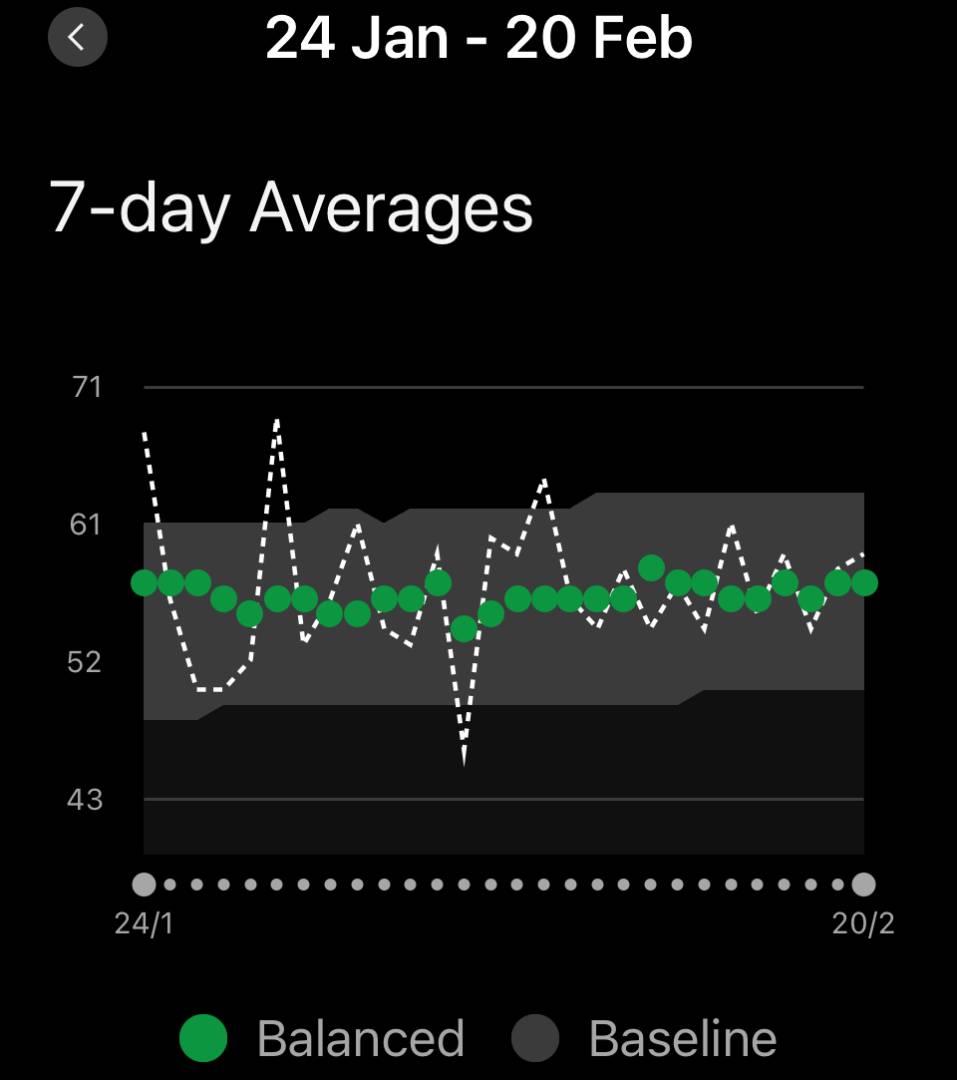
Are you on a training plan? Every plan I’ve ever used or seen for cycling has rest weeks every few weeks (usually 1:4 or 1:6) to let you absorb the training a bit. I find it helps a lot with maintaining consistency in the medium/long term.
i assume the principle also applies to running plans.
However my natural reading is pretty low (20-25) so I’m not sure what to make of it. Does it mean I am naturally unfit or have an unhealthy heart? Don’t think I can do much about it so I pretty much ignore the issue
I have long COVID / chronic fatigue and mine is around 20-25. I got the watch when I was 43 - I don't know what my HRV was like before I was sick!
I don't really worry too much about it - it seems to follow the same patterns as everyone else, ie lower when I feel shit, higher on the rare occasions that I sleep really well. I don't think there's much else I could really do about it, that I don't already.
I've used HRV4Training for several years to track resting HR and HRV. Resting HR correlates well with fitness but HRV can be all over the shop, even day to day. Agree with Rivett that alcohol has a big impact.
I used ithlete to for a morning HRV snapshot for years, but they recently discontinued it, so have switched to Elite HRV. I really liked ithlete, the interface was good and it presented longer terms trends and how they related to various factors really well. For me, poor sleep and life stress along with obvious hard, high intensity training /physical efforts were the clearest triggers of low HRV along with illness / impending illness. Oh, and poor hydration.
My take, fwiw, is that it's quite a nuanced measure, which I use as part of an overall take on how I feel on an individual day along with a wider perspective on trends. I'm not ruled by it, but if it plunges suddenly, I'll maybe back off a little on the basis that - particularly if it's not triggered by really poor sleep / a night out / a super hard session the day before - it could be illness.
That said, I'll also try to listen to my body and if I feel a bit crap, I'll take account of that too, regardless of what HRV tells me. Bear in mind that high HRV could actually mean your body is in a parasympathetic state because it's deep in recovery mode rather than it being a sign that you're super ready for hard activity. High HRV isn't a 'good' thing per se.
Anyway, I'd maybe back off for a week - lower intensity more than not doing stuff at all - and see how you feel / how your HRV responds.
I think trends over time are arguably more useful than daily snapshots. You're looking for falling RHR and rising HRV in general terms. If the opposite's happening, you maybe need to build in more recovery. But mostly, listen to your body and use HRV as something that's just another pointer in the overall picture rather than an absolute.
I did always find it great on days when I felt a bit crap, but also had a nagging commitment to doing something hard. If HRV gave me a red light, it kind of empowered me to sack it off rather than flog myself pointlessly into the ground. But that's just me. YMMV.
A single alcoholic drink can halve mine. But sometimes it just trends lower and I have no idea why.
People's scores on here put me (and my weight/health) to shame, currently getting data on it as only had a 255 for 10 days, but sitting in the 30's.
I am finding the Connect app very anti being heavy, but also doing regular exercise, it complains my load level is too high all the time with just a few sessions of riding to and from work a week and some weights. Currently not running pending an MRI on my ankle/foot which isn't helping.
Well, went for quick 5km in lunch hour, and the snot was flowing out of me! So maybe that's the issue.. what organ produces snot and can it be removed?!
I know it can be a sign of illness, over-doing it etc. Bit i don't feel ill...
That's the point of monitoring; you want advance warning that things are trending in the wrong direction so you can take action. You don't need confirmation once you are ill or overtrained!
Back in the distant pre-smart watch past I used an HRM for racing and would manually check my resting heart rate in the morning. I remember during a heavy training period that my HR during a couple of events was significantly below its normal level, despite the fact I felt strong and was putting in good performances. I took the hint, backed off and tapered for the next couple of weeks before a target event, and ended up with some of the best form of my life. I think I was on the verge of overtraining, and might not have realised that without the HR measurement.
Thanks KCR, strangely resting heart rate is fine, stays at 46-49 - feel ok in myself bar a bit of a cold, but HRV is definitely a way below base and been like that for 7-8 days now.. will back off and keep things in Zone 2 for a week and have a couple of rest days
None whatsoever. The garmin stress indicator is mildly amusing but nothing more than that.
......
i'm 50, my HRV sits between 20-35 and has been like that since starting to look at it about a year ago (I got a fitbit, briefly) a few years back I used the HRV4 app and I'm sure it was quite a bit higher, so the low range was quite concerning. However my fitbit didn't last and I now don't really measure it. Did out of interest this morning, just after getting up, relaxed but not steady HR (between 53-65 during the test) and got a result of 63. tried 5 mins after, having relaxed, with a steady 51-55HR and got 23.
maybe my heart is screwed. I don't know. I recall talking to my GP about increasing frequency of fluttering, palpitations last year, as I was having venesection treatment and was concerned that my haemochromatosis had knackered my heart, but he'd seen my biking HR range from 120-180bpm with a lot of variability and said that if it was knackered, or anywhere near it, it'd not be doing that. However, the HRV is in the back of my mind....but I don't know if it's actionable.
I have a Garmin Epix Pro watch, which claims that my HRV is about 25. However, if I measure with a strap and Elite HRV then it comes out between 50 and 60. So I choose to just believe that I'm splendid and that HRV measurements are not.
A single alcoholic drink can halve mine. But sometimes it just trends lower and I have no idea why.
Quality of sleep seems to play a part for me.
For alcohol timing seems to count although what seems to really batter it is a beer after hard exercise (as in maxing out heart rate) Either have an impact on their own but combine them and its a multiplier.
Its a bit unhelpful that way since I do start carrying out experiments to try and figure it out.
In terms of tracking illness I dont find it overly useful since generally I can feel it without needing HRV.
I do use it though to try and figure out whether it is sensible to resume exercise which is going to ramp up my heart rate. Got hit by a weird bug in December which had minimal symptoms beyond a sore throat and being knackered easily for a week or so but took longer for the hrv to start to recover.
https://podcasts.apple.com/ie/podcast/the-real-science-of-sport-podcast/id1461719225?i=1000693948989
Interesting listen.
I'm the same as others and just monitor it as a guide as it generally indicates fatigue or oncoming illness, mine drops dramatically with alcohol consumption or work stress as this is normally related to sleep issues, was ill last week and away at the wknd (so drinking) so not sleeping well and its dropped right down but started to pick up to normal now. I tend to use as a guide and if lower than normal i just go to bed earlier or take the afternoon nap i normally fight against. I did dry January for the first time ever as well and noticed a dramatic improvement to my sleep and general well being as a result so have drastically reduced my alcohol consumption now and until last week my HRV was steady away. I was anti tech for ages but actually like the low level guidance you get from wearable stuff. I'm not sure I'd rely on it totally but along with how you feel its very useful reminder to either rest more or conversely train more!
Interesting thread as I had my first brush with an instance of HRV last week when my watch alerted me that I was undergoing a period of AF. I rang NHS 111 the next morning and they did the "please report to your nearest A&E within the hour". As luck would have it, after ~20 hours of being all over the place, my HR stabilised pretty much as I walked into the hospital. I got the impression the nurses were a bit skeptical, but when I saw the doctor (after ECG and bloods), he said they are seeing a lot of smart watch induced walk-ins, but he said that was a good thing. He actually asked to see the ECG that the watch had produced when I was in the period of AF, and nodded at it like he thought it was totally worthwhile data for him. Been pretty impressed how seriously it has been take, I'm booked in for an echocardiogram and 48hr heart monitoring next week.


My Garmin also has the ECG facility and I have suffered with AF since Covid and Pleurisy a few yers ago. The problem is when I experience heart rate "flutters" they dont register as the ECG function only works above 50bpm and my resting rate is around 32 so even sitting watching the TV or reading a book I am below the threshold. When my symptoms were at there worst it was bouncing between around 40 and 150 and that was monitored on a paramedics ECG machine when I was being taken to A+E. Fortunately it has settled quite a lot since.
Thanks all for the replies, @timmys hopefully nothing too serious for you, I had an "episode" where heart seemed to be to race as i lay down and felt like heart wanted to jump out of my chest and the A&E couldn't of been more dismissive of any data from my Apple Watch i had at the time.
I must admit whilst my Garmin watch has all the bells and whistles, it does not seem to be anywhere near as accurate as the Whoop band i used before, that was a great bit of kit, but expensive at £30 a month subscription.
Coincidentally a really good overview on HRV popped up on my podcast feed:
https://podcasts.apple.com/gb/podcast/fast-talk/id1490521721?i=1000691831232
It's a deep dive into measuring HRV and how to use that data with an expert on electrical heath monitoring devices. Way too much to summarise, but some points are that it's very sensitive to small variations in posture / movement etc during monitoring. Suggests overnight measures are interesting but not particularly helpful in measuring recovery. That chest straps are more accurate / consistent than optical monitors.
Absolute values don't matter and aren't comparable between individuals, the usefulness is in how readings differ from your personal baseline. Fwiw different apps etc may use different scales anyway.
Anyway, it's an interesting half hour or so for anyone curious about what HRV is, the best way to measure it and how to use it as an athlete.
Been covered very thoroughly here but to add my thoughts -
Been a Garmin user for about a year and I've found the HRV data and insights really interesting and useful.
The key bit for me - the trend definitely gives you a headup of either an oncoming illness, or that your overdoing it. The former, being really very obvious. My 'data' seems to spot an incoming headcold or dose of something about 48/24hrs before it seems to affect me outwardly, and it seems really quite accurate.
I've had a torrid February, quite annoying as its always my month to start getting back into serious training and fitness etc, but I was completely wiped out for about 2 weeks. The red line I've annoted is the period where I felt properly grotty, it was definitely Valentines day when I got back to 'normal'. You can see at the end of January I was getting the warning signs it was coming.
My experience - its useful, and a good way to help you know your body and your health.

I had a very serious set of injuries following a crash with a car, my garmin watch survived the accident and started whining at me because my HRV was off the scale bad. This lasted for some months, I wasn't really fit to worry about it and thought the watch was broken, but it wasn't. Once I became sufficiently functional in the mental department it was apparent that I was stuck in fight or flight mode due to the trauma, even through I wasn't really aware this was the case in retrospect it clearly was and this caused other issues, eventually it just flipped back to normal range quite suddenly. I'd say that it's worth listening to even just as a measure that there is something wrong.

OP Back again, post above is my HRV over the last month, now i have worked out how to add image, as you can see despite backing off an having two rest days a week, not one, and trying to get a full 8 hours sleep, not usual 6-7, my HRV has slumped down and seems to be stuck at a new low.
The weird part is that, despite this, i had a restful day on Saturday and went for a decent family walk, but on Sunday ran my first half marathon...
My reason for the initial post was, although i have dropped a lot of the cycling and turbo training i'd do as well as the running, I am following a running half marathon plan to try and get round London Landmarks half on 6th April in good time, so i am increasing my weekly mileage by about 10% each week.
Over next weeks it has me running around 20 miles a week, with an easy pace 4-5 miler, a 5 miler with intervals and then a long run between 1hr 45 to 2 hours at weekends, it then tapers for last 2 weeks, so i don't have a lot of harder weeks left
I feel ok in myself, my resting HR seems to stay the same at 46-49 BPM.
What i want to progress over next few weeks, do the taper fortnight and arrive fresh.
My concern is that if i looked at my HRV chart above, it would seem to imply i'm overdoing it, and actually going to arrive at start line knackered!? Or, is that "over-reaching" a bit before backing off to recover in taper?
My hrv is balanced, but usually high 20s according to my garmin. Low for my age (41). Feel fine physically, and I'm reasonably fit, so I don't take too much notice. Interrupted sleep a lot, because the family cat is a ****. Can i blame the cat?
That is so consistently low now that I'm wondering if the earlier readings were simply abnormally high 😂
Are you aware of any change to how/where you wear the watch, new strap etc? You could even try it on the other wrist for a while. Either that, or some specific health change at the start of the month - new medicine etc.
Also, can you overlay the nightly averages line on that. It'll show whether or not it's full of peaks and troughs or just in a narrow, but lower, range.
My concern is that if i looked at my HRV chart above, it would seem to imply i'm overdoing it, and actually going to arrive at start line knackered!? Or, is that "over-reaching" a bit before backing off to recover in taper?
If you can be bothered, have a listen to that podcast link I posted earlier, it's really informative and useful. Also, their take is that overnight tracking HRV data is interesting, but much less useful for gauging recovery than a finite HRV reading from a consistent measurement every morning - how most HRV apps work - and that wrist-worn devices are not as reliable as a chest-strap.
One of the other things they talk about is pre-event prep and how some athletes simply stop using HRV in the weeks running up to the event and train on feel to remove the distration/distortion. Fwiw, if you feel good and your body is responding normally, I'd just listen to it and how it feels relative to what's happening with your training and more generally in your life.
Fwiw, my HRV today 'good' relative to my established baseline and Elite HRV says I'm bang on and up for a hard session, but I feel a bit crap for whatever reason. I'm going with how I feel rather than how an app governed by various opaque algorithm thinks I feel.
If HRV is actually introducing an additional stress factor, maybe consider not using it. I think the bottom line is that if you feel good, then you still feel good even if your HRV isn't backing that up.
Or to put it simply: if you didn't have that Garmin HRV figure, are there things that make you think you're run down or on the edge of overtraining?
Thanks @scotroutes and @badlywireddog, i have downloaded that podcast for the listen on the commute home.
I suppose my concern is that for me I have a tendency to go full "bull at a gate" at things, I only started running in December with C25K, and constantly have a habit of trying to push myself a bit farther than i should, plus being diabetic, exercise is literally medicine to me, so i feel rough if i don't exercise and burn off any excess glucose, and then i feel rough if i do too much, so i'm constantly trying to push myself to do better, whilst trying to find that happy middle-ground between being tired as a symptom of the disease and being tired from doing too much!
This was an interesting read;
https://simplifaster.com/articles/interpreting-hrv-trends-athletes/
Sample size of one, but mine plummeted three days ago (from 140 to 70) with no symptoms. I now have a cold. Not sure whether as a forecast it's that useful (I guess I'd have got the cold either way), but I did avoid doing a hard run that day which might have helped mitigate things.
"One of the other things they talk about is pre-event prep and how some athletes simply stop using HRV in the weeks running up to the event and train on feel to remove the distration/distortion. Fwiw, if you feel good and your body is responding normally, I'd just listen to it and how it feels relative to what's happening with your training and more generally in your life"
This is important. If you have made a decision to race you should block out all external noise in the lead up. Unless you become injured or ill then you simply race and analyse the performance afterwards. I cant remember where i read it but Dave Moorcroft was using a technique for analysing his readiness for hard training sessions. He was away racing and wasnt able to perform the tests as he had planned. He shattered the world 5000m record a day or two later. Thats not to say its not useful but I would ignore any distractions in the run up to an event.
Training Peaks talking about HRV at the moment.....
https://www.trainingpeaks.com/blog/how-to-interpret-hrv-training/