 You don't need to be an 'investor' to invest in Singletrack: 6 days left: 95% of target - Find out more
How humid is your house? If it’s above 70 percent or so do you have issues with condensation anywhere on windows or walls?
When we switch our dehumidifier on (for drying washing) I'd say the humidity is less than 60.
Regularly at 50-70%. Condensation only on windows when it's cold outside other than bathroom. We have a dehumidifier. We use the CH less than we used to.
Edit: this is very variable, as we had condensation before we got the dehumidifier. Also, I am quite dubious of the accuracy of the cheap thermometer/humidity dooberry we have
@muddyjames all windows are DG and less than 8 years old. Cold is anything below 3-4 degrees. It's very hit and miss though. The dehumidifier is in the landing. The house is 80s built (has the wondrous Paramount walls 🤦🏻♂️😢😢) and has cavity wall insulation.
The wiser room stat says 55-60%
Condensation only in the upstairs rooms where we sleep.
Ours is terrible. Built in 1902 and then pumped full of inappropriate cavity wall insulation in the 2000's. Does a wonderful job of keep the house warm but it just can't breathe now so we did get horrific condensation problems - waterfall levels of it running down the windows by morning.
Carpets were getting damp, walls were getting damp. Really was a significant issue. IMO really should not have been done but it was before we owned the house so hey ho.
We now run two dehumidifiers at night, one in our room and one in the boy's. Life changing. No condensation at all and the air feels softer somehow. Even just running them in the bedrooms they control the moisture well enough we do not have problems downstairs now also. ON a good night they'll be full so 2.5l each they collect. More often, now we've been running them for a bit nearer 0.5-1l each per night.
I have a moisture thingy and the walls were reading up to 15% and they now well down to between 5-7% at worst and pretty much completely dry elsewhere.
pumped full of inappropriate cavity wall insulation in the 2000’s.
I think this is our problem. The bedroom windows are the worst. Our living room 'window' is a sliding patio door so huge slabs of new, but no doubt not brilliantly, thermally efficient glass
50-70% is a vast range, 50% is close to too dry for comfort, and 70% would have water dripping down the walls.
Using Tado here so humidity measured by TRVs. Rooms vary between 41% and 52% 🤷
Currently 44% (it's snowing outside) but have seen it as low as 20% when it's been dry frosty weather. Quite a bit higher than that in summer.
Weather station says 52%, located in the kitchen. No real condensation problems, sometimes bedroom windows a bit wet.
50-70% is a vast range
Thermometer bought off amazon (recommended by STW forum mind). For everything else there are proper devices for sale 😂
50-70% is a vast range, 50% is close to too dry for comfort, and 70% would have water dripping down the walls.
It's not that simple. You'll only get condensation if you have colder spots below dew point. We regularly have 50% to 70% and often in the spring and autumn up to 85%, but, with the exception of the conservatory, we are condensation free because the thermal envelope is good everywhere else.
Early December our upstairs walls were very wet. So much so it kept tripping electrics.
We bought a dehumidifier before Xmas and it was reading 85% to start with. We ran in intensively for a week or so and now only have it for an hour after showering in a morning.
Reading now is 58/60% ish and wet walls have gone completely. It’s been a revelation!
Our is this one…
https://www.sealey.co.uk/product/5637198333/20l-dehumidifier
In the bathroom after the two of us have had a shower, around 80%, if I open all the doors and windows then whatever it is outside, currently 93% according to the weather forecast. Most common number I see in the living room without the dehumidifer in Winter with the house about 15°C warmer than outside is 68%. No condensation at that level. If it's over 70% in Winter I turn on the dehumidifier for a few hours.
As for condensation on walls at 70%, all that tells you is that the walls are poorly insulated and colder than the air.
No idea how accurate the meter is.
58-60% during the day. More in the bedrooms in the evening.
We get condensation on the front bedroom windows in the winter as they’re VERY old and VERY broken.
Next on my to-do list.
I don't have anything to add other than this chart, which is possibly the most elegant graph I've ever seen. You can use it to work out dew point for a given temperature and RH. Find the conditions of your room (temp and RH), then travel horizontally left until you reach the curve. That's the dew point, where air is saturated. Surfaces at, or below, that temperature will collect condensation, for those given conditions 🙂
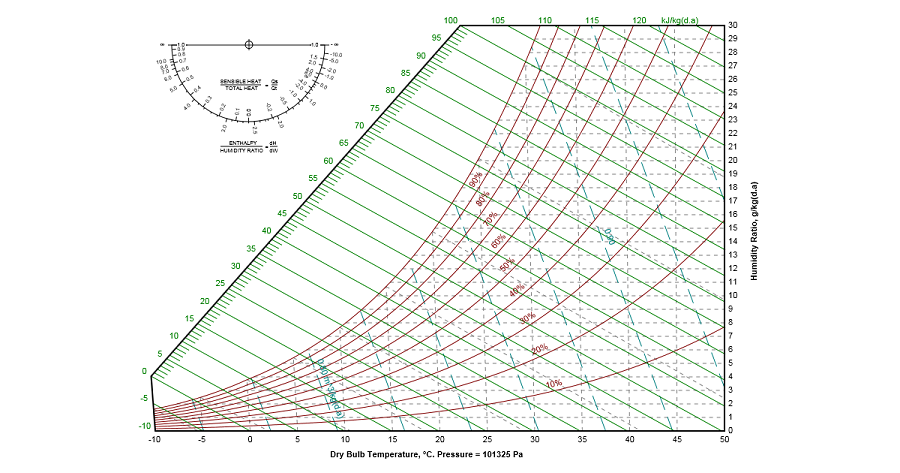
Here's an interactive version:
Online Psychrometric Chart
No idea. Does it matter? We don’t see to have water running down the windows. Always dry washing on the rads. House seems warm and comfortable (1990s detached).
Should I care and go buy a meter?
Bear in mind when comparing humidity readings that most cheap sensors will be for relative humidity which is hugely dependent on temperature.
maybe. Where is all the water from your washing going as it dries? If you keep your whole house very warm, the air can hold a lot of moisture, though it might not “feel” like it. Breathing damp air all the time really isn’t great for health.Does it matter?
Currently 47% in the lounge. Was up just above 60% last week during the heavy rain. Got down into the 30s during the cold snap in mid December.
Above 70% is not good - potential mould problems etc.
54% in the kitchen just now.
Exactly, Zilog, which is why I stated the relative humidity with the temperature above outside temperature.
Houses pretty much always higher absolute humidity inside than the air outside but they are also usually warmer so the relative humidity remains below dew point.
Here in SW France there are days when after a cold period warm humid air arrives and even without rain everything outside goes wet. There are days when it's warmer outside than in and likewise every surface in the house goes damp if I open up to let the warm damp air in.
Ours is terrible. Built in 1902 and then pumped full of inappropriate cavity wall insulation in the 2000’s
We moved out of ours with a similar past. Dread to think how bad the next wave of government-grant-driven schister door-knocking contractors will mess up perfectly good homes with the promise of better insulation.
Insulating the inside of walls with a vapour barrier you can't go far wrong, even with an older property.
@andeh that looks like a useful chart. Couldn’t quite follow your instructions. So say the rh is 70pct and the temperature 18 what is the dew point temperature?
The reason for the question is I’ve got a problem with condensation on new windows - frames not pane, although when really cold it spreads to pane. I think it’s because they’re installed badly and so the frame gets very cold but not really sure how I prove this or get someone to write me a report that agrees with this as the installer can just argue that it’s because humidity is too high.
Should I care and go buy a meter?
Only if you have damp walls and windows and mould building up in places.
If all is dry and good then no need.
According to the nest stat, we hover between 65-68%. It's a 60's bungalow with a central hall that opens onto all rooms, but we always use the bathroom extractor and kitchen extractor.
Occasionally dry washing inside but in a closed room with a dehumidifier. We've got early cavity wall insulation (2 inch disguised holes and it looks chopped fibreglass). No trickle vents in the double glazing.
We get some milk mould in the typical areas prone to condensation (corners of rooms). I tried running the dehumidifier for a week straight recently and although it was pulling about 2 litres a day the overall humidity still hovered above 60%, we are on the brink of buying a PIV system to see if that helps out, and it'll be cheaper to run than the dehumidifier.
Sorry, probably didn't explain very well. Temperature is the bottom axis, then those curved red lines are relative humidity. Find the point which represents the conditions (green marker below) then look horizontally to the left until you reach the 100% RH line (red line and cross below), then the corresponding temp is the dew point (blue line)
18°C and 70% is about 12.5°C dew point.

The reason for the question is I’ve got a problem with condensation on new windows – frames not pane, although when really cold it spreads to pane. I think it’s because they’re installed badly and so the frame gets very cold but not really sure how I prove this or get someone to write me a report that agrees with this as the installer can just argue that it’s because humidity is too high.
Unless they're aluminium, you shouldn't be getting condensation on the frames. Usually the frames (assuming well sealed) should have a higher thermal resistance than the glass. Did you get a spec sheet for the windows? (U-values etc)
70% humidity is maybe a touch higher than it should be (aim between 45%-60%).
Fitted a PIV before Christmas, it certainly seems to have made a difference in the house.
It hasn't totally eliminated condensation on the windows.
I would suggest getting one with a heater as it's noticeably colder on the upstairs landing.
You can program the heater to come on at a certain temperature.
The Tado roomstat is claiming 45% in our house currently.
Late 70's build with dubious 70's cavity wall insulation, air bricks, wall vents, etc!
Thanks @andeh I see now. The Frame is meant to be thermally broken (strip of plastic in between two bits of aluminium) but it clearly isn’t working somehow.
The u value is meant to be 1.2 with triple and 1.5 with double glazed.
What temperature differential should you see inside to out for a given u value? Is it possible to do a calc like that. I guess not as depends how long the temperature differential persists.
Unless they’re aluminium
Ours are aluminium and are soaked as soon as it is cold. Got to keep on top of keeping them wiped otherwise mould builds up quickly. Would a PIV unit help with this?
House generally between 55 and 65 by the way.
@whippersnapper - thermally broken or old school aluminium?
we only get a tiny amount of condensation on windows, only when its below freezing all night, and only in the bedrooms. Modern house (7 years old), fans running pretty silently in all wet locations 24x7, heated moderately, washing air dried inside.
Varies between rooms, low 40s to low 70s. Little bit of condensation on sill in worst room.
What temperature differential should you see inside to out for a given u value? Is it possible to do a calc like that. I guess not as depends how long the temperature differential persists.
It's not really as straightforward as that, the conductive flow of energy is a product of the temperature differential and the conductance. So it changes depending on inside and outside temperatures. You can do a dead simple thermal balance at the surface of the window, but it won't be particularly accurate as U values are given in a few different ways (sometimes average, sometimes centre pane - which isn't really helpful for the frame, in this case). Some quick, possibly incorrect, napkin maths for 6°C out and 18°C in gives me an internal window temp of about 16.5°C, which isn't anywhere near the dew point from earlier. At 0°C outside 18°C inside it still should be >15°C.
Edit: that's for U=1.2
@andeh thanks - that was my thinking if working properly it should not be as cold as the dew point.
Where can I find an expert who could assess this and do me a report? Wouldn’t even know where to start to look!
I'm not entirely sure who you want to look for in the UK, I'm currently retraining in this exact field (building science/sustainable building tech) in Canada, but not sure what the equivalent is back home. Possibly an energy advisor/envelope engineer (the sort of folk who do blower door testing etc) could help, you could maybe try asking the local planning dept. and see if they have any ideas. Sounds like there's a thermal bridge or air leakage in there somewhere, so worth getting sorted, particularly as they're new!
Don't know what the humidity level is in our new house (5 year old bungalow) but it is totally mould free, even in the little shower room. Only condensation we get at times is on the outside of the north facing windows Our old house was a constant cleaning exercise trying to keep the black mould at bay around all the windows and the shower room ceiling. We can't work it out really. Old house was only 25 years old, double glazing, thermolite block etc. Plenty of ventilation.
Moisture traps, those cheap things that look like a britta water filter and take refills are great.
I don't have problems like some of you're having, just occasional condensation but I find the moisture traps work well and make the room feel significantly warmer.
The one in the bedroom collects abour a litre a month, I woke up a bit cold and sweaty the other morning and realised that the refill tablet had run out, it definitely makes the air feel more comfortable and feel 2 or 3 degrees warmer.
Getting hold of one at the moment is another matter as they seem to have sold out everywhere, I bought some refill tablets and made my own plastic drained containers to pit into another couple of rooms.
No issues with condensation anywhere in the house.
Dehumidifier and oil filled rad both put to good use - in workshop/big shed.
The humidity in your house will go up and down depending a little to the weather outside
ours is always relatively stable in high 50’s/ low 60’s. Recently though we have started drying some towels on racks rather than the tumble dryer which means we have some condensation on windows
@whippersnapper – thermally broken or old school aluminium?
@muddyjames I presume old school aluminium. They are double glazed but pretty old. They are definitely broken, not sure about thermally broken 😉
It's damp outside with rain forecast, but humidity is only 46% here according to the cheap gauge I have sitting on my desk. At the height of summer I'll often see <20% which is definitely a dry heat, and not entirely unexpected in Madrid...
Constant 48-53% rh, 21 degrees c and hardly any heating required. A world away from the freezing home with water pouring down the windows that I used to live in. Should be building all new homes to Passive house standard.
I posted on here last week due to a wet wall inside my house which I'd assumed was rain bring driven through single skin brick, but people pointed out that it might well be condensation instead. As the suggested step one was to get a dehumidifier I got a Meaco 20l one.
When I turned it on it was reading in the mid-70s and after having it run constantly for a week I came down this morning to the high 48s and it had automatically turned itself off.
The wall isn't wet any more.
@soundninjauk nice one. Worth monitoring humidity in the house and making sure there is adequate extraction/ventilation particularly in bathrooms and kitchen. It will be the coldest wall in the house and the point where condensation forms first.
ours sits about 75% ish. more in a morning 1900 red brich house with cold floors (air bricks) and cavity wall insulation.
We used to get water running down the walls every morning. Last year we boarded the cold walls with insulated board. Nothing as bad this winter and RH moving towards 65% ish.
we still get enough water in the morning to fill a karcher widowvac (that i got for christmas 🙂 ) from one set of windows and its lifted the paint off the windowsill.
Ive wired the bathroom extractor (that was one of these constant on trickle ones) to be on boost all the time now and that has also helped a lot.
I have a dehumidifier running 9am to 9pm. although this is about 10 years old so maybe its worth replacing?
Before fitting a PIV unit, high 70’s, sometimes into the 80’s. Mould issues and constantly wet windows in winter.
Dried up within days after fitting PIV unit and now I don’t even monitor it.
nice one. Worth monitoring humidity in the house and making sure there is adequate extraction/ventilation particularly in bathrooms and kitchen. It will be the coldest wall in the house and the point where condensation forms first.
Ta! We've got a Nest system and the thermostat is in the kitchen/big open plan family room, plus some protect smoke/CO sensors throughout the house that apparently also measure humidity (including one in the kitchen, and one near the bathroom on the first floor). Currently it's reading inside humidity of 53%, although I forgot to look to see what it was last week before I plugged in the dehumidifier.
The extractor fan in the bathroom has always struck me as a bit weedy (we moved in coming up for a year ago) but as it does seem to do something it's not yet made it to the top of the list to replace. I do have trickle vents open in the window though.
How humid is your house?
Very. We have got on top of the problem now but it was pretty bad. Having the windows open a bit overnight and judicious and targetted use (kitchen, bathroon) of de-humidifier have improved things a lot. I have also fitted a load of lap vents in the loft but not been back up to see if that's made any difference up there. That was worryingly damp up there.
We have a somewhat sprawling bungalow which tend to be the worse for damp and poor ventilation. The main bedroom was pretty damp (at the end of a corridor) I've somewhat sorted this with a meaco dehumidifier and stopping my wife hanging her towel on the rad in there. Also upgraded the extractor in the bathroom and sorted out the temperatures in the house by fitting a wiser system. I run the dehumidifer at 65% which is on the high side, but since the house runs at 16 degrees (otherwise the oil bill is insane) that's actually the same absolute humidity as 45% at 21 degrees. Walls aren't wet and certainly no mould.
We do get condensation on the old aluminum patio windows which is addressed with a karcher vac but long term i need to replace. I would fit a PIV system but the obvious place to put it is tricky as the loft above that area is semi converted. I guess long term i'll fit some kind of MVHR system which is apparently not that hard to do DIY in a bungalow. Short term i'm going to add some trickle vents to the windows.
Nest in the living room says it's currently 34% and 19c. No signs of mould anywhere (70s bungalow)
currently at 49% according to the nest thermostat - its surprising how quickly the humidity changes on a day by day basis, I think its usually somewhere between 45% and 65%.
We do not have a dehumidifier.
We have Tado and I've been tracking this as the windows get very wet in our old stone house with no lack of draughts.
One room was sitting at 85% and no amount of dehumidifying seemed to help at all. Finally tracked it down to a leaking TRV, weeping round the pin and the Tado was damp inside! Swapped the valve itself and room now back in the 50's and Tado still working, luckily. Doh!
I have a condensation issue that ironically is realated to 'good' ventilation. The issue is that in a 60's house we have a ventilation brick in the corner of the room, origionally with no control over the airflow. In the winter this results in cold air blowing along and cooling an internal wall that then suffers condensation and mold. Reducing the ventilation improves things but to prevent condensation I'd need to block it compleatly reducing the ventilation to the house to window trickle vents only. Is there a better solution?
Have you tried making it more diffuse?
Depends alao if you have any extractors and if the combustion appliance that the vent was originally for is still present.
If not, Id just block it up and rely on the trickle vents, but we dont know the other particulars. Are the floors suspended or solid?
Before fitting a PIV unit, high 70’s, sometimes into the 80’s. Mould issues and constantly wet windows in winter.
Dried up within days after fitting PIV unit and now I don’t even monitor it.
^^^ This ^^^
Worst I saw it was 87% we had waterfall windows, black mould in bedrooms, wet walls. I had constant asthma and the carpets felt damp. We still get a little condensation in the windows, which are single glazed Yorkshire Sash, but none of the other issues. It currently reads 44%.
At the same time as fitting the PIV I removed about 36 big bin bags of loft insulation that had been triple layered and also stuffed down into all of the eaves. I possibly removed too much but at the time we had interstitial damp; the insulation was hip deep and when I reached down through it my hand and arm came out wet.
Basically it was so deep that warm air condensed within the fibre rather than allowing evaporation into the loft.
As mentioned above, if I was to fit another I’d buy the heated version as the cold air is noticeable.
It’s not that simple.
Yes I appreciate that, depends on temp etc, but most british houses in winter with 70% RH are going to get condensation issues. I only speak form experience of managing condensation across a range of properties and measuring changes in internal vs external RH as fans function and heating comes on etc.
thats a point. keep your house at 21deg and 70% RH is a lot more moisture content than if you keep it at 18deg.
dewpoint at 18deg/70% is about 12.5 deg.
Just a mild warning about PIVs and humidity. If you're forcing new air into a building, without a balanced extraction, that old hot, damp air has to go somewhere. If you've got air bricks/vents etc, it shouldn't be an issue as it'll vent that way, but it can force it's way into walls/ceilings/floors, cool, and condense on surfaces, causing internal damp and potential for mould or moisture issues. Even a small pressure differential can cause a large air flow.
Often it's a good idea to have a balanced, or close to balanced, incoming/outgoing ventilator (ideally with heat recovery) to avoid this...but they can be much more expensive, so initially less appealing. Essentially, make sure you've at least got a path for the air to vent through.
I possibly removed too much but at the time we had interstitial damp; the insulation was hip deep and when I reached down through it my hand and arm came out wet.
Basically it was so deep that warm air condensed within the fibre rather than allowing evaporation into the loft.
So what's needed there is a vapour barrier at the base of the insulation and no vapour barriers within the stack of insulation. Once you have a vapour barrier moisture can't get into the insulation from teh house and even a tiny temperature gradient though the insulation will eventually dry it out and prevent it getting wet again.
Often it’s a good idea to have a balanced, or close to balanced, incoming/outgoing ventilator (ideally with heat recovery) to avoid this…but they can be much more expensive, so initially less appealing. Essentially, make sure you’ve at least got a path for the air to vent through.
I thought this also, but having fitted six in various houses this year, all they have is trickle vents, bathroom/kitchen extract fans. Has made huge differences across the board. We fitted them a some problem properties about 10-15 years ago and they fixed all issues. However the recent ones are all due to the no heating, and wet relatively warm weather.