 You don't need to be an 'investor' to invest in Singletrack: 6 days left: 95% of target - Find out more
Laying some beading today - generally nae bother but I've got two small convex curved walls to deal with. Tried to place cuts along the back of the beading but it did next to nothing - barely moved at all. The beading is 21 x 21 pine scotia.
Any ideas? Is there a technique to cutting the back that would make a difference, or maybe try something else? Cheers.
Think you're going to struggle to bend it with cuts into the back to be honest. Maybe try steaming it?
Soak it in water then leave it in a bent position, increasing the bend over a period of time.
There are various ways of keeping it bent - use your ingenuity !
Depends upon your radius, however 21 x 21 pine will be pretty bendy.
Presumably you've fixed one end and tried to bend it around the radius? The problem you might face is the scotia twisting as you do, in which case DD above has it.
Best way to achieve this, rather than build yourself a steamer for a one off job, will be to wrap teatowels around the length of bead and pour boiling water over them. Do this a fair few times until the bead is nice and flexible. You'll probably only need to apply the hot water soaked tea towels to the central part.
Then fix one end and leaving your bead overlong, bend it gently around the curve, pinning as you go, cutting to required length as you ease it around fully.
Dont forget to pilot drill your pin holes....
How tight are the curves?
Soaking the beading in boiling water for a while might help, but I'd still say you'd need to remove some material from the back.
I think the OP's problem with scotia, is that with it being an internally curved moulding, it's quite a faff trying to remove material from the back. 21x21 is chunky enough too when it comes to bending it. I like slackalice's suggestion above. A lot of messing for a bit of beading. 🙂 Is it too late for the OP to go for 18mm?
Thanks for the tips - I'll try the steaming method. Curve is relatively small, radius would be approx 10 cm, so nothing elaborate.
radius would be approx 10 cm, so nothing elaborate.
nearly small enough to mitre then 😉
jeez thats tight. Do you have a pressure cooker? I'd have thought you could put just the curve in the cooker - you're going to need a lot of heat and moisture to get 21mm x 21 mm to bend through that.Thanks for the tips - I'll try the steaming method. Curve is relatively small, radius would be approx 10 cm, so nothing elaborate.
Can you laminate it ?
Cut the beading in to three 7mm strips, then bend them individually.
You may need to cut each length of laminate from two lengths of beading to allow for wastage from the saw cuts.
Something like this...
[img] 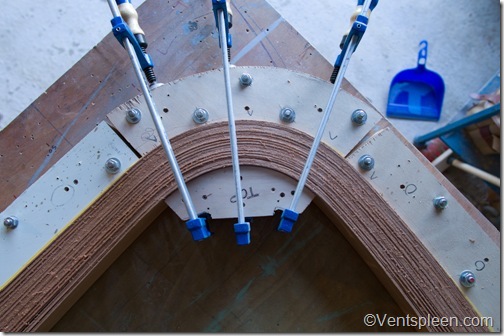 [/img]
As above really..but the fact your using finished pine suggests you're not painting it afterwards otherwise laminate, fill, sand, paint. Alternatively cut from a plank/ block of pine 21mm x say 150mm.
What tymbian said.
Have you got a router ? If so, machine it from solid with one of these and a jig.
[img] https://encrypted-tbn1.gstatic.com/images?q=tbn:ANd9GcQBfAoANkS9oEVbg3GtuywVvv2_pr5d4lz37-pN31_oSe-y2y-S [/img]
I'd mitre it.
I think this is turning into a much bigger job than the OP thought. 🙂
I take it this bit of 7/8" scotia is on the floor covering the gap at the edge of some laminated flooring or such like ?
Well since no one will be standing staring at it for prolonged periods of time I would stop fussing and just take the scotia round the 100mm radius curve with several bastard mitres. Job done.
Not 100% on my terminology - what does mitre mean here? Like cut several small pieces, say 1 inch, at appropriate angles and lay them around the curve with filling as required?
That sounds OK, one of the curves is behind the couch 🙂
There's no way I have the skills or tools to laminate the scotia into 3 bits. I think even if you did it would be quite difficult given the profile of it.
ernie's method, with some filler and a bit of careful sanding would most probably look just fine.
Mitre is to just cut 'chunks' (technical term) of the bead at angles that allow it to go round the corner without leaving large gaps at the top. Use several small pieces and shallow angle cuts and you'll be fine.
Not 100% on my terminology - what does mitre mean here? Like cut several small pieces, say 1 inch, at appropriate angles and lay them around the curve with filling as required?
You got it !
BTW (since your not 100% on terminology) a bastard mitre is one which does not create a 90 degree angle, I wasn't being crude 🙂
EDIT : It's occurred to me that you might not know how to calculate the angle for a bastard mitre, see if this helps :
[img] 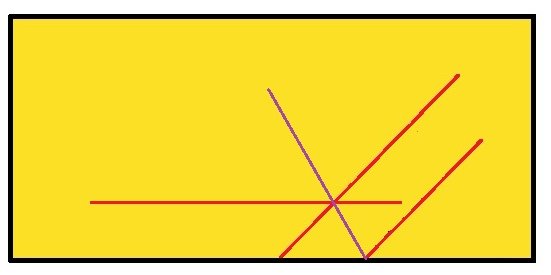 [/img]
Draw those red lines on the floor using a parallel piece of wood (2x1 or 4x1 or whatever) the purple line is your angle. In the case of a curve just play around until you are satisfied with the route that your scotia follows the curve.