 You don't need to be an 'investor' to invest in Singletrack: 6 days left: 95% of target - Find out more
A little bit of background information;
I live in a wooden bungalow. It was originally built as a holiday home, but I've been here so long I've got the right to live in it permanently. Some others round here have got an 11 month occupancy limit.
There are some strange rules governing what repairs and alterations I can do.
I am allowed to clad it, with a self supporting cladding extending up to 300mm from the existing walls.
I can extend the existing roof to cover this cladding, but I can't build a new roof supported by the cladding.
So, the plan is to build a brick plinth up to ground level with timber walls on top.
The problem is that the site slopes and the floor is level with the outside ground at the back.
Here's a sketch of what's there and my idea for getting round the problem of water running in to the kitchen when it rains.
[img] 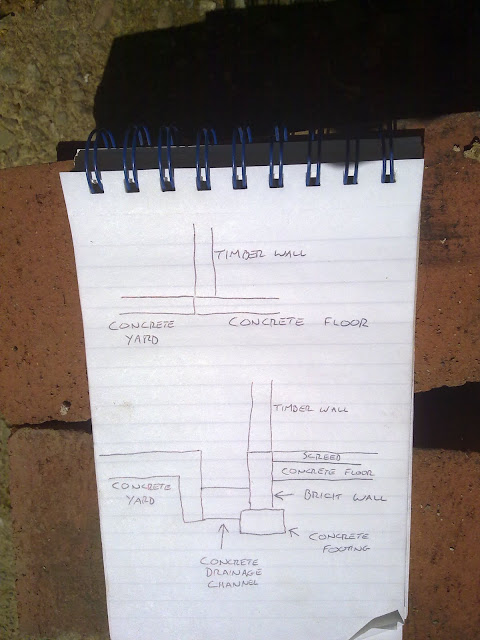 [/img]
Here's what it looks like at the moment. I've got a moat and a draw bridge. 😀
[img] 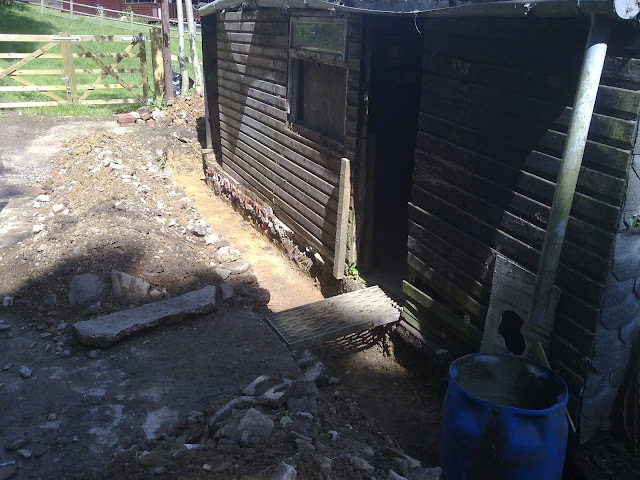 [/img]
Any more knowledgeable opinions on my idea ?
Is that the best way to do it ?
The plan is build a brick wall up to 25mm above the existing floor.
Screed the existing concrete floor to level it. What's the minimum depth for a screed ?
Concrete the base of the channel with a slight fall from the middle outwards.
Make good the concrete yard up to the new channel.
Damp proofing is the next big question.
Would a layer of DPC between the bricks and timber be adequate ?
I know I should ideally have damp proofing under the floor, but I reckon keeping the wood dry is the most important. As it is now, the kitchen floor regularly floods, but soon dries out again.
I will need to fix the timber through the DPC to the bricks. Can I just squirt some sealant down the holes first before putting the screws in to keep it water tight ?
so you want to take down the existing timber structure, chisel 225mm of fhte edge of the concrete slab and build a brick plinth around hte house? seems alot of work.
why dont you just put aco drainage channels along hte back of the property to drain to whereever the roof drains to? This will prevent water getting to the timber cladding. (essentially this will be a posh version of your moat)
if you want to screed the floor without it cracking i think the minimum thickness is around 50mm with 75mm desireable.
you want to lay the screed on a damp membrane and bring this up over the plinth. or up behind the timber cladding if you do away with the plinth.
Not wanting to dampen your bonfire, but if you're proposing that much work Building Control may take an interest and want you to comply with all sorts of Building Regulations. Might be worth a "hypothetical" chat with them first. Or just don't tell them 😉
Step-free thresholds are pretty commonplace now - you want a waterbar to reduce water ingress at the door threshold. But anyway, as Vanhalen says put an aco all the way round and drain it to [somewhere else].
I think you would be advised to think further about your cladding methods and new brick wall + screed.
There are loads of thin screeds available but surely you'll want insulation/ dpc etc etc too?
Are they the drawings you submitted for planning 😆
But seriously as asked above are you taking down the existing cladding or building out from it, i couldn't quite work that out, if so how'd you plan to do the roof? By extending the rafters which, Is the obvious way you're going to bring your soffit height below the top of the window shown in that picture.
I think, as above, being allowed to do stuff according to your lease/deeds isn't the same as being allowed to do them from a planning/building regulations point of view.
Installing drainage as above is the easiest solution to the runoff issue but I'd check ont he rest.
Sorry, that wasn't a very good sketch this is a bit more like it.
[img]  [/img]
I should have explained that I am not allowed to take down the existing walls, only to clad them, although the cladding can be self supporting on a brick dwarf wall.
This is nothing to do with a lease or deeds, it's the local council's rules. There's a bit of information [url= http://apps.wyreforestdc.gov.uk/wfdc_html/planning/local_plan/index.htm ]here[/url] if you click on "Chalets" on the left, although I only got the information about cladding and so on verbally from the planning department.
I thought about an Aco drain, but if I lay that directly up against my brick or block plinth, that means the timber will be right down to ground level. I just thought it would be better to keep the timber at least 150mm above ground level by artificially lowering it with a moat.
That back wall is a bit low anyway where the roof slopes down to it. What I'll probably do is move the door to an end wall where the roof is a bit higher.
Most of the bungalows around here have been altered or extended in some way. Nobody seems to be all that bothered by building regulations or planning permission. I seem to be the odd one out by actually going to the planning office and asking what the rules are.
You'll also need to think about how the new cladding works - is it rainscreen cladding? Also the way that your existing opening - ie doors & windows work and how the SVP and waste outlets fit too.
Then I'd definately go for the new wall etc, but why put the timber direct to the floor, what's to stop you installing one brick above damp then going with timber, 75 mm will still be plenty of clearance if you then put an aco at damp level. We've even done scenarios in the past where you put an edging all the way round say 100mm off face brickwork at damp level, install a channel yard side and then fill the 100 mm gap with a nice gravel etc.Everything we build now has to have level access at some point for disabled entry with low rise thresholds. Also your proposed gap will keep good ventilation, which you could also insulate with a rigid board stuck to the existing cladding. Still doesn't cover the issue of dropping your eaves level though.
the wall as shown will undermine the floor slab where the existing wall timbers sit - this is not a great idea given the slab might not even be reinforced if they are ex holiday chalets.
the aco channel will offer that 'reduced ground' protection while not being as obvious as the moat.
It's not rainscreen cladding, I'm just using the word "cladding" as that's what the planning department call it. It will be a self supporting timber framework with either shiplap or T&G on the outside.
The eaves height is a bit of a problem. If I move the door,like I said, and put kitchen cupboards and worktop against that wall, I will just about have enough headroom further in to the room where the roof is higher.
There does seem to be a big difference around here with what the planning rules allow and what people get away with.
I can "clad" my walls, but I can't take the existing walls down afterwards.
I can extend my existing roof over the cladding, but I can't support the roof on the cladding.
I think my best bet is to build the cladding, then repair the inner walls by using the cladding to support them, then build a new roof supported by the now reinforced existing walls.
Van Halen, I've already dug the trench and undermined the existing wall and floor. It hasn't fallen down yet. 😀
I'll take some more pictures tomorrow to show just how bad the existing timberwork is. It's a wonder the whole place hasn't fallen down on it's own without me disturbing it.
For some reason, I had an idea that a DPC had to be at least 150mm above ground level, which is why I went for the moat idea.
what you're all suggesting is something more like this.
[img] 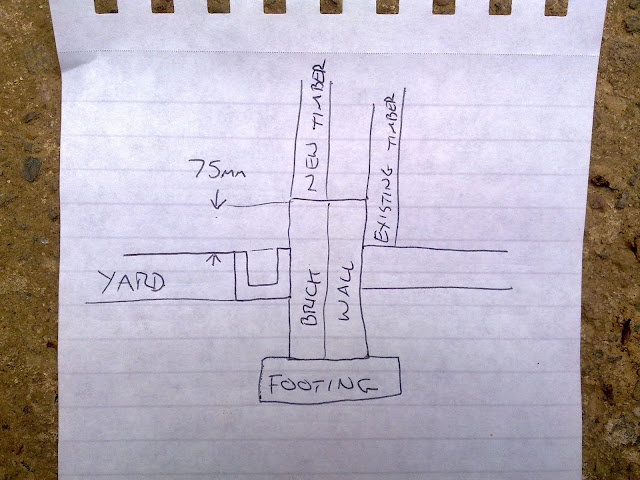 [/img]
Or possibly even do away with the 75mm brickwork above ground level and bring the timber right down to meet the Aco drain so I can have a flush threshold ?
I just had a thought.
If I'm not putting a door in the back wall where the floor is at ground level, I can build the wall two bricks or 150mm above ground/floor level and just step it down to floor level where the new door goes on the side wall where the ground slopes down lower.
Yep standard practice is 150 below damp and then slope up to door ways, there's
loads of options, you seem pretty advanced in the way your doing it and it is a plausible method. I'd definately put the timber frame on one course tho. Keep the timber flush with face of brickwork then you can always clad say half the brick. Whichever method you do choose tho, be careful when fixing the timber to the bricks because the faces will want to burst off when you fix down. Might be an idea to use a non expandable method such as threaded bar and resin. Best of luck getting out on the bike this summer btw 🙄
Have you thought of jacking the whole structure up about a foot?
I lived in Queensland where many houses are on stumps (stilts). Want more room? - jack up the house and put in taller stumps to get a large underhouse storage area. Getting too old to manage the stairs? - lower the house.
A wooden house doesn't weigh much. The job can be done with car jacks. (I've done this 3 times on my own).
One of the planning restrictions is that I can't raise the roof. It's barely standing as it is, any attempt to jack it up would probably end up with the whole lot toppling over anyway.
I'd thought about fixing the timber down to the brickwork.
How big a hole would I need for resin anchors ? I'm guessing even M8 studding would need a 12mm hole.
I reckon the vibration of drilling a 12mm hole with an SDS drill would be more likely to split a brick than the expansive force of a 7mm rawl plug and screw.
I was thinking of using coping bricks on the top course, the ones with the sloping face. If I make the top course all headers, I'll be drilling more or less in to the centre of each brick, so I don't think there's too much risk of them splitting.
The only problem is that coping bricks are £1.80 each. By using headers I'll need twice as many.