 You don't need to be an 'investor' to invest in Singletrack: 6 days left: 95% of target - Find out more
According to a quick Google the breaking strain of 1mm gear cable is 70-80kg approx. As far as I can see, the nipples are just melted blobs added onto the end of the cable.
Does anyone know if the nipples will pull off the cables before the cable snaps?
I am thinking of using some black 1mm gear cables on my floating chair but if I support the chair on 2 - 3 cables based on that being enough to cover a proper fat bloke, I don't want my nipples being ripped off because they fail at 30kg or something.
Funny enough I am cautious about googling for nipple ripping related stuff on the family computer.
Advice welcome
I don't know how you intend to fix thehother end of the cable but whatever method you choose it will weaken the cable more than the nipple.
The strngth of the nipple depends on its length, the longer the stronger. I can't remember the multiple of the cable diameter needed but if it's respected there's next to no loss of strength.
Drill a small hole through a bit of metal, thread it through and attach it to a ceiling. Then pull on the other end using your bodyweight, a handle or something to clamp onto it (molegrips?) might be handy. See if it snaps! Don't forget to video it as proof it does hold.
Don't forget for a chair it's the dynamic load of a fat person plonking themselves on it that matters, not the static load.
I can't see a gear cable being very durable, even with 2 or 3.
You could rig up a test. Drop a 50kg load a few cm onto a gear cable and see what happens.
Don’t forget for a chair it’s the dynamic load of a fat person plonking themselves on it that matters, not the static load.
and you want the safe work load, not the load the cable fails at. The SWL would typically only be about a third of the breaking strain.
I'd use brake cables.
Have a play about with brake/gear cables, <span style="font-size: 0.8rem;">then when I’m next actually at home, if they prove too weak I’ll bring you some 3mm stainless cable and swages with our hydraulic swager. Bolt those to the thing via some decent clevises and that should be plenty to take the weight. </span>
Mattbee - I might take you up on that after I have died the first time.
The idea is to have as thin as possible so they don't look like they will work but mysteriously do. Brake cables should be fine at about 1.5mm I guess if I spray them black so they don't show too much.
I tried looping a gear cable over a rafter and lifting myself but gave up when the cable was cutting into my hand and I hadn't left the ground.
Not sure quite how I plan to fix the none nipple end. My first thoughts are to have the nipple captive in the bottom half of the contraption with the cable threaded through a small hole. At the top end the cable will be wrapped around a metal peg a few times and then secured. That should mean that the loops of cable take the main strain and not the fixing.
I learnt the difference between static weight bearing and impact load bearing as a kid when I made a rope swing across a disused quarry as a bet that I could swing from one side to the other. The only way it was possible was to fix the swing to a branch way out over the edge of the big drop and then take a running jump and hope you caught the handle. I did and carried it with me all the way to the quarry floor when the rope snapped. A very interesting conversation in A&E with a retired physics teacher* explained my mistake.
*He also said he always wanted to find someone about to jump off a building as a suicide attempt purely to use his one 'physics' joke. "Don't jump, you have such potential". Fortunately I was doing A level physics at the time so actually got the joke and laughed
get the gear/brake cables that have a nipple each end. (campag/shamino for gear, road/MTB for brake)
Think Clark do/did them, might still have some kicking about.
[i] cables that have a nipple each end[/i]
Probably a sod to adjust to the length required
I should have time next weekend to grab some bits from work for you and bring round.
Can always bring the pull tester and bridge round for you to try different fixings etc out; it is capable of putting up to 40kn of pulling force through something so would give you the confidence that whatever you use is capable of providing sufficient strength.
You can get slightly thicker bowden cables around 2 to 3 mm used on things like older motorcycle brake cables or car choke cables, and solderless nipples for adjusting the length to secure (little bolts in them).
You could consider using Dyneema cord rather than wire. Breaking load of 1.5mm Dyneema is stated as 110kg. No need for nipples, just tie a stopper knot. And you can buy it in black.
My current thinking is to have perhaps 3 decent thickness cables holding the weight, shown in black on this high-tech CAD diagram, and then some lots of silly thin cables around the edge weaving each direction to provide the stabilising effect, shown in blue.
The black cables, although thicker, won't show as much and the multiple thin cables will distract people as the think they are far too weak to support my athletic body.
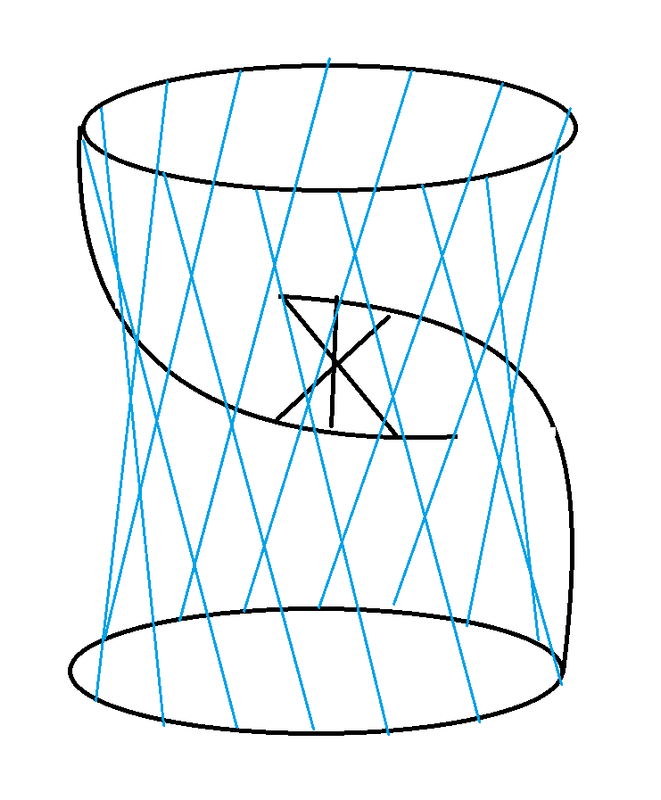
Not sure quite how I plan to fix the none nipple end
Think about they are secured on your bike.
The clamps on you bike significantly weaken the cable. Nipples are best, swaging the next best IIRC.
That picture looks dodgy as. I take it that the weight of the top part is supported by the black cables, and all the blue cables are to prevent rotation? It looks like it would rotate quite easily. It is late and I’m tired, I could be hugely mistaken.
Concerning that no one has popped up to say something along lines of I did that no problem!
Have you considered clear high strength fishing line? Stronger than brake cables Think they have clamping crimps for the real big stuff?
In 1 week, OP username will check out
[i]Have you considered clear high strength fishing line? [/i]
I had assumed it would be weaker than cables and suffer solar degradation.
I used a length of gear cable and an old handlebar to lift/heave a clothes airer spike out of the lawn. Not sure about force but it took pretty much all my leg strength. Multiple loops of cable though
I used an electrical choc block to connect the cable (like a poor mans swage).