 You don't need to be an 'investor' to invest in Singletrack: 6 days left: 95% of target - Find out more
Our kitchen has a reasonably sized bit of tongue and groove cladding, which we'd like to cover to so it can be painted to look like a 'normal' wall. What's the easiest way to do it? I'm thinking that thin ply/mdf over the top would do most of the hard work, but how do you deal with the joins, skim it with plaster? Or can we just skim straight over the tongue and groove?
Ideas please, hopefully the new fancy image upload will allow me to add a picture...
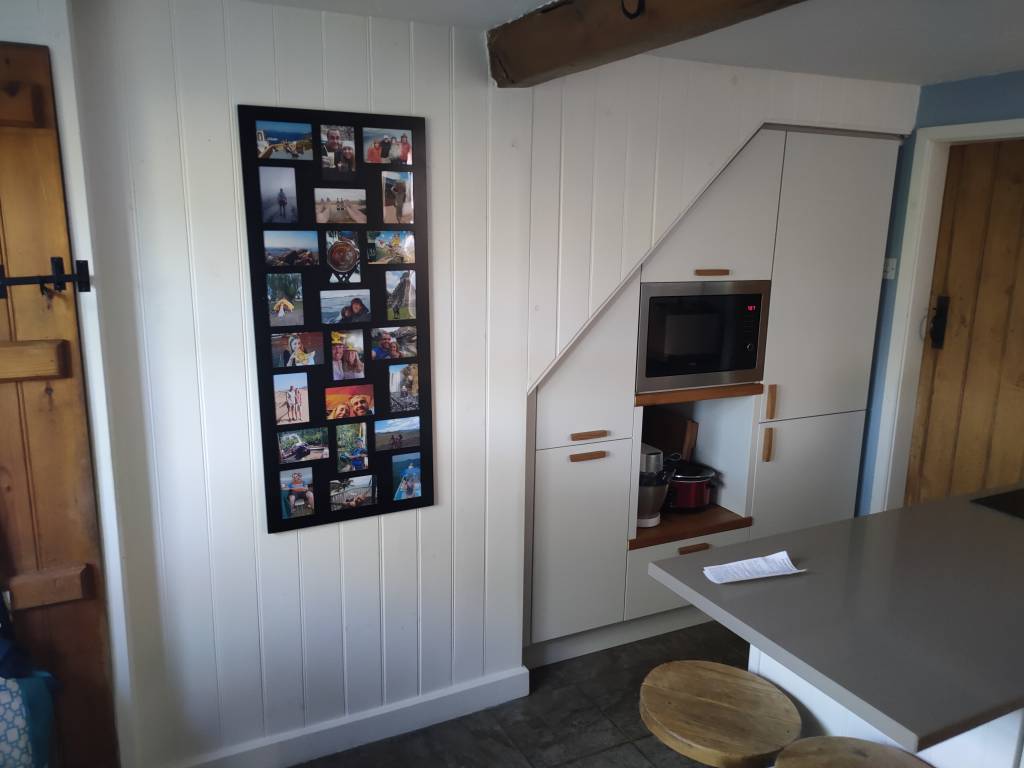
ooh, it worked
Is there a proper wall underneath?
We just ripped the cladding off the kitchen wall when we moved into our place.
If you are thinking of having it skimmed anyway then do it properly and take if off and re-plaster the wall.
Is it old? Looks like it might be. If so i would leave it as adding to the character
You can just paint it with emulsion if you want or you could rip it out and plaster the wall or just put plasterboard over the top of it taper edge boards and scrim and fill the joins but then the skirtings might look odd
IIRC plaster does not stick properly to wood so ply is a non starter as the edges will be visible - filler might work on ply edges. but I suspect they would crack
Agree with all of the above – rip it off and start again. If you really don't want to do that, then don't use ply or mdf – batten it and cover with plasterboard, properly seal all edges with tape then skim over. Anything else would inevitably look like a bodge-job.
TBH, if it were me, I'd just sand it all down and tidy up as required then repaint it – I quite like the look of it in that setting.
However, I do wonder if it was initially installed to hide what might be going on behind (ie, damp). I know I considered doing very similar myself when I had a house with a damp problem.
If you try to use wood and plaster it will crack along the joins as they expand at different ratios
Best option is to strip back to original wall and replaster
Batton / plasterboard will loose you a few inches and mean the skirting and architrave will need redoing. plus if the room is small it will make it a little smaller. One benefit is its easy to run cables / pipes in the voids if you are looking to do other work at the same time.
It is old, and I'm reluctant to take it off both from a mess perspective and to avoid uncovering whatever horrors it's currently hiding (experience in this house suggests "if it ain't broke, don't fix it" is a good mantra).
Batton / plasterboard will loose you a few inches and mean the skirting and architrave will need redoing.
How many inches (ish)? The only skirting is the small section you can see, and the archtrave to the door on the left is pretty deep anyway.
Old? Leave it then. just paint it with emulsion if you want to blend it in with the rest of the room.
If you're getting a plasterer in anyway to skim over it, the mess is already happening.
Painted ply/mdf will still not 'quite' look like a normal wall.
Just strip it all off. Morning's job at most, then reskim the wall.
As above, if it really is just cladding, rip it off. If it is the wall, leave as is.
If you try to use wood and plaster it will crack along the joins as they expand at different ratios
Can confirm, neighbours house has done this, TnG walls on old houses move quite a bit.
Either strip back and plaster/plaster board on the original wall, or clean it up properly and repaint.
well you could probably get away with 12.5mm plasterboard and battons are usually 25mm so say 4cm with a skim coat (I am not a builder !)
stripping will be bloody messy. prepare for dust. everywhere.
Anything involving plaster is likely to result in some collateral damage to floor, kitchen units, pine doors etc.
IMO if you're 'redoing' the whole kitchen then you could rip it off and dry line the wall with dry lining plasterboard but wouldn't be essential.
If not sand it down and put some good quality paint on. It is expensive (£50+) a tin but we've found that the Farrow and Ball modern emulsion (not the chalky one) is tough and wipeable for kitchen and bathroom as well as having a flat finish (yes I know you can get colour mixed etc. etc. but for the sake of £30 extra we just paid up).
Also IMO the cladding fits well with the other aesthetics of your kitchen and house, based on the one picture, with period features etc. I think it looks good and not out of place. Old houses are never going to be all clean modern lines and so embrace that as it shows love for the place.
stripping will be bloody messy. prepare for dust. everywhere.
I wouldn't have thought it would be that messy – yes there will be dust, but if it's removed carefully, it'd be quite minimal (ie, systematically removing it piece-by-piece, rather than just going all 'Hulk' on it and attacking it with a lump-hammer).
How old is the house? Ours was built in 1912
my one experience is that when I tried to remove very similar cladding from a wall that it had old lime plaster behind it that someone quite a while ago had obviously put the cladding there to hide and as with all the plaster in the house it all came away in one or two lumps and a whole load of dust as soon as I touched it.
+1 on I actually like it, it looks in keeping with what I can see of the rest of the room, I'd keep it.
if you're really for covering it, I'd expect horizontal battens on the wall behind it, can you see lines of nail holes and / or locate supports by tapping? If so, perhaps just screw up plasterboard through the T&G into the existing battens? That way you'd only lose ~15mm of room, which looks like it would even work with the existing skirting. Some edge trim round the recess and you could just fill the screw heads and tape/fill the joins (use taper-edge plasterboard for this to work properly).
I'm with the posters who suggest a bit of sanding and painting.
Anything else, once you've started, you'll be at it until the whole lot of T&G is stripped, and probably the existing old plaster underneath, and the wall is replastered, and the skirting and architrave removed and replaced because they no longer fit, and the whole lot repainted.
Looks similar to our house. Is there a staircase behind? That adds to the movement issues. Keep it it looks nice.
I'm in the "keep it - it suits the style of the room" camp. Life is too short for the pain involved in either trying to conceal it or remove and replaster it, although I realise that "which we’d like to cover" implies there is at least one more person to convince.
Cheers all. After a conflab with MrsIHN we've decided to keep it and paint it. f it looks rubbish we can always look at replastering in the future.
*chuckles* at the “dust will be minimal if your careful” comment.
old plaster creates loads of mess. Once you start stripping that t&g off it’ll distingrate and the plaster behind will go everywhere. Doesn’t matter how careful you are. If it’s there it’ll crumble and make a right mess
Yeah, I'd keep it..... the cupboards under the stairs on the other hand ....... 😉
We have a wall in our dining room which was the same, I covered it in 9mm plasterboard and had it skimmed. That was 20+ years ago and it's been fine ever since. Looks much better for it.
I really like the cladding - it has a bit of character and compliments the rest of the room.
Those fitted cupboards on the alcove are really nice and neat too.
Nice kitchen
To answer some of the questions
Is there a staircase behind? That adds to the movement issues.
Yup
How old is the house? Ours was built in 1912
Don't know exactly, but this bit is the oldest bit, and could be 17th century
Yeah, I’d keep it….. the cupboards under the stairs on the other hand ……. 😉
Don't you start.
And don't worry about the hours of debating paint colours, tester pots etc. Just think of the time and money saved on plaster, plasterers and sorting out the rest of the mess. It doesn't feel like that at the time though 🙂
Pull the cladding off and there's probably battens underneath for the T&G. They might (wishful thinking) even be at a useable spacing for plasterboard.
Or just sand and paint with normal emulsion paint so it blends with the rest of the walls.
To all the 'rip it off'
Rip it off and discover the framework its pinned on to, and the horrific state of the wall under that,
Just skimming it with plaster might result in cracking as the wood moves seasonally, and you'd probably need to heavily sand it first to provide a key
You could overlay it in gyproc, but if you use ply, make it 12mm as a minimum because if you go too thin, the pins can punch in around the nailed area and make it look bumpy. Overfill any joins in 2 pack filer and sand back