 You don't need to be an 'investor' to invest in Singletrack: 6 days left: 95% of target - Find out more
Not a lot they could of done apart from drop an anchor.
The anchor is to stop a stationary boat from moving, not as a brake. Dropping it would either snap the chain or rip out part of the anchor handling mechanism.
Selling preventative engineering is hard work,
I can imagine.
In my field, obsolete kit is problematic. It's a security risk and if it goes bang tomorrow then we're screwed because manufacturer support is long gone. I used to harangue Sales to try and get customers to upgrade, they'd say the customer attitude was almost always "but why should we spend tens of thousands when what we already have just works?" And it's a fair argument, everything works... right up until the day it doesn't.
No it's not.
It is also used as an emergency brake.
That's why a ship's crew will clear away anchors, when arriving or departing a port, removing all the fastenings that are used to secure them at sea, then have a couple of crew members with a radio standing by to drop them quickly in an emergency.
Dropping a large ships anchor straight from the hawse pipe is not for the faint hearted and it puts loads of strain on the equipment but it is designed to be used like that if really necessary. It's not a routine operation.
There is an old saying "never go aground with your anchors in the pipes".
I'm guessing making those supports bigger and stringer would make the space between them even narrower. Which was probably all fine when the bridge was built but not now that ships have grown so massive.
@gobuchul the Chinese barge took out a section of the bridge with similar results. Was just pointing out it's not long since a very similar incident happened.
Dropping a large ships anchor straight from the hawse pipe is not for the faint hearted and it puts loads of strain on the equipment but it is designed to be used like that if really necessary. It’s not a routine operation.
Sounds like they got to test this on the Dali but it didn't stop them. Im guessing it could have even contributed to the incident pulling them further off course.
It could of easily put them further off course but that might of made things better, ie aground but not hitting the bridge or not hitting it as hard.
I can't see what action they could of took that would of made things worse?
I thought this was an interesting read.
https://twitter.com/cybergibbons/status/1772564868974915633
https://threadreaderapp.com/thread/1772564868974915633.html
Sounds like they got to test this on the Dali but it didn’t stop them. Im guessing it could have even contributed to the incident pulling them further off course.
How would it have done that? A ship swings round it's anchor, if it was caught it would have turned on it. Even if it was dragging it would swing. Probably, that's certainly the picture of the dynamics I have in my head.
I wasn't a deckie so have no idea what the procedure is but it could well have still been taking up slack in the chain when it hit. It if it was launched then the chain would have just flown out the locker until it hit the end. They're long buggers.
It takes time for an anchor to bite (and that varies significantly depending on what the seabed is like) and then it also takes time for the massive chain to pull tight*. There might not have been anyone near the mechanism to actually drop it too, so (especially on something that size) add in more time for that too.
Safe guess is that the current (and possibly wind as even in calm conditions these things are huge sails) took them towards the bridge and the anchor was too little too late
*in normal use the chain would be fairly relaxed sitting on the bottom and actually doing a lot of the work
That video above on twitter/X/whatever looks like the ship was starting to initiate a turn under the bridge when it lost power. Assume this locked the rudder etc so the turn continued, past the point it should be straightening up. Power came back on, everything fired up, tried to correct it but too late and then the power went again...
@daveyboywonder read Cougars thread link, it explains it all. They would still have had emergency power but only once the blackout generator kicked in.
I'm amazed this doesn't happen more often. The sheer volume of worldwide shipping and state of some boats is asking for trouble.
Also, you have to appreciate big ships can take a mile or so to stop!
Dropping an anchor like that, is an action of last resort.
You wouldn't be keen to do it, it puts crew and equipment at risk.
I doubt anyone would make that call when the ship first blacked out, you expect the back up systems to restore power.
If you did it and the power came back on, then you would have very little control of the ship and the anchor would be controlling your movement.
By the time they made the call it was too late.
The Tay road bridge protection is detailed at https://www.icevirtuallibrary.com/doi/full/10.1680/bren.13.00010 - it only covers the main navigational channel which wouldn't have helped when at out of control tanker tried to take it out in 1983 ( https://www.reddit.com/r/dundee/comments/pdq2x8/tay_road_bridge_almost_hit_by_700_foot_oil_tanker/ and https://www.thecourier.co.uk/fp/past-times/2515193/oil-tanker-tay-bridge/).
Somewhat ironically, Perth Harbour was losing so much money it looks set for closure, and there is not a huge amount of traffic heading under the bridge anymore - the Dundee docks are before the bridge.
@jca
Thanks for posting,I had never heard that story before.
A proper near miss😲
in normal use the chain would be fairly relaxed sitting on the bottom and actually doing a lot of the work
This. Most people think that it's the anchor that holds a boat in position, but a lot of the work is done by the chain, which also means that a certain amount of chain needs to be let out for it to work.
Anyone thinking an anchor, even dug into clay, is going to stop a 90,000 ton ship travelling at about 14kph in short order is going to be very disappointed!
Anyone thinking an anchor, even dug into clay, is going to stop a 90,000 ton ship travelling at about 14kph in short order is going to be very disappointed!
Yeah, but they could have used it to change direction...
It wasn’t clear earlier in the day but fortunately they did manage to stop traffic before the collapse.
Yep, pretty much confirmed that the boat sent a mayday and the bridge authorities were able to stop traffic. Slightly less confirmed is whether all the traffic was off the bridge, but seems fairly likely that it was the maintenance teams on the bridge that were caught- big bridge, not quick for people on foot to get off it.
This seems pretty informative https://www.youtube.com/v/N39w6aQFKSQ
Video embed is no longer working "MV Dali Hitting Key Bridge in Baltimore - Track and Video Analysis"
As for pier protection, can anyone provide examples on bridges which span major shipping channels?

This is the newest of the two Severn Bridges, you can easily see the size of the caissons holding the supporting towers, and as the tide is out, how narrow the main channel is. The biggest ships negotiating the channel are car transport ships and container ships going into Avonmouth and Royal Portbury Docks, which may not be quite as big as the ship involved with the Baltimore collision, but the Severn and Bristol Channel are very difficult to navigate and very dangerous - it has the second highest tidal range in the world at 48 ft/15 m, it’s the longest river in Great Britain and has the greatest voluminous flow of any river in England and Wales by far 107 m3/3800 cu ft/sec.
It’s at this point the Severn becomes the Bristol Channel.
AFAIK, there’s only ever been one accident involving a bridge over the Severn, when two river barges collided in 1960 and hit the Severn Railway Bridge between Sharpness and Lydney, causing two spans to collapse into the river. Repair work was under consideration the following year when another similar accident occurred, so the bridge was demolished between 1967 and 1970.
I don't think the channel upstream of Avonmouth (and downstream of the bridge) is deep enough for the container ships to drift up as far as the bridge if one broke down entering or leaving the docks.
Here’s the first of the modern Severn Bridges, the caissons are a similar size, but the construction was unique, the decision was taken to use a completely new design and technique, it opened in 1966, and my dad took me down to Aust Ferry to see the bridge under construction.
There’s a footpath and cycle path across the bridge, and it’s well worth walking or riding across and back, especially when the tide’s on the run - you really get to see how powerful it is, and how dangerous, because of the large expanses of rock on both sides.

Forth Road Bridge a few months back. Shipping channel beyond the tower.
https://www.geograph.org.uk/photo/7658730
By coincidence, I’m watching ‘Saving Lives At Sea’, and there’s a converted Dutch barge with engine failure drifting in the main channel of the Severn heading directly towards the Prince of Wales bridge at full flood tide, the barge is about 30 tonnes and a lot bigger than the inflatable life boat! They ended up having a Port of Bristol dredger take over the tow, the lifeboat was doing 1.1 kts into the tide, which gives an idea of how fast the tide flows, and how fast shit really does happen!
An aside - from the BBC
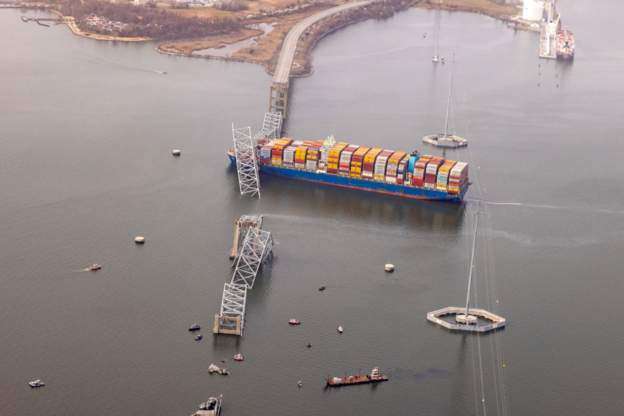
The cargo vessel, called the Dali, was built in 2015 and sails under the flag of Singapore. It can carry 10,000 shipping containers (standard 20 foot units). It was carrying 4,679 units.
Where the hell would the other 5321 containers go?

convert
Full MemberAn aside – from the BBC
The cargo vessel, called the Dali, was built in 2015 and sails under the flag of Singapore. It can carry 10,000 shipping containers (standard 20 foot units). It was carrying 4,679 units.
Where the hell would the other 5321 containers go?
I think what they're saying is it has a nominal capacity of 10000 standard 20 footers, but the 4679 on board weren't necessarily 20 footers, they come in 20 30 and 40 foot and also there's a variant which is a foot taller
@jca, thanks for posting those Tay links - I’d not heard of that before, but then I was only 4 at the time it happened.
All those little mult-coloured boxes on the ship will be weighing 30 tonnes each if they are standard shipping containers.
Plus the weight of the boat, you can't just put it into reverse gear... if it's going in one direction, it's going to keep on going in that direction.
Dropping anchor might slow it down, but not enough...not even close to make any difference.
To me, it seems like they were driving to fast for the conditions, at least, that's how it appears on the surface.
If you'll excuse the blunt ananogy.
“they were driving to fast for the conditions…”
Now if the bridge was wearing hi-vis, none of this would have happened…
Bloody bridges getting in the way of ships.. who do they think they are?
It’s not much, but there’s a little bit more background information to the story, which might clarify some points:
Dropping anchor might slow it down, but not enough…not even close to make any difference.
No, not with a ship weighing probably 100,000 tons. I could expect it to drop anchors to get chain out, as the chain is as important if not more than the anchor itself, as its the weight of chain resting on the bottom prevents the ship sliding just as much as the anchor.
But if its running out in an emergency, then its just running free and thats going to do nothing for momentum.
So they would have to run out chain, then brake it and hope theres enough out for a drag effect, al in the space of a few hundred meters.
But run out the anchor and hope it grabs ? thats not going to do anything other than snap the chain, or destroy the handling gear or even tear out the slates surrounding the fairlead
well excactly... it would make no odds. Any anchor would just snap the chain with that much weight and momentum, and cause more problems.
And, thats assuming flat water and no tide.
The boat came in too hot, simple as that.
negative - ghost rider- the pattern is full.
They appear to have just dropped the port anchor. Maybe they were hoping to just change direction enough to get through the pillars rather than actually stop. Most impressive in all of this so far is that during the few minutes it took for this to unfold they managed to get out the mayday call, it got to the bridge and they got the traffic stopped. Doesn't look like anyone was asleep
Dropping an anchor on the run causes massive drag. The "chain" is incredibly heavy and will run out at speed.
A ship like that will typically have about 210 - 250m.
The anchor cable is secured to the collision bulkhead, the strongest bulkhead on the ship, just aft of the cable lockers with a huge fitting.
It is designed to hold the ship in extremis.
It is not a routine operation and could easily damage the ship and equipment. It is also almost impossible to predict what the result of that action to be.
As I posted earlier, it is the last resort but definitely worth trying.
Some interesting comments from a ship's captain 'Stick Legs' on Pistonheads:
There are a lot of comments here speculating about what has happened and why.
I'm only chipping in my 2 cents because I feel that I can at least answer some questions, and provide a little guidance until the final report comes out.
I have worked on Containerships, I have been a Pilot, I have a Master's Qualification and am a Ship's Captain.Caveat: I have only seen the images you have all seen, it has been a VERY long time since I last worked in the US on Containerships so some things have doubtless changed.
My comments here are only designed to answer FAQ's and not to further speculation or claim that somehow 'I am right'.
If there is something I have missed or someone knows more or I am just flat wrong on procedures that may have changed since I last read the regs I will of course defer.PILOTS-
The vessel is under pilotage, I believe 2 pilots, which is normal for a Ultra Large Container Ship (which is how ports classify anything >360m in length).
In the UK the vessel must be under the CONDUCT of a licenced Pilot. Conduct is a funny word, the Master may have the control of the vessel and be 'driving' it themselves but providing they are listening to the Pilot and complying with directions then they have not assumed conduct. This is 'the Conn'. Not as is popularly imagined 'Control'. I cannot imagine the US is different and the myth that it's Master's orders & Pilots advice is out of date.
If the Master is unhappy with the Pilot's direction they can request another Pilot and the ship will be taken to a place of safety and anchored to await another Pilot. Similarly if the Pilot feels the Captain is ignoring them they will warn the Captain and if still ignored will simply state over the Radio to Port Control that the vessel is 'No longer under my conduct'. This has the effect in the UK at least that the vessel is now no longer insured, and the Master has committed an offence under the UK Pilotage act.Big ships (stuff >140m usually) the Pilot gives verbal orders and the bridge team operate the controls. The Captain stands with the Pilot and either translates or confirms the orders given. This Bridge team dynamic is fragile but works well and is respected the world over.
In this case the Senior Pilot would have the Conn, the Master would be monitoring the passage and working with the Bridge team.
The Junior or Second Pilot would be monitoring the actions of the First Pilot and doing things like radio comms and liaising with tugs.In many cases, with a long passage the Pilots will swap roles half way through as Piloting really big stuff is incredibly mentally draining.
THE VESSEL-
Blackouts can occur on vessels and it's deeply unpleasant. In this case, where she appears to lose everything I suspect it's a switchboard fault.
On sea passage a ship like this will be running her main engine at constant revs so a turbo or shaft alternator will provide the electrical power for the ship.
Main engine will be in the 60-80MW range, low speed 2 stroke diesel running on heavy fuel oil. These engines are direct drive and are reversed by stopping them, changing the firing order (by moving the fuel pump cam on the old ships, electronically now) and re starting with the crank running in the opposite direction.On approach to port she will require variable revs and as the propellor is direct drive from the engine, the engine is changed over to gas oil (what you know as diesel) and also a dedicated generator is run to provide electricity for the ship, and another generator is on standby with water & lube oil pre heated and circulating to come on the board asap in the event of a black out. These generators will be in the 4-6MW range.
There is then an emergency generator, in another space to the engine room, that provides enough power to run the winches, lights, steering gear. This should auto start within 15 seconds of a blackout.
There is also a standby 24v battery supply for things like emergency lighting & control systems.
The only engine that provides propulsion is the main engine.
Anchors can be released even when deadship by simply loosening the brake. For port arrival and departure a couple of men should be standing by forward with a radio for this sole purpose.
The length of time this vessel was blacked out suggests to me that either the engine room was set up and manned correctly and the systems failed, or that the systems were operative and the vessel had not been configured correctly for port arrival, generators on standby mode etc etc.
THE PUFF OF BLACK SMOKE / STEERING TOWARDS THE BRIDGE / TRANSVERSE THRUST -
On the video the vessel appears to steer towards the nearest bridge parapet and there is a big cloud of black exhaust smoke.
My best guess is that when the blackout occurred the Pilot ordered, or the Master decided to initiate, an astern command on the main engine to slow the vessel. Single engined ships running ahead exhibit good directional stability, they go in a straight line mostly.When going astern that huge propellor with thousands of horsepower turning it acts like a paddlewheel. It is conventional for ship's to have 'right hand acting' propulsion, most do and these big containerships almost always do, I have never encountered one that doesn't.
Right hand acting implies that when viewed from astern the propellor turns clockwise, so when the propellor direction is reversed it will rotate anti clockwise. Without 360m of hull ahead of it to resist the side forces it causes a sideways moment, this is referred to as transverse thrust and you can use it to your advantage when manoeuvring, even with tugs if you swing the vessel bow to stbd instead of bow to port a kick astern on the main engine will help her round.
The puff of smoke and the subsequent bow to stbd motion says to me that the vessel went astern, a big engine movement, perhaps full astern, at that point. I would have to be convinced that wasn't what happened and is the only thing I am 100% confident on.
The size of the puff of smoke implies that it was the main engine, no 4MW generator is kicking that out on start up. A 60-80MW engine will.
I have a suspicion that if they had not gone astern, and had continued though the bridge and restored power that this wouldn't have been anything other than a near miss report.
ANCHORS -
One should have been released for no other reason than to allow your defence lawyer to prove you did everything in you power to stop the vessel.
In reality it wouldn't have stopped >150000 tonnes moving at 10kts.Thank you for reading.
madeupname
“they were driving to fast for the conditions…”
Now if the bridge was wearing hi-vis, none of this would have happened…
I notice none of the ships were wearing a helmet
That Pistonheads post sounds a bit off, there's no way a ship would be piloting with only one generator running, when I was on the boats we would always run enough generators for the power requirements plus one (or two depending on whether we needed the bow thruster). And that was with cheapskate companies that didn't do things if they didn't have to.
I'd also bloody hope the engine room was manned under manoeuvres!
@convert you're looking at mostly 40' containers in that picture, if you look at the row forward of the funnel you will see the 20' containers. Obviously 1x40' = 2x20'
That Pistonheads post sounds a bit off, there’s no way a ship would be piloting with only one generator running, when I was on the boats we would always run enough generators for the power requirements plus one (or two depending on whether we needed the bow thruster). And that was with cheapskate companies that didn’t do things if they didn’t have to.
I’d also bloody hope the engine room was manned under manoeuvres!
I thought it was insightful anyway 🤷♂️
"In reality it wouldn’t have stopped >150000 tonnes moving at 10kts."
It doesn't weigh 150,000t. No way near that.
It wasn't doing 10kts, more like 8.5.
Her speed dropped from 8.5 to 3.5kts just before the collision. I wonder what did that?
It doesn’t weigh 150,000t. No way near that.
116,000t
Her speed dropped from 8.5 to 3.5kts just before the collision. I wonder what did that?
Umm... no idea where you got that but everything I've seen states it was doing 8kts at the point of collision.
There is a good analysis of the AIS track on "Whats going on with shipping" youtube channel.
Can't post any hyperlinks at the moment.
7-8kts then.
Her speed dropped from 8.5 to 3.5kts just before the collision. I wonder what did that?
Full reverse on the engine? The black plume could lend itself to that.
Just thinking about it though, the only time I've seen black smoke like that was when we tried to start an engine with failed auxy blowers (electrically driven superchargers for low speeds before the turbos have enough gas to work). Performance was, shall we say, sub-optimal.
Full reverse on the engine? The black plume could lend itself to that.
Just to be clear, the ship didn't reduce speed from 8.5-3.5kts..... it hit the bridge at about 7.5 kts so barely any speed reduction at all (do you know just how slow 0.5kt is!)
It's odd though, i looked at the speed trace just after the incident and it was showing gradual reduction to 3 knots or something just before impact. The line was green initially and it went all the way down to red.
Unfortunately it seems you need a paid membership to look back at the old trace.
(do you know just how slow 0.5kt is!)
Nah mate, not a clue 🙄
It’s odd though, i looked at the speed trace just after the incident and it was showing gradual reduction to 3 knots or something just before impact.
Which is what I'm guessing Gobuchul was referring to.
If you look at the AIS replays it shows the ship doing 7.5kts when it was opposite the Yara Baltimore Terminal - which is pretty much 250m before the bridge. The AIS transmitter will take the position from the GPS unit which will be in/around the bridge, which is almost amidships of the [300m long] ship.
So it can be assumed that when the GPS was 250m away from the bridge the bow was about 100m away from the bridge. Chances are the AIS updated [which occurs every 3.5 seconds on a ship like the Dali at that speed] while the ship was actually colliding with the bridge (and coming to a halt).
Something I read on an American site said Dali with a full load weighed 116,000 tonnes, at 8kts her stopping distance would be 6000yds/3 miles, or thereabouts. There were ‘Dolphins’ set either side of the channel to act to stop vessels colliding with the bridge. However, they were installed when the bridge was built in 1977, and they’re timber - I don’t know what sort of kinetic energy a 16,000 tonne ship carries when travelling at 8 knots, but I’m pretty certain they would have been hopelessly inadequate at stopping something of that size.
don’t know what sort of kinetic energy a 116,000 tonne ship carries when travelling at 8 knots
About 982 megajoules.
About 982 megajoules.
Or 1346585848 nautical calories.
https://www.nsia.no/Marine/Published-reports/2024-05
Timely publication of the report on the loss of propulsion on the Viking Sky cruise ship, which nearly drifted onto rocks after all three available diesel generators shut down repeatedly in rough seas due to oil starvation.
While human factors related to ignoring oil level alarms are implicated, it’s interesting that their blackout drills never considered a situation where all diesel generators are unavailable, always assuming there’s at least one in standby.
Also of interest is no capability for the Chief Engineer to inhibit the automatic engine shut downs. When the blackout occurred, over a thousand separate alarm messages were generated, none of which were sorted by priority. Compare this to a modern passenger aircraft which identifies the problem and (usually) presents the appropriate steps to take automatically.
The report does praise the actions of the bridge crew who appeared to demonstrate exemplary decision making. And I learnt where the term “to the bitter end” originates.
I don’t know what sort of kinetic energy a 16,000 tonne ship carries when travelling at 8 knots
Lots.
When at university I had a job as crew on the P&OSL Aquitaine when it hit Calais quay at 7 kts. That was enough to put the ship and quay out of action for nearly a year and to ripple the entire car deck for the length of the ship and she was only 28000 tons. There were over 200 injuries on board.
Incidentally, I was also on her a few year later when we had a blackout running parallel to the French coast. The main generator failed and everything shut down including the main engines and the stabiliser system. We drifted for nearly 6 minutes before power was restored and reach a list to stbd of about 34 degrees. That's probably the most scared I have been on any form of transport as the angle from which we wouldn't recover was just under 40 degrees according to the Chief Engineer.
@jonm81 how did Aquitaine’s loss of power lead to such a list? Sounds terrifying!
The stabilisers were in operation and stopped in a position that the direction of the currents and waves as she drifted pushed the ship further over rather than countering the motion.
TheFlyingOx
don’t know what sort of kinetic energy a 116,000 tonne ship carries when travelling at 8 knots
About 982 megajoules.
For those of you not on the metric system, that's 2162 superhans
While human factors related to ignoring oil level alarms are implicated, it’s interesting that their blackout drills never considered a situation where all diesel generators are unavailable, always assuming there’s at least one in standby.
This is similar to the Fukushima nuclear disaster - the reactors survived the earthquake but all the diesel backup generators were knocked out by the tsunami. There were multiple generators, but they weren't dispersed. Having multiple backups doesn't work if they are all vulnerable to the same problem.
Also of interest is no capability for the Chief Engineer to inhibit the automatic engine shut downs. When the blackout occurred, over a thousand separate alarm messages were generated, none of which were sorted by priority. Compare this to a modern passenger aircraft which identifies the problem and (usually) presents the appropriate steps to take automatically.
Similar to the Three Mile Island disaster. The operators just had panels of red lights flashing and alarms ringing. They knew something was wrong, but having every warning going off simultaneously doesn't help them to understand what went wrong and how to deal with it.
Also of interest is no capability for the Chief Engineer to inhibit the automatic engine shut downs.
I'd say there will be very sound reasons for that, I can't think of a scenario where running to destruction would be necessary. That's just bad operation and the fix for that is NOT to just cancel alarms! I'm also not sure how you could implement a system that only the chief can disable, they're designed to be run by whoever is on watch and that's still not going to help at 2am when the generators fall over and everyone is in bed.
In an ideal world you would design a ship using the DRIFTS principle - Diversity, Redundancy, Independence, Fail-safe, Testable & Segregation. They already have the failsafe and redundancy in that there is a blackout generator and multiple generator units but diversity is rarely if ever used and I've never seen proper segregation (compartmentalised into separate locations). Without diversity you're at the mercy of common mode (latent) failure, segregation is supposed to account for common cause failure.
But it all comes down to cost, owners want to pay as little as possible so without legislation to say otherwise nobody is going to design a ship like a nuclear power station.
@thols3 picked up the multiple alarm issue as well, TMI is the classic example that sprung to my mind.
Apparently this is going to be the biggest maritime insurance payout of all time.
Here’s another article with more details and close inspection drone footage from the NTSB:
One thing that’s really obvious and crucial is that the bridge structure played an important role, in particular the points where the main supporting pillars go down to the river bed - they’re nothing more than rows of steel piles driven in with steel and timber cladding around, and they’re just effectively rectangular boxes, there’s little structural mass to them to fend off an approaching vessel, other than a small cargo boat of maybe a couple of thousand tonnes. This caught my attention:
As for the failure, the NTSB chief explained the bridge’s design had a role to play. “It’s a fracture critical bridge,” said Homendy. “What that means is if a member fails that would likely cause a portion of or the entire bridge to collapse.” She noted that unlike modern designs, which prioritize redundancy, the bridge in question had none.
At this stage, the NTSB has determined that 21 crew were present on the vessel at the time of the incident, plus two pilots. Pilots are specialists in navigating local waterways and board vessels for critical transits in and out of port areas. At least six workers are believed dead as per The Washington Post, with two bodies recovered at this stage.
The cargo manifest recovered by the NTSB featured 56 containers of hazardous materials, weighing a total of 764 tons. Most of these materials were in the corrosive or flammable categories, along with miscellaneous Class 9 hazardous materials including lithium-ion batteries. Some of the hazmat containers were breached and a sheen has been spotted on the water in the area.
The NTSB’s Operations and Engineering group boarded the ship, taking in the bridge and engine room. The team has been looking for cameras, CCTV systems, or other downloadable recordings. The search continues, but nothing has been turned up as of yet. The team will be looking at the maintenance history of the vessel and are doing interviews with crew on board.
The Recorders group has had more luck. This group is responsible for “locating, retrieving and downloading any recorder or recorded information that may relate to the accident.” The team has found the voyage data recorder (VDR) and has a printout of the vessel alarms log.
Information from the VDR was successfully recovered on the morning of the accident by the Coast Guard, which was later provided to the NTSB. At this stage, approximately six hours of VDR data is in NTSB hands, covering the period from midnight to 6 a.m. on the night of interest.
NTSB officials have been on board the Dali to capture images, take interviews, and recover evidence.
By regulation, the VDR should record 30 days of history. Homendy notes the six hour period is a “standard timeframe” provided immediately to capture the time frame around the incident. NTSB teams will recover the full 30 days of recording in due time.However, at times during the press conference, Homendy hinted that the full period may not be available. Noting unconfirmed reports of prior outages for the vessel, Homendy didn’t commit to what the NTSB will actually find. “We are going to look at what we can get from the VDR data because there should be 30 days,” she said. “Hopefully we’ll be able to find something in that data if the entire 30 days is there.”
The NTSB chief also pointed out that VDR data is “basic” compared to flight data recorders used in aviation. “An FDR would give you 1000 parameters, that’s not this,” explained Homendy. “VDR is basic, it is a snapshot of the major systems on a vessel.” She notes the NTSB has long wanted more recording and more parameters to be recorded on VDRs for assessment in cases like these.
Muise noted that most sensors recorded by the VDR are from the bridge. This includes GPS data, audio, rudder feedback, and rudder commands. However, more detailed engineering information like the temperature of each cylinder or power distribution status was not recorded on a voyage data recorder. “We are looking for other sources of data in the engine room that would give us that data,” says Marcel. At this stage, the agency noted it’s not clear yet if data is available to determine the cause of the power outage on the ship.
For now, the NTSB has reconstructed a timeline of events based on recordings from the vessel’s VDR. Times are converted to Eastern Daylight Time, and the agency noted the information is preliminary and subject to validation. The VDR recorded limited sensor data including speed, engine rpm, heading, rudder angle, and some alarm information.
The VDR recorded Dali’s departure from Seagirt Marine Terminal at 12:39 a.m. local time. By 1:07 a.m., the ship entered the Fort McHenry channel, and by 1:24 a.m. the ship was underway on true heading 141 in the channel at a speed of 8 knots (9.2 mph) overground. Alarms started ringing at 1:24 and 59 seconds based on audio recorded on the bridge. Around the same time, VDR sensor data ceased recording, while audio kept recording thanks to redundant backup power. At around 1:26 and 2 seconds, the VDR resumed recording sensor data, with steering commands and rudder orders recorded on the audio.
The first open call for assistance appears to have occurred at 1:26 a.m. and 39 seconds, when the pilot made a general VHF radio call for tugs in the area to assist. At this time, the dispatcher for the local pilot association phoned the Maryland Transportation Authority (MDTA) duty officer regarding the ship’s blackout.
At approximately 1:27 and 4 seconds, the pilot ordered the Dali to drop its port anchor and made additional steering commands. Around 1:27 and 25 seconds, the pilot issued a radio call over VHF reporting the Dali had lost all power and was approaching the bridge. MDTA records indicate the duty officer radioed two units already in the area due to local construction at this time, ordering them to close traffic on the bridge. All lanes were thus shut down by the MDTA. Around 1:29 a.m., the speed of ship was 7 knots (8mph). From this moment until 129 and 33 seconds, the VDR audio recorded sounds “consistent with the collision with the bridge” according to Muise. MDTA cameras showed bridge lights flickering out at this time. At 1:29 a.m. and 39 seconds, the pilot reported the bridge was down to the Coast Guard.
Muise noted additional analysis was needed to verify the exact time of impact. The NTSB will convene an expert group to review the recording and develop a detailed transcript of dialogue and event alarms as part of its report.
The Challenge Of The Bridge’s Construction
Homendy noted the Francis Scott Key bridge was built in 1976. It had three spans, with a main span of 1200 feet and a total length of 9090 feet. The average annual daily traffic is 30,767 vehicles per day.
As for the failure, the NTSB chief explained the bridge’s design had a role to play. “It’s a fracture critical bridge,” said Homendy. “What that means is if a member fails that would likely cause a portion of or the entire bridge to collapse.” She noted that unlike modern designs, which prioritize redundancy, the bridge in question had none.
The bridge was in satisfactory condition prior to the incident, according to the NTSB. The last fracture critical inspection was in May 2023. Homendy also noted there are presently 17,468 fracture critical bridges in the US out of 615,000 bridges total, according to the Federal Highway Administration. In due time, the NTSB will analyze all available inspection documents for the bridge. The agency also requested information on pier protection on all MDTA-owned bridges.
The agency’s full investigation is expected to take 12 to 24 months, with a preliminary report out in 2 to 4 weeks. Homendy stated the NTSB won’t hesitate to issue urgent recommendations prior to that time if needed
squirrelkingFree Member
In an ideal world you would design a ship using the DRIFTS principle – Diversity, Redundancy, Independence, Fail-safe, Testable & Segregation. They already have the failsafe and redundancy in that there is a blackout generator and multiple generator units but diversity is rarely if ever used and I’ve never seen proper segregation (compartmentalised into separate locations). Without diversity you’re at the mercy of common mode (latent) failure, segregation is supposed to account for common cause failure.
DP2 or DP3 Classification gives full segregation of systems. Single failure will not result in the vessels ability to hold position. Common in offshore industry and also now in cruise ships and some tankers. Granted not much use in a ship with a single form of propulsion.
As with most things in life, a lot of design decisions come down to £££. Especially when balancing very-low-probability events like this, vs costs of implementing things like dual power paths, segregation, etc across tens of thousands of ships.
The NTSB will of course want a 1000 channel, 100 samples a second recording rate, etc data recorder. Because they don't have to pay for it.
Shipping is also notorious for it's worldwide adoption of the race to the bottom principle - hence all the dodgy boats registered in Panama, Belize, etc. There's a whole lot of shit rotten boats out there on the seas.
(Here's a simple comparison- how many cars have full rally or race level roll cages or 5 point harnesses ? Definitely safer. But... maybe 1 in 10,000 and then that's in an enthusiast's car).
@paladin I exited long ago, newest ship was 2003 vintage! Glad to hear they're catching up.
And yeah, if they can save money they will. Look at the trash they use as fuel at sea.
they’re nothing more than rows of steel piles driven in with steel and timber cladding around, and they’re just effectively rectangular boxes, there’s little structural mass to them to fend off an approaching vessel, other than a small cargo boat of maybe a couple of thousand tonnes. This caught my attention:
You wouldn't design a bridge so the structural components would resist any significant ship impact. The competing criteria is to great. It's the same principal as squirrel king is getting at.
You build the bridge efficiently to hold up, the bridge in question achieved that but Apparently it's a simple structure (determinate, each component is required very easy to design) rather than a complex structure (indeterminate, you can remove one or more components and the structure stays up or fails very very slowly, if thr deck was cantilevered AND supported by the piers, lots more complicated to design, requires modelling and much more complex techniques). It's weird seeing a bridge like that built when it was, I'd expects something that looks more modern, particularly suspension, not sure why, maybe Tacoma Narrows and Silver Bridge disasters making a reluctance.
Then you worry about the ship impact using mass, energy absorbtion (plastic or elastic deformation), deflection and separation preferably a combination. Essentially you don't let the ship hit the delicate bits.
What's weird is they KNOW there is a risk, they have fenced the cable pylons right next to the bridge. On a navigable bridge crossing a massive access to a huge container port this incident is completely foreseeable. Which makes the loss of life that little bit more tragic. I've alluded to it previously but America's record on bridges is quite shocking!
Being educated in a subject under discussion on the internet really gives you perspective on how low quality internet forum chat can be. Makes you want to switch off and do something worthwhile instead........
Is that directed at me? I'm educated ish on a subject. I just might not be very good at my job 😀
And I can write a mean DRA.
As I'm not educated in the subject so I haven't contributed, Waderider, but have found some posts and some of the links compliment well what I've seen in the press and on TV. Multi21's link to the Pistonheads Captain's post explains why the ship turned and Squirrelking's anchor comments explained why an anchor wouldn't have stopped it in time even if deployed.
So from STW I have it that some sytems blipped but not for long, however, someone panicked and reversed engines which caused the boat to veer right into the bridge. Oops.
Being educated in a subject under discussion on the internet really gives you perspective on how low quality internet forum chat can be. Makes you want to switch off and do something worthwhile instead……..
And yet here you are, being educated in a subject under discussion, posting something that is (well, was) arguably the lowest quality contribution in the thread.
I hope sneering at the uneducated peasants made your day better.
however, someone panicked and reversed engines which caused the boat to veer right into the bridge. Oops.
Not necessarily…
Yes prop walk is absolutely a thing, that’s not in doubt, but it just so happens that the Dali started turning just as the Curtis Bay Channel meets the main channel. This would have had had an interaction effect on the ship, pulling it to starboard (due to drop in pressure where there is no bank). This effect would happen anyway in normal circumstances and you’d steer away, but this is also the point of the power outages so maybe they couldn’t.
Good little explanation here:
And the interesting contributions continue. 🙂
It’s weird seeing a bridge like that built when it was
I'd been thinking this too. It was built very close to the time of the Tasman Bridge disaster.
Or 1346585848 nautical calories.
That’s about one and half Finniston Stonners.
[blockquote] I’d say there will be very sound reasons for that, I can’t think of a scenario where running to destruction would be necessary. [/blockquote]
In this situation the choice would be between running the engine with intermittent loss of oil pressure or drifting into a rocky shoreline under a severe gale and losing the ship. I know which one I’d choose.