 You don't need to be an 'investor' to invest in Singletrack: 6 days left: 95% of target - Find out more
It is not clear how long after the collision it collapsed. Visibility looks fine at the time of the collapse.
Holy shit indeed. The amount of energy in one of those massive container ships going at a few knots is terrifying.
It is not clear how long after the collision it collapsed.
Looks pretty much instantaneous to me, even with sped-up footage.
https://twitter.com/S_K_Mar/status/1772532627599188092
Up to 20 vehicles fallen into the water says the BBC who're are calling it a mass casualty event
It is not clear how long after the collision it collapsed.
Looks pretty much immediately I think. It went down unbelievably fast, very finely balanced structures.
Only positive is it wasn’t a busier time of day.
From the pics there are no man made islands around the piers to protect them. They must go straight in to deep water for the ship not to groumd first - this would be a risk factor folks would have been awsre of?
Looks pretty clear to me, it went down instantly.
looks like it's made of matchsticks when it collapses but when you look on google maps its pretty chunky girdering!
though it is quite rusty in places 😕
Horrible. You can see the headlights of vehicles on the deck as it falls down. Poor sods didn't have a chance :-/
The ship appears to lose power prior to the collision, and then regain it. Several hundred thousand tonnes of ship takes some stopping/alter course.
And the ships crew unaccounted for, pretty gruesome to consider what might have happened to them also.
That’s terrible so fast too, seems to what appear to be works vehicles on the bridge too. Thoughts with those involved
greyspoke
And the ships crew unaccounted for, pretty gruesome to consider what might have happened to them also.
Not according to the BBC:
Posted at 8:378:37
No injuries among ship crew, company says
Shipping company Synergy Marine Group confirms that its Singapore-flagged container ship 'Dali' has collided with a pillar of the Francis Scott Key Bridge in Baltimore.
"Whilst the exact cause of the incident is yet to be determined, the 'Dali' has now mobilised its Qualified Individual Incident response service," it says.
All crew members, including the two pilots who were aboard, have been accounted for and there are no reports of any injuries, it adds.
This is awful 😌
Don't those big ships usually have a local on board when entering our leaving port?
My wife's from Baltimore and we've driven over that bridge, horrendous stuff, just a horrible horrible accident.
Kinda glad it wasn't a Chinese ship....
There were two pilots onboard according to the Beeb.
How long before the conspiracy theorists claim it was a terrorist attack?
Was going to say surely this would have been under the contol of a local pilot not the ships master?! How the heck has a guy with all the local knowledge made such a monumental cock up? Blind faith in a malfuctioning gps?
Grim way to go-thoughts for all involved.
Don’t those big ships usually have a local on board when entering our leaving port?
The quote from the shipping company mentions two pilots.
Cant imagine how horrific it would have been for the poor sods on the bridge. The only "plus" is that didnt happen during rush hour. I assume the bridge would be absolutely packed then.
That's horrific. It's just incredible how vulnerable a bridge is to impact on one pier. And the obvious question as to why the pier is not better protected. How the pilots got it so wrong is going to be a tough question for them to answer.
How long before the conspiracy theorists claim it was a terrorist attack?

Yeah, they're already in full swing. It's an interesting phenomenon to watch.
Wow, that's terrible. Shocking how fast it goes after being knocked off the pillar.
How long before the conspiracy theorists claim it was a terrorist attack?
Quicker than you can think that! See the Xitter post above:
Is it me or this looks very deliberate
It's you mate 🙄
"That’s horrific. It’s just incredible how vulnerable a bridge is to impact on one pier. And the obvious question as to why the pier is not better protected. How the pilots got it so wrong is going to be a tough question for them to answer"
America has quite a poor track record with bridge safety. It wouldn't surprise me if no one had thought about risk assessments... Considering it's quite obviously a navigation risk
How the heck has a guy with all the local knowledge made such a monumental cock up? Blind faith in a malfuctioning gps?
Neither...... a simple power failure or loss of power to the drive would be enough. It's a river and there will be a current that will take over fairly quickly and they were far enough away from the docks that any tugs would have been unable to get there in time.
As said, once a ship this size starts to go off course then it takes time and space to get it back on course - neither of which were available.
Not only is there the terrible loss of life but the bridge (and the ship if it sinks) is now blocking the only access to the port which can no longer function.
It's going to take quite some time to open up the channel again.
Christ, life is fragile.
Just to show the size of the bridge, and its quite small supports, this pic shows it:

^^ ok, must confess it's a damned site bigger than it looks in the video!
Big bridge over busy shipping lane and no pier collision protection in place as is common on this side of the pond. Looks like that could easily have been avoided with better safety standards.
You can see that it angles for the channel, but there's a strong wind coming from the side (smoke stack) and as soon as it's broadside to the wind, it stops moving toward the channel and starts moving back toward the pillar. It looks to me like they didn't account for the wind and thus didn't power far enough toward the channel to avoid being pushed back into the pillar. Pilot(s) error?
but there’s a strong wind coming from the side
That water looks pretty glassy to me and the smoke isn't moving much. The smoke is interesting though as I think ship engines smoke more when just started - may indicate a loss o power that came back too late.
It looks to me like they didn’t account for the wind
It had two pilots on board who do this day in day out on that piece of water - I'm not saying it's impossible, but it's pretty doubtful.
How long before the conspiracy theorists claim it was a terrorist attack?
The conspiracy theorists would be claiming its a government false flag attack.
Here are a couple of nice drone shot photosphere on Google maps showing the scale of the bridge
https://maps.app.goo.gl/k2HVX9Yk4vq3jiiq7
https://maps.app.goo.gl/PLGWKULXTE5kNfJT9
And a Streetview on the bridge
https://maps.app.goo.gl/BAsT8g34LBPpvW177
It is/was a big one.
Also, an amazing lack of edge protection for those crossing the bridge when compared to European bridges.
<quote>The smoke is interesting though as I think ship engines smoke more when just started</quote>
I reckon the smoke was a full throttle reverse
pedlad
Full Member
Was going to say surely this would have been under the contol of a local pilot not the ships master?! How the heck has a guy with all the local knowledge made such a monumental cock up? Blind faith in a malfuctioning gps?
From what I have read (which is wholly unreliable) the ship lost power multiple times, so they could not control it
Seems it was an old ship, and was involved in a collision in the past too.
Then at 01:25 MarineTraffic data shows that the ship suddenly diverted from its straight course and began to slow down.
Around this time, video shows that all lights on the exterior of the ship suddenly turned off and smoke began emanating from the ship's funnel. [BBC]
Oh right..... there you go. Power failure and a maybe a restart but too late.
Looks like they had a black out and lost control.
Back in my day, we would of had the anchors cleared away and crew standing by to drop them if required.
Although dropping a big anchor out of the "pipe" is pretty scary shit, so maybe they delayed in making that call.
Looking at the chart of the area, it's very shallow outside of the channel and I'm surprised it didn't ground before it hit the pillar.
I am slightly surprised that they don’t negotiate that bridge with tugboats for a ship that size. Suppose it would slow down passage too much.
I hope the rescuers get everyone safely out of the water but that's unlikely.
There is nothing unusual about the bridge design; comments about 'flimsy supports' lack engineering credibility.
As for pier protection, can anyone provide examples on bridges which span major shipping channels?
The span between the central piers is 1150' and the ship had a maximum width of 150' so it was about 500' off the centre line.
I'm calling either human error and/or technical failure.
Someone on the deck must have seen they were way off-line in a shipping channel. Was there no ship-to-shore radio messaging warning of an imminent collision?
I’m surprised it didn’t ground before it hit the pillar.
Or hit the 'protective island in the middle of the other span (plus there seems to be a large pillar in the water in line with the bridge pillar).
Edit: ignore that..... the island was quite a distance away.
Was there no ship-to-shore radio messaging warning of an imminent collision?
Very likely between the ship and the harbour authorities but only when it was too late, and I guess the latter would then have to get the police to close the bridge which would have taken time.
It's a narrow channel, the ship wasn't "way off course".
It only took seconds for the ship to drift out of the channel when power was lost.
I didn't say ' way off course'.
My wording was 'way off-line'; there is a difference.
I stand by my comments.
This pic really highlights the scale of what happened
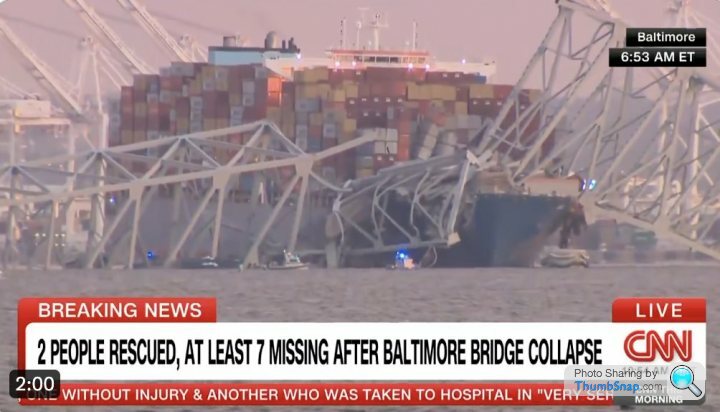
"I didn’t say ‘ way off course’.
My wording was ‘way off-line’; there is a difference.
I stand by my comments."
They weren't way off-line before the blackout, you can see their track on Marine Traffic.
Once they lost power they would of known they were heading off track, the radars and nav systems are some of the last things to go but they wouldn't of had enough power to operate the rudder. Not a lot they could of done apart from drop an anchor.
As for pier protection, can anyone provide examples on bridges which span major shipping channels?
forth road bridge;
tay road bridge;
https://www.tayroadbridge.co.uk/about/history/past-projects
and I’m pretty sure there is comparable protection on both the Severn bridge and the Dartford crossing too.
From elsewhere on the Internet:
"the ship lost power twice, officials are speculating a fire on board."
This is, of course, completely unconfirmed.
Someone on the deck must have seen they were way off-line in a shipping channel
They weren't.... and then they were, but were basically powerless to do anything about it.
(also they wouldn't go through the middle of the span as they need to leave the Fort Carroll island to port so would probably already be on a course closer to the starboard pier)
Holy shit.
I won't speculate on the cause, there are plenty of seemingly innocuous things that can shut down an engine but if you're blacked out you're at the mercy of the currents. Looks like a genuine case of wrong time and place.
I'm more concerned about the folk on the bridge tbh.
frankconway
There is nothing unusual about the bridge design; comments about ‘flimsy supports’ lack engineering credibility.
Yeah, there's "flimsy" and there's "collapsed when hit by several million tons of ship"
I'm looking forward to the the whole "Today I am expert in (but not limited to) Harbour piloting, maritime navigation, and multi-span bridge engineering" vibe that this thread will descend into in short order. Don't let me down.
I can claim 2 of those.
can't believe someone just got themselves out of the water and refused help.
Fingers crossed for others, but at 9deg it's sadly unlikely there will be any further survivors.
Horrible all round.
It will be a massive task to even recover the bodies.
As for pier protection, can anyone provide examples on bridges which span major shipping channels?
Forth yes, is there a major port on the Tay upriver of the bridge? It'd be interesting to see what calculation they used to size them because I wonder how feasible it would be to stop a container ship that size. Because if you made it strong enough then the ship sinks and you end up with even worse disruption as/if it blocks the channel anyway.
And from watching American politics, infrastructure funding seems very disjointed with projects being added as amendments to other legislation to get votes.
Øresund Bridge
It will be a massive task to even recover the bodies.
Possibly considered a bit distasteful at this point so close to the event but I'd say basically impossible unless they get very lucky. And possibly worse - given the time pressure they will be under to get the wreckage of the bridge clear and the shipping lane reopened , the chance of the 'final resting place' being given any sort of respect is slim to none. Bodies might be 'recovered' amid the clearing maybe but I'd sure as hell not want to be present as a family member when it happened.
Because if you made it strong enough then the ship sinks and you end up with even worse disruption as/if it blocks the channel anyway.
Not necessarily, ships can t-bone each other and still sail themselves to dry dock.
And I'm not sure about worse disruption, in case you missed it there's an entire bridge blocking the channel.
The main navigation channel is pretty narrow.
It shouldn't take too long to open that back up, however, if that would be enough to make be considered safe enough to use, with all the other stuff going on, is another question.
It's going to be an interesting job getting the ship free of the wreckage before you even start clearing the channel.
I wonder how feasible it would be to stop a container ship that size
The islands they build are rarely put together to flat out stop a ship of that size, and indeed if there were a direct collision it would still be pretty bad I'm sure. But they do try and build them strong enough that they can deflect such a vessel and leave the structure largely in tact.
How often they actually get put to the test though, I don't know...
I’m looking forward to the the whole “Today I am expert in (but not limited to) Harbour piloting, maritime navigation, and multi-span bridge engineering” vibe that this thread will descend into in short order. Don’t let me down.
In that case I'd recommend IFLS's feeds on Facebook. We're going to need more Bacofoil.
Christ, those poor folk seeing that coming towards them on the bridge, and I feel for the pilots who will be native to the water, know the route/tidal currents extremely well and do this job many times a week - must surely be a propulsion/engine/rudder failure.
Not necessarily, ships can t-bone each other and still sail themselves to dry dock.
In engineering terms "not necessarily" gets into the realms of business cases though. Civils isn't my area but I imagine it goes something similar to my industry:
New stuff is built to codes, standards and best available technology / best industry practice.
Old stuff remains as it is unless either there's a mandatory (not necessarily legislative, might jus t be forced by insurance, or your safety case is no longer valid as you stated that something never happens) change required e.g. after Buncefield I was busy for years re-designing the instrumentation on storage tanks. Or someone develops a business case that says £.. million will save you x*£..million on a 1 in <x chance.
In this case I'm guessing someone figures the risk of a collision was low enough.
Selling preventative engineering is hard work, a few tens of millions on this would not have won any votes compared to building a school or fixing potholes.
And I’m not sure about worse disruption, in case you missed it there’s an entire bridge blocking the channel.
Yup, but you'd have exactly the same problem (probably harder to solve) if it was a ship sunk in the channel.
I can claim 2 of those.
I can claim 1 but without any knowledge of protecting bridges against ship collisions. It would appear that protection to the Forth bridges was considered well after the original construction, I would imagine due to increases in ship size.
Because if you made it strong enough then the ship sinks and you end up with even worse disruption as/if it blocks the channel anyway.
I would go with the ship sinking any day rather than a major bridge collapse. If the protective caissons around bridge piers are well shaped it would only be a glancing blow anyway.
"As for pier protection, can anyone provide examples on bridges which span major shipping channels?"
Um... The cable bridge about 50m away from the bridge that was hit?
there's cost/benefit on any engineering. Lets say adding some islands big enough to stop a massive container ship costs $1bn per bridge (guessing, obviously). And there's maybe 1000 bridges that need such protection - thats a trillion dollars - if bridges last 100 years on average, that's 10bn dollars per year. If 20 people died last night, its terrible, but when was the last time such an event occured? a decade ago? if so the cost of putting protection up would be $5bn per person.
even if the numbers are way way different what I'm suggesting - $100m to build an island, only 100 bridges worth protecting, one falls over ever year, you'd still be looking at $5mm per person which has got to be only *just* breaking even.
"I can claim 1 but without any knowledge of protecting bridges against ship collisions"
I can claim all 3 of them.
Forth yes, is there a major port on the Tay upriver of the bridge?
Perth, not major in any way. Boats are still big enough you would not want them bumping into any transport bridges.
I am fairly sure (because I remember both event) the forth protection was put in in the 90 on privatisation of the rosyth docks. I assume to allow civilian shipping, coincided roughly with the ferry terminal.
"there’s cost/benefit on any engineering."
True, but don't forget about the cost of rebuilding the bridge, the cost of the obstructed maritime channel, and the cost of increased congestion on I95 etc (which in my amateur observations are rammed 20 hours a day).
you’d still be looking at $5mm per person which has got to be only *just* breaking even.
Its not just per person though but the additional costs of a)removing the wreckage b)rebuilding it and c)the disruption caused during that time to normal traffic flows in the country.
you’d still be looking at $5mm per person which has got to be only *just* breaking even.
Obviously we're not crude enough to actually put a number on it like that. But if you work backwards it's usually ranked:
personal injury - £100k lost profit
on site fatality - £1million
multiple fatalities or one member of the public - £10 million
Varies between industries as it's linked to reputational damage, so nuclear will rank it much higher because 1 death in a nuclear facility is news for the next couple of decades.
That Tay Bridge project for example was ~£30million in todays money.
Yup, but you’d have exactly the same problem (probably harder to solve) if it was a ship sunk in the channel.
"Not necessarily" was in reply to the notion that it would sink a ship. They're surprisingly resilient, even loaded up the way that one was.
but when was the last time such an event occured? a decade ago?
Barely a month ago when a barge hit the Lixinsha Bridge in Guangzhou.
So it appears there was an international symposium on ship collisions in 1998
Ships and barges hit bridges all the time.
But usually it's the vessel that's smaller or a similar size to the bridge.
This one was the other way around and a very long bridge to boot.
When I was a kid of about six, my uncle took me in his delivery truck for the day, drove me all around various neighbouring towns delivering dairy stuff. We stopped at a bridge, and he knew the chap who controlled the bridge, I got to go in the control room and pull the red lever to open the bridge. We opened it fully, and then waved through an American tourist who was piloting his beautiful glass-cabined river cruiser. And we all watched in amazement as he slowly steered it straight into the bridge and smashed it to bits, taking out pretty much the entire above deck area of the boat. So I think I can consider myself an authority here.
There is a trade off we make between convenience, cheapness and safety. Occasional interactions between critical infrastructure and mahoosive ships are the price of our demand for vast amounts of stuff to be brought almost into the heart of a city. I don't know if they could have done more to protect the piers, or used tugs more often for these vessels, but there is likely to be a financial consideration for both options.