 You don't need to be an 'investor' to invest in Singletrack: 6 days left: 95% of target - Find out more
.... railing
So it's friday and we haven't had a mystery object thread for a while.
The answers provided to my last two mystery object threads back in 2020 were that the car that had rusted away to just a floorpan found several miles from a tarmac road was a 1974 Ford Consul - identified by its semi-trailing independent rear suspension. And the 8ft diameter rocky thing that looked like it had fallen from space was an aglomeration of mining material that had melded together the spoil heap from a coal mine had caught fire.
So... knowing there is no question STW can't answer..... Here is a section of ornate iron banister. Its in Scotland, the building was built 1750s, remodelled 1830s so the ironwork could be from either date.
What I want to know is...the ironwork has a floral / plant / botanical motif. What sort of plant is it referencing? It was built for a guy who made his money from Sugar plantations but I'm not seeing sugar cane in those shapes so I'm guessing it's a more general classical motif rather than something celebrating the owner.
What say yee
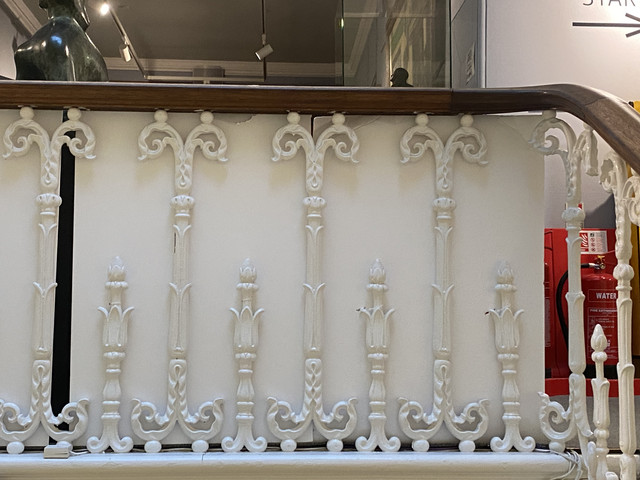
Tulip?
Anyway, I'm guessing that yes it's more a general classical motif than any particular plant... doubt the designer cared much beyond "looks like a flowering plant of some sort".
Acanthus ?
Don’t know.. but I had a similar issue and a guy from Ballantine Castings in Bo'ness was able to identify the pattern and replicate it for a job I was doing in Park Circus.
I would say those are more likely to be 19thC rather than 18thC.(especially mid 18thC). They look like tulips to me and in the 19thC world of flower meanings (look it up, it's wild) Tulips represent love. But it could be just a pattern that looks "exceeding neatly" as one catalogue described it's very expensive do-dads and flim-flams...And the Victorians did very much love their do-daddery
a job I was doing in Park Circus.
Strong Man? Lion Tamer?
The middle bit of the banisters could be mare's tail. Dunno why you'd want that in your house though!
(We call mare's tail "the lego plant" because you can pull apart and fit back together the smaller stems)
Panther Taming. Obviously.
Didn’t work out. I’m still feral.
Ha - from the from page of Ballantine's website 'we have 250,000 patterns' - thats easy to narrow down then 🙂 Unfortunately each example just has a serial number so even if I spotted something similar it would ID the design elements
I don't need to match it - its a thematic thing - a jumping off point for something new in the building but want it to have a conversation with the old.
If you don’t know then it’s unlikely anyone else does either. Make it be whatever suits your design idea and just bullshit the rest.
“Oh yeah, I was inspired by the Triffids on the balustrade “
Equally likely to be tobacco than sugar cane in Glasgow. Or an ornate slavery motif.
Not a thistle then 🙂
Acanthus for the top curly bit, the shorter bud bit is a common motif but not sure what it is called.
Enjoyably not Doc K compliant either way 🙂
The central finials look very much like a styleised pineapple which are really common designs. They represent wealth and hospitality, and also I Believe were used to depict the owner was worldly wise or well traveled. All over Leith, our old street had a pineapple topped washing post in every garden
If you Google pineapple railings and finials you'll see loads of similar designs
I have to agree, its not the pineapple that first comes to my mind!