 You don't need to be an 'investor' to invest in Singletrack: 6 days left: 95% of target - Find out more
Seems like it.
Anyway, if Alex can do it by headtorch in the middle of the Atlantic, this huge shore crew (and I suspect a lot of volunteer helpers & goodwill) will have that boat back up and sailing one way or another.
There’s a part of me that thinks that if the Americans can’t complete the round robins then they should be booted out
I don't think crashing and nearly sinking your boat gives any competitive benefit. If they can come back from this and win the Cup, the other teams would only have themselves to blame.
but what if Prada or Ineos destroy their boat in the last race of the round robins and don't have time to rebuild it, and US go through without having completed the qualifying rounds?
I don’t think crashing and nearly sinking your boat
maybe they should learn to sail without doing that? It's not good being quick if you can't finish....
yeah..there’s a reason you don’t see those anymore 🙂
I had three. Definite one trick ponies. But on the right day they did work. My Tinkler tails were both better all round. Once I got all that out of my system a good conventional board was better. Because by then we’d learned how to shape windsurfers properly, oh, and the rigs had improved too.
My Tinkler tails
jeez...haven't heard that for years....you must be as old as me...I had a Mistral Challenge Flex 🙂 (I think it might still be in my attic)
maybe they should learn to sail without doing that?
I think there was a fair dose of bad luck with the wind there. I'm sure all the other teams are just glad it wasn't them that got unlucky.
but what if Prada or Ineos destroy their boat in the last race of the round robins and don’t have time to rebuild it,
They should probably include "not crashing and sinking" in their race strategy then.
They should probably include “not crashing and sinking” in their race strategy then.
why? if US can crash and sink and still be allowed to compete, why shouldn't Italy or UK? you can't have one rule for one team and another for the rest!
I think there was a fair dose of bad luck with the wind there
also a fair amount of bad decision making..you could hear the tactician saying "this (the tack into a gybe) is going to be a very hard manoeuvre", "the gybe the other way would be safer"...and the helm overruled him
If there were a dozen competitors then the US challenge would be sunk (excuse the pun!). As there are only three, they have devised a way to maximise the TV revenue stream/time exposed for sponsors.
RYA doctrine for Youth Squad / L4 back in the day was 'To finish first, first finish' - very appropriate bearing in mind how fine the cutting edge is with these things. The margins for error are a lot skinnier than, say, a Laser 3.
I’ve got an image in my head of them taking a chunk out of one side of the old boat and it ending up like asymmetric wave boards from windsurfing.
My (comprehensive) school used to get sailing boats from wherever it could to compete in the Surrey Schools against very well-funded teams from the local private schools. One wooden Enterprise we rescued from a field, Mr Incredible, was astonishingly competitive on Olympic courses. This may or may not have been due to it being about 3/4" narrower on one side at one of the key class measurement points. Until we found that out, I thought I'd been finally getting half good...
I expect there has been quite a lot of discussion in all three teams about the best way to cope with gusts during a bear-away. The focus in manoeuvres has been to keep the boat foiling, but in the stronger winds they can afford to lose a bit of power to keep control. I think Terry Hutchinson said that the traveller was right out, which I took to mean it was directly below the boom so minimising the mainsail twist. If it had been further inboard, with the sheet eased more it would have taken some of the power out (according to my 30 years out date dinghy sailing knowledge!).
jeez…haven’t heard that for years….you must be as old as me…I had a Mistral Challenge Flex 🙂 (I think it might still be in my attic)
Yep, I had a Challenge Flex with both tails. I still dont think it was as flexible as my old Mistral Tarifa. Now that really did bend in the corners.
My custom Tinkler was a Lodey I smashed the tail off in the Canaries and had a new flexing tail fitted by Alan Neighbour. Flex was controlled by wedging different sized bits of rubber from car exhaust hangers in there.
i used to race Larks at Uni. We had a couple of boats which were somewhat amended from the original measurement and were very fast in light winds. Half the fleet infact had big holes in them from time to time, bumper cars have less collisions than team racing boats.
If it had been further inboard, with the sheet eased more it would have taken some of the power out
I think that in these boats, during the bear away, easing the main to create twist, when your apparent wind is not on the nose, powers the rig up more, until the apparent wind has got back off the beam and in the right place, unless you really let it go, which these boats don't/cant.
Yep, I had a Challenge Flex with both tails. I still dont think it was as flexible as my old Mistral Tarifa
Yep I had both tails..not sure I ever used the long one..maybe once. Also had a Tarifa bought from my sister when she moved onto a hookipa (or diamond head)
maybe they should learn to sail without doing that?
Aye, because no-one else has had this happen.
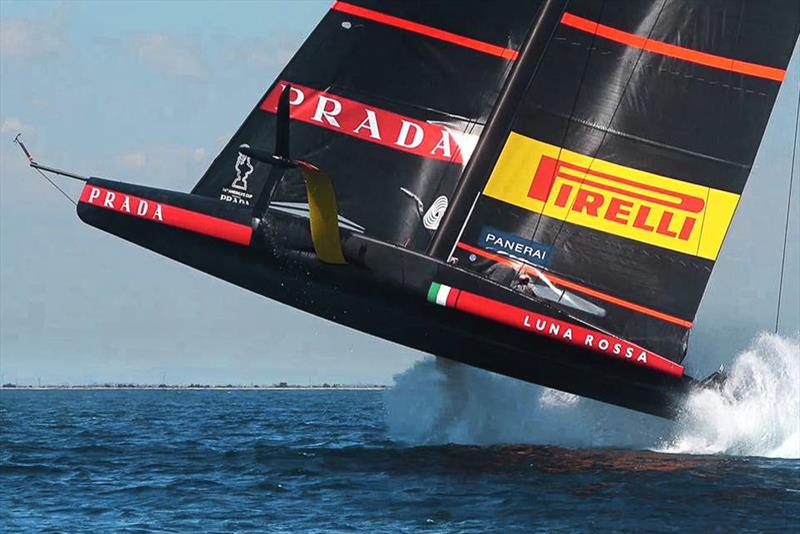
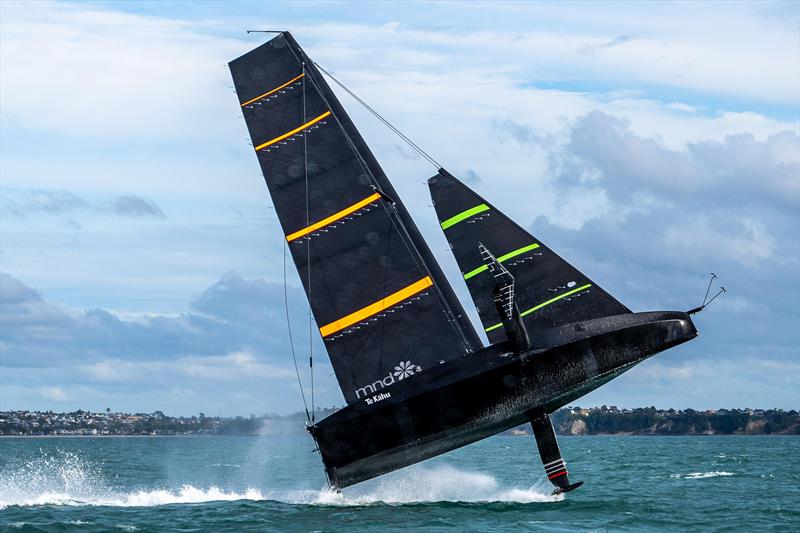

I think Terry Hutchinson said that the traveller was right out, which I took to mean it was directly below the boom so minimising the mainsail twist. If it had been further inboard, with the sheet eased more it would have taken some of the power out (according to my 30 years out date dinghy sailing knowledge!).
American Magic also have backstay that interferes with the sail. There is a lot of chat on SailingAnarchy about the fact that they rushed into the turn and the backstay was not eased enough as well - so keeping the top of the sail hauled in hard. They are also discussing that to ease the sail slows the boat down and *increases* loads as you go around the corner, whereas keeping the thing sheeted in leads to fast acceleration and a reduction in loads. It seems fast, level and low is more consistent but with a narrower margin for (bigger) crashy....
This is also combined with a mother of all gusts and a desire to not take the foot of the gas...I am sure i had the same gust issue in a Tempest in 1991 leading to a broach and concussed me after headbutting the keel having been on the wire a moment earlier....
The physics of these things is totally different from any other dinghy and boat I can think of - that said it seems the dinghy sailors are coming to the fore driving them, so clearly some parallel or other.
There is a quote I like about this crash - "it was like an airplane loosing it's tail in flight...." and perhaps thinking more as a pilot than a sailor is what is needed.
Interesting photos, Matt. Looking at them, I don't see much difference between how the other boats flew and how Patriot did, but they didn't hole on impact, and (I don't know) did they capsize? Maybe my earlier hypothesis was right, that the backstay wasn't the primary cause of the initial airtime, but after they landed and slowed it became significant - having the power wasn't enough to get them foiling before they capsized. Maybe the hole was scooping up water and preventing them accelerating?
to ease the sail slows the boat down and *increases* loads as you go around the corner
True - downwind you want to be going as fast as possible when gybing as loads on the rig are lower, but they're sailing faster than the wind anyway so I'd have to think about this.
whereas keeping the thing sheeted in leads to fast acceleration and a reduction in loads.
Well I dare you try this in a blow. If you try to bear away without easing the main you stand a very good chance of the the rudder losing grip.... especially one with a high aspect foil section. If they lost grip (or had cavitation) then they would lose the ability to control the back of the boat.
The running backstay's job is to control the forestay tension - not to adjust the power in the main.... they have other systems for controlling the depth of the sail within the sail itself. So I'm not sure of the importance of the runner not being released other than holding the boom inboard - but then the boom doesn't go very far outboard on these things anyway. If you want to dump power from the main quickly you dump the vang (or whatever system they use to controll the leach tension) - open the upper leach and the power leaves the top of the sail.
If you look at your pictures above, in the top two the leeward runner is very eased and yet the boat has taken off - I don't even think either were at a mark roundings/bear away either which may point to it being more of a rudder cavitation issue.
but they didn’t hole on impact
Indeed, but all the boats are built differently - the only thing that's the same is the foil arm system which is delivered/installed as a standard hydraulic/framework/arms package.
Other than that they can do what they want within the measurement rules.
So there's a decent chance that exactly the same crash might not have holed the other boats.
then there’s the question if why the runner wasn’t released…. Schoolboy error.
If you watch through the press conference he addresses this, there's only enough slack in each system to deal with the normal range of motion, so even when eased the backstays don't fly off like they do on a normal keelboat, they're just slack enough to allow the top of the sail to twist.
But the wind is still horizontal, so I don’t think the angle of the mast matters.
Even on a more normal dinghy, it makes a big difference. You can try to sail it with the mast canted slightly to windward then the rig generates lift. More important on a foiling moth, but still worth a few tenths of a knot in something more mundane as it reduces the wetted area of the hull.
Also, the wind isn't horizontal and homogenous. It's quicker higher up, hence you need to twist the sail to suit it as the apparent wind angle is greater. It also has a vertical component in a gust. They talk about "pressure" rather than gusts because that's what it is really, it's areas of descending air that then have to accelerate out when they hit the ground. So if you get caught heeling in one then that air really is pushing downwards on the sail.
Why would the rudder foil hold the stern down….the foils provide lift
Assuming the physics of small boats still holds true then the rig is pushing the boat sideways and forwards. The sideways component is countered by the keel/crew normally and you don't notice the forward component as boats are so much longer than they are wide. But once the loads increase it's hugely significant (look at where the crew put their weight downwind even in a non planing/non spinaker boat). So the foils will have to counter that because unlike a dinghy you can't just move the crew weight aft. I'd guess the optimum rudder would be neutral? But that would be very wind strength dependant.
Although, like the rig I'd assume the trim tab only does so much once it's no longer moving vaguely parallel to the surface (e.g. when it took off) I'm guessing it's producing a lot of lift.
The thing is, it was hardly the mother of all gusts. It went from 15 to 25 kts. In aviation anything under a 10 kt gust doesn't even get reported.
Pressure is proportional to wind speed squared, so 15kt to 25kt is 2.8 times the pressure. I've read somewhere that the race window for the AC is up to 23kt, so 25kt is more than than the boat is designed to race in.
If that really is the case then they aren't suitable as an offshore race yacht. Any day of 15kts with showers will have gusts up to 25ktas.
then they aren’t suitable as an offshore race yacht
That's probably the very last thing they were designed to be!
My understanding is that the rudder suffered from cavitation. That acts like the horizontal stabilizer on an aircraft, which keeps the plane stable in pitch. With that stalled, the stern dropped and the angle of attack of the foils increased, which increased their lift. That set off a positive feedback loop that launched the boat out of the water. As soon as the rudder stalled, the crew were just passengers, there was nothing they could do except hold on and hope for the best.
so, ghost races for the round robin events the US should have been in....the opposition just have to turn up and cross the start line to collect the point. That's going to make fascinating viewing....:-)
The newly published schedule only shows two races between Luna Rossa and INEOS, one on the 23rd and one on the 24th.
I'm really hoping that American Magic makes it back onto the water and into the semi-finals.
Where is the best place to follow detailed analysis & comment? The main media is pretty useless.
Any day of 15kts with showers will have gusts up to 25kt.
Yes, that's why I wrote "more than than the boat is designed to race in" - I'm not suggesting they can't cope with a stronger wind, but their performance won't be optimised and they may need back off or sail differently.
The aerial video of the incident shows quite a sharp turn just before the major problems - it would be interesting to know whether that turn was initiated by the rudder and caused the cavitation, or resulted from loss of control following the cavitation.
I've also been wondering about the trim of the boat. The rig forces will be tipping it forwards, so I guess the foils are a bit forward of the CoG, optimised for somewhere in the middle of the design wind range so that the rudder foil isn't doing more than necessary and increasing drag. In that case, I'd expect the rudder foil to be holding the stern down in a big gust, but if the stern drops when the rudder cavitates, that suggests the opposite - just shows how hard the dynamics of these boats are to understand!
Where is the best place to follow detailed analysis & comment? The main media is pretty useless.
@danstw13 If you can cut through the antagonism and bullshit and enjoy wild speculation then there's some good reading on the sailing anarchy forum.
Livesaildie doing a good job as 'proper media' too.
Tom Morris on youtube (Mozzysails) also putting some good analysis out.
I’ve also been wondering about the trim of the boat. The rig forces will be tipping it forwards, so I guess the foils are a bit forward of the CoG, optimised for somewhere in the middle of the design wind range so that the rudder foil isn’t doing more than necessary and increasing drag. In that case, I’d expect the rudder foil to be holding the stern down in a big gust, but if the stern drops when the rudder cavitates, that suggests the opposite – just shows how hard the dynamics of these boats are to understand!
Looking at the video again, the boat starts heeling a lot to port and carries on in that state for a second or so, then suddenly takes off. The angle of heel might affect the amount of lift from the main foil under the heavy sideways forces caused by the gust (the vertical part producing some lift not fully countered by the reduction in lift from the horizontal parts). The rudder would would not be acting normally in that situation - the "horizontal" part would be producing some sideways forces and the "vertical" part producing some vertical lift. Maybe it would have been programmed to produce a combination of steering and vertical control in such situations.
ETA also the downward force from the rig when heeled over - you can see the boat heel over, sink down, accelerate and then take off. So the vertical part of the foil would have been fully submerged and acting like a lifting foil at that point. Huge opposing forces at play, at the edge of or beyond the envelope, one of them won out...
Yep, as in any fast boat, you don't bear away if the boat is healing, all it does is lift the back of the boat, then the rudder gets air to it and lets go.
Yep in conventional sailing boats ventilation of foils is the problem but the the speeds of these and the loadings on the foils cavitiation can really happen.
as in any fast boat,
I will say it again - I think they are closer to planes and many sailing norms and physics are just totally different....normal expectations don't really apply.
Surely physics remains the same?
This made me chuckle. Link to IG story where an Australian 49er team has a 'similar' experience to the Americans, leeward heel and all. I'd say that whilst many of the principles are different, you absolutely have to keep a foiling boat flat or heeled to windward to survive a turn at the top mark.
Surely physics remains the same?
Yes, but as eddiebaby said above, ventilation (where air is sucked down the foil and results in a loss of water flow over the foil and therefore no grip) and cavitation (where the water boils due to low pressure resulting from too much flow or too much angle of attack or something and therefore no grip) is different. May result in the same issue, but a different "bit" of physics. Planes are the same, but the liquid they are in is much much thinner.
The 49ers went through the wake of the film boat and submarined. Was funny though. The second boat was going much faster in the turn and was off downwind before the first boat has even beared away.
I will say it again – I think they are closer to planes and many sailing norms and physics are just totally different….normal expectations don’t really apply
Foil cavitation/ventilation has been known about for decades in windsurfing (maybe surfing also but not sure) - it's certainly not new.
Ineos had a new rudder design as part of the post-WS upgrade package as they had instances of "losing grip".
The physics are still the same as water is merely very very thick air!
And handy link to technique and loads in apparent wind sailing/foiling.
https://www.northsails.com/sailing/en/resources/north-sails-international-moth-speed-guide
Pertinent here I think because of the discussion around US boat easing the main and runners.
May result in the same issue, but a different “bit” of physics.
I meant this rather than changing physics.
Part of the different bit has to be that the lateral resistance, drag and main lift is significantly offset from the centreline, with a rudder and controlling foil still on the centre line. This is nothing like other foiling designs such as moth or even catamaran.
We then need to think about the speed (and related momentum). Again, a Moths and foiling small cat's are hitting mid 30 knots. Ocean going foilers such as Gitana hit 50 knots - but have a huge wide base of stability and don't do the 'swerving' manouvres these guys are doing around the cans. Imoca 60's reach 40 knots on occasion, but that is edge of control and they are designed to semi-foil and they weigh a lot more.
So an AC75 seems to speed like an ocean foiling trimaran, with the momentum of an IMOCA60, and be expected to fling around corners like a Moth. Combine the speed, momentum, competing forces and a unique sail-foil layout and I think things are head meltingly complex.
Back in the day when I sailed an International Canoe a few times I was taught (like Moths do) to keep the hull under the rig - that is to say we steered gusts and heel's to keep the tip of the sails above the hull and sailor. Doing this mean I went from sail-swim every 50m to sailing for a full race with occasional dips... It was just *different* to anything else I had sailed up until then...
(Matt's claim to fame - I have beaten Mr_Ainslie in a sailing race. 8)
We were 16 at the time on youth squad, and it was a fluke. But I have. Once. )
Part of the different bit has to be that the lateral resistance, drag and main lift is significantly offset from the centreline, with a rudder and controlling foil still on the centre line.
I thought about that, and then I wondered how much of the total drag is water on foils and how much is air on hull and rig.
I would think the drag on the foil is way more than that on the rig - I figured that might be why they don't put both foils down when the wind is lighter to give more lift.
tbf, I know nothing about it, my only "relevant" experience is foiling windsurfers (and they're not really relevant other than having a big foil at the front and little one at the back, and not moveable parts...height is controlled by moving your weight) - but they do launch out of the water just like those boats if you get overpowered and can't get your weight forward to keep the wing in the water. (and once the wing leaves the water, they stop dead).
A good question @greybeard - and one then wonders if the sudden lift on American Magic was as much hull-becomes-wing-at-particular-angle as underwater foil influences.
hmmmm.
I would think the drag on the foil is way more than that on the rig
Again, another useful thought.
And would this change in a sudden gust of wind or acceleration situation?
I think we're overthinking it...once that rudder wing was ventilating, the stern is going down, the bow is going up, the angle of attack of the front wing massively increases, giving even more lift, and it shoots out of the water. Once out of the water..no lift. splat.
As to why the rear wing was ventilating..you'd need several degrees in hydrodynamics to figure that out I suspect!
why the rear wing was ventilating
I think that this is fairly straight forward. Not enough speed (for that much breeze), (or not enough acceleration before the breeze) creating too much pressure causing a bit of heel leading to a sideways slip and the ventilation - boom, airborn! whether it was ventilating or cavitating (if indeed these are different) we do need hydrodynamics experts in for - i am amazed we don't have any here already!
once that rudder wing was ventilating, the stern is going down
I didn't know it was the rudder wing ventilating, I thought it was the blade - but maybe it's the wing that steers the boat? I can see why the wing ventilating means losing control of trim, but not why that necessarily drops the stern. I'm tending to think that the heel lifted the hull and then the apparent wind under it lifted the nose, like Donald Campbell's Bluebird. While Bluebird was going six times as fast, Patriot is 3 times as long (and so probably 9 times the plan area) and only 3 times as heavy.
I think that this is fairly straight forward.
I very much doubt that it is straightforward.
From Andrew Campbell, the flight controller on American Magic:
According to Campbell, they tried everything to minimise the impact - but were left helpless once the boat headed skyward.
"When we did get round the top ...we didn't quite manage to get the rudder through that turn. On the [TV] replays you can see the rudder sink [and] at that point you don't really have any more control over the foils at all.
"No amount of minimum flap is going to bring the hull back down at that point [and] you're just waiting to see if you can get any grip on that foil at all to cushion the boat on the way down."
so, AM out for another week, RR2 starting at 3am ish tomorrow morning for us. Who is getting up early/not going to bed to watch Ineos vs Luna Rosa.
RR2RR3 starting at 3am ish tomorrow morning for us
/pedant!!
Who is getting up early/not going to bed to watch Ineos vs Luna Rosa.
No!
Actually I'm doing my vaccination training all day tomorrow so won't get to see it until tomorrow night at the earliest.
Very much hoping that they get the first strike in to put them into the finals.
Very sorry, RR3. 🙁 Don't think it was pedantic of you, i was wrong.
I’ll record it and watch it when I get up. What’s the forecast conditions?
Up at 4am (don't ask!) expecting to watch it recorded but pleased to see it's been delayed to a 4:20 start.
Read the report - sounds like an amazing race.
Well done ineos.... Who'd a thunk it 4 weeks ago!
Plenty of work still to do.
I want to see them racing in 12 knots again to see if they have actually sacrificed strong wind performance for more mid range.
How does Ineos fly?
With balls that big to go for the port-starboard call at the finish...
😎
Come on UK.
What do the racers on here think about that last leg protest?
The Italians were bearing away towards UK, in effect aiming for a collision course to get Ineos to gybe away or luff hard. UK also altered course a bit too help avoid. You can see the wake shape afterwards.
If the Italians had held course, things may have been different.
The call therefore was good.
Thanks - from a non racer it certainly seemed like LR turned off their racing line to force a penalty as they had otherwise lost.
Blimey, that was exciting. Can someone in the know give a quick dummies guide to which bit of Ineos was a bit broken and why that meant they were a bit slow windward?
Getting quite into this match racing malarkey 🙂
Great race.
It was the Cunningham - a type of downhaul used to change the shape of the sail. What is good for upwind isn’t for the downwind leg.
Yep Cunningham flattens the upper part of the main and opens the upper leach.
(Flatter sail is "depowered" but also potentially ultimately faster"
Interesting in Ben Ainslies post race interview he said that in that final leg cross, he thought they were well clear, but both teams went for a power mode (I assume a short term burst of speed that would cost you in the long term)and LRs was more effective because of their Cunningham issue.
If they managed to win the race whilst suffering a technical that affected downwind speed it definitely bodes well.
LR messed up 2 tacks today which cost them.
Did they fix the cunningham before the race or just put it on and tie it off so they where less than optimum downwind?
Apparently set to about 75% (I have no idea what that means). It was on their list of things that could fail, so had a system on the tender that could pressurise the hydraulics, then lock it at fixed value.
Whats going on with this possible DSQ hanging over them with a problem with the measurement of their outhaul? Shouldn't all this crap be sorted before this stage?
That was fixed I think. The main shouldn't have any openings in it and theirs did for the outhaul - I think it was fixed pretty quickly (sure I saw it taped over for day 2)
Either way it was measured in before the event so they can't get dsq.
Exactly, it went through scrutineering so all good.
They will have to change it for main event.
So not any real chance of being DSQ unless some other measurement/rule is broken?
It's not like previous cups where there have been events on set dates where you have to show the opposition the underside of your boat so unless one of the other teams is holding an ace card of knowing about a violation but hasn't reported it, and the measurers haven't noticed it then it's a nonissue.
Thanks – from a non racer it certainly seemed like LR turned off their racing line to force a penalty as they had otherwise lost.
It's not like motor racing where you get to make one correction per corner then have to hold your line. You can't make a sudden change of course and cause a collision, but LR's tactic was pretty obvious so I'm not sure what nuance it's judged on. To me I think Ineos had all the time in the world to see what was going to happen. Although I suspect LR was losing boatspeed so if Ineos had gybed they would still have won because LR was going to have to luff up again to pick up speed to gybe back for the line.
I don't sail a downwind VMG boat so I'm not sure how the rules work with regard to propper course and downwind ley lines. But if I was on a starboard gype and an opponent was on port I'd be bullying them off the course because unlike upwind they cant tack off and become the leeward boat and luff you, you get to luff them.
If the UK wins the AC, would the next race be a round the island race, as per the original race in 1851?
I don’t sail a downwind VMG boat so I’m not sure how the rules work with regard to propper course and downwind ley lines. But if I was on a starboard gype and an opponent was on port I’d be bullying them off the course because unlike upwind they cant tack off and become the leeward boat and luff you, you get to luff them.
These high speed boats are insane in the way they go round the course sheeted in all the time but although they look like magic is going on I'm sure they are limited by laylines. 🙂
Watching this racing has been great and I've been up early to watch it live for the last couple of hours of the shows. I used to think windsurfing was fast.
If the UK wins the AC, would the next race be a round the island race, as per the original race in 1851?
I think the challenging club and defenders negotiate over the specifics and it goes to the NY Supreme Court if they can't agree. I assume that a major consideration will be financial, they will be looking for public subsidies and TV rights, so nobody will want to go back to the historic format.
https://en.wikipedia.org/wiki/Deed_of_Gift_of_the_America%27s_Cup
The Club challenging for the Cup and the Club holding the same may by mutual consent make any arrangement satisfactory to both as to the dates, courses, number of trials, rules and sailing regulations, and any and all other conditions of the match, in which case also the ten months’ notice may be waived.
In case the parties cannot mutually agree upon the terms of a match, then three races shall be sailed, and the winner of two of such races shall be entitled to the Cup. All such races shall be on ocean courses, free from headlands, as follows: the first race, twenty nautical miles to windward and return; the second race, an equilateral triangular race of thirty-nine nautical miles, the first side of which shall be a beat to windward; the third race, (if necessary), twenty nautical miles to windward and return; and one week day shall intervene between the conclusion of one race and the starting of the next race. These ocean courses shall be practicable in all parts for vessels of twenty-two feet draught of water and shall be selected by the Club holding the Cup; and these races shall be sailed subject to its rules and sailing regulations so far as the same do not conflict with the provisions of this deed of gift, but without any time allowances whatever. The challenged Club shall not be required to name its representative vessel until at the time agreed upon for the start, but the vessel when named must compete in all the races; and each of such races must be completed within seven hours.
Video about the repairs to Patriot. It's a huge new panel that's been made!
When I watched the race live, I agreed with the jury decision on the starboard protest at the end. Watching the replay from onboard, it does look more like it should have gone to Luna Rosa.
So it’s a first to 4 wins Semi, then a first to 7 final.
Rita seems to be the only boat with a flat bottom. The others all have a pointed bottom to the keel. Is there a technical reason for the difference?
Rita seems to be the only boat with a flat bottom.
No, it doesn't