 You don't need to be an 'investor' to invest in Singletrack: 6 days left: 95% of target - Find out more
Someone on another thread mentioned the Whyte PRST-1, which was famous for its linkage forks. They always got great reviews, even though opinions on their looks was, erm, divided. Personally I think it looked great.
Now, the advantages of a linkage fork are that you can fine tune the travel path of the wheel (I seem to remember that the Whyte went backwards then up) and that they can be made stiffer than a 'normal' fork. Plus, surely, with a bot of thought they could be made to look a bit more aesthetically pleasing than the Whyte's. I would hav thought that you might also be able to isolate braking forces like on the USE ones of a while ago.
So why aren't there any around?
So why aren't there any around?
Cos you didn't look for any?
http://www.german-a.de/en/kilo.html
I often wish to
" feel the supremacy and the light weight of their suspension fork on every single ride,"
;-P
http://books.google.co.uk/books/about/Motorcycle_tuning.html?id=l2Zizg8I8p8C&redir_esc=y
and look at the bibliography in the back too.
Generally people don't like the feel or lack of from them although they can work quite well for given uses.
It would take a very long time to answer this fully 🙂
When the travel goes over about 2" the axle path starts getting a bit weird and unpredictable. That's probably why the ones you can get these days ([url= http://www.german-a.de/en/kilo.html ]like the German A forks[/url]) are lightweight short travel jobs.
Plus you have the fun of dealing with lots of little fiddly bearings and the simplicity of two tubes sliding inside each other starts to look more appealing 🙂
IMO the conservatism of the consumer and probably most importantly thay cannot go on conventional frames ( apart from leading link which misses someof the advantages)
BMW use them on motorcycles to great effect - both double and single wishbone systems. I had a BMW with the telelever set up. it was great and would work well on MTbs IMO
Amp use to do some years ago.
Pushbikerider - not necessarily - using double wishbone you can tailor the fork to have any path you want. My BMW had 7" of travel.
[i]Plus you have the fun of dealing with lots of little bearing[/i]
But you have that at the back of full sussers anyway and everyone seems to get on with it quite happily.
IMO the conservatism of the consumer and probably most importantly thay cannot go on conventional frames ( apart from leading link which misses someof the advantages)
i agree 100% - bmw have been the bravest with the recent hossack and latterly the telelever front end, but largely everyone else has stuck with forks.
i would love to see something like a hossack system on a mtb. a friend of mine raced a hossack supermono and he claimed it provided huge confidence in the front end, especially on the brakes. i am imagining a 6" travel bike with a ccdb
Fashion to some extent.
Plus there is a greater body of knowledge on how to make a telescopic fork work nicely.
There's nothing wrong with the idea of a linkage fork, but many of the early linkage forks were poorly made with inadequate bearings (but so were the telescopics). However the suspension unit can be replaced with something more modern to improve them.
For the modern market the amount of travel would need to be greater so the linkage designs would have to be beefed up. Although you don't need as much travel on a linkage fork if you have it set to anti-dive, you still have to satisfy the market about having so many inches of travel.
Don't know if [url= http://www.parafork.com/ ]Parafork[/url] are still going, but their fork looks ok.
[img]  [/img]
I've got a set of the amp ones- they are steel, light as, and work pretty well for xc.
If they worked better than telscopic forks, they'd be used in racing.
There is the agument that when motorcycle production was big, just after the war, when they had alot of machines for producing tubing (gun barrels) the most effective and cheapest way to produce the forks was make telescopic ones using the skills and machinery from the war effort, development went down this path and has stayed like that.
I don't necessarily agree with either of these statements mind you 😉
teej has it I reckon, too hard to get a foothold in the market place, and forks work pretty good..
I had a pair of AMP forks on a Merlin ti XLM they were not to good I remember reading the instuctions and thinking this is so wrong " if you get a squeaking sound from the bushes just spray your bidon over them'' !!!!! 😯 Thats after nearly 20 years and I still can't get that out of my head. I sold them on soon after getting them.
everyone who ive ever heard about the PRST-1 from said the fork dived deeper and faster than..... (insert poor taste joke here) and was therefore a complete nightmare to stop yourself going over the bars.
they do look good on some bikes;
[img] 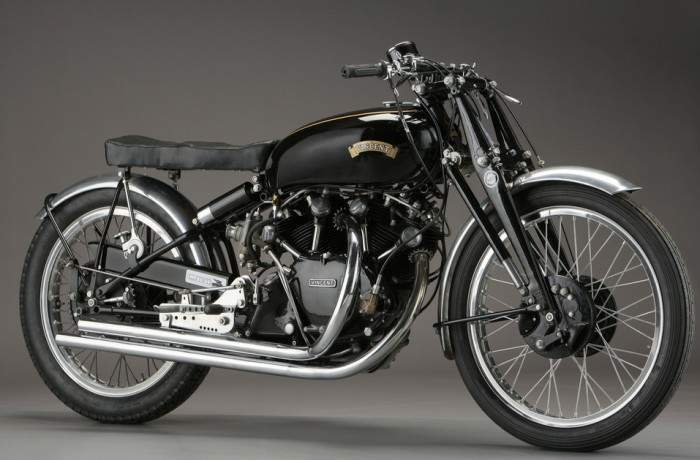 [/img]
just mainly not bicycles.
The forks epicyclo posted above are compromised to allow them to fit on conventional frames - the BMW / Hossack system the wishbones and shock do not turn with the steering
[img]  [/img]
Where do USE SUB forks com in? Kind of halfway between a leading link and telelever setup.
I always thought the problem was no one knows what the 'ideal' front axle path would be, do you go back then up to absorb impacts (which telescopic forks do quite well) but gives you sharper steering as the suspension compresses, or do you go verticaly upwards, giving a nice constant wheelbase as the axle path matches the rear better, but doesnt absorb impacts so well?
What I dont get is why fork stanchions are always parralel tot he steerer tube, surely they're missing a trick to slow the steering down a bit by making them more vertical so for the same static rake/trail figures the steering would slow down as the suspension compresses.
It is much easier to come up with a bad design for a linkage fork. 🙂
I would prefer something like the Vincent Girdraulic to a tele.
TJ - you're right; you can get a much better axle path with a frame designed around the forks and longer links, I was thinking more about the self contained design needed to retro-fit to a conventional frame.
That Para fork does look rather good mind, unfortunately I was involved with making these instead 🙂
[img] 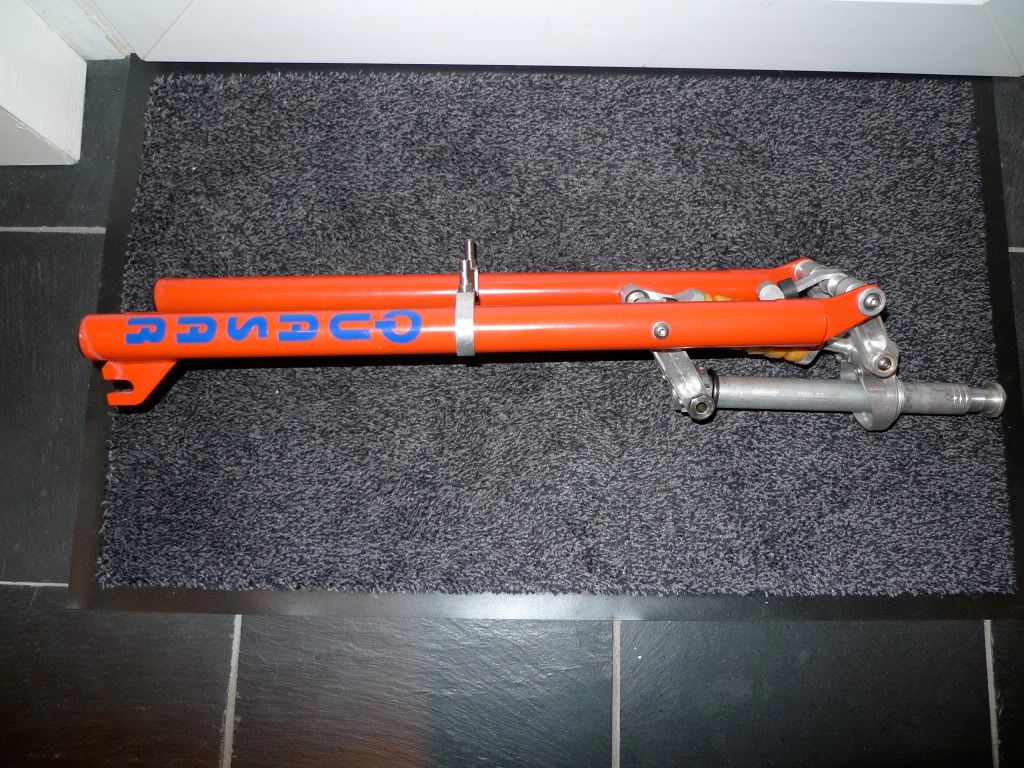 [/img]
thisisnotaspoon - Member
...What I dont get is why fork stanchions are always parralel tot he steerer tube, surely they're missing a trick to slow the steering down a bit by making them more vertical so for the same static rake/trail...
The more vertical the fork tube is the more likely it is to stick. There's a sweet spot of headangle for teles - too much slack and they bind, too little and they bind. Fortunately the sweet spot has a reasonable range. Also with larger diameter tubes being used now, it is less of a problem. The shorter the fork the lesser the problem.
Suntour FTW!
[img] http://www.srsuntour-cycling.com/gateTools/scripts/binary.php?BinaryCodeID=1723&convert [-resize]=400x600[/img]
there must be, oh, several whole milimetres of travel on those suntours.
I think the telelever single wishbone type have potential for mountain bikes. Simple system, not too many bearings needed, direct mount handlebars, natural antidive while allowing bump absorption so yo can have soft springing without it plunging under breaking
[img]  [/img]
I my mate had some Girvin Vectors when I had RS Mag 20s and his were far more reliable than mine. I'd still love a set of linkage forks but then I'd also love a belt drive IHG full suss as I'm odd like that.
One of the issues with linkage forks has nothing to do with the suspension, they'll only fit a certain maximum headtube length so they end up being made long to accommodate all sizes and can as such look a bit odd
The limiting factor on the Whyte (and you can see it on mine (apologies for posting the picture on a 2nd thread) is that the top linkage swings up towards the handle bars; limiting the maximum travel available by the height of the front end. It feels a little high with the travel available as it is; if you were to up it to 140 or more than it would get ridiculous.
[img]  [/img]
I know Ade Ward (who was involved in the design and sometimes pops up on here) uses a 24" front wheel to help drop the front end down; though this steepens the head angle slightly. I've just swapped to some fleegles to help lower the bars without compromising the head angle change - it's a little steep by todays standards 😀
Oh; and fwiw @titusrider - I've never had an issue with that problem; but then I've only had air cans on the front of my PRST1 / 4's - It may well be a spring thing.
My thoughts are that the weight and complexity to benefit ratio isn't quite there for push-bikes, and might not be there for motos either.
It's often a more effective solution to put your time and effort into making an already relatively mature technology fit the application better (linear push-rod dampers in telescopic forks), rather than scrapping the whole system and generating entirely new sets of problems (stiffness, damping characteristics, unsprung weight etc) for a possibly marginal gain (better wheel path).
In a way, this is analogous to the single pivot vs multi-link question: by putting design effort into damper technology, stiffness and weight, single pivot bikes remain competitive despite their 'obvious' flaws. Linkage forks are the same but more-so IMO.
I also had Girvin Vector forks many years ago on a Proflex.By far the worst forks i've ever had.I swapped them for some RS Judys and even they were massively better.
the whyte is also compromised by the short top wishbone and the top wishbone being used for steering - compare to the BMW double wishbone system which has a separate steering linkage. the shock would also effectivly have a falling rate leverage ration from the angle its mounted at - presumably for a reason tho
I got into the whole 'telescopic forks are a compromise' story back in the 80's when I had a Feet Forward M/C, like these:
http://www.bikeweb.com/node/458
And I've ridden most of the old crop of various methods, but tbh none of them were as good as the mass-produced forks available on bikes at the time. I don't doubt that with some decent engineering they could be (as good?), but even those tried didn't sell particularly well (BMW excepted):
http://en.wikipedia.org/wiki/Yamaha_GTS1000
And tele-forks just work 🙂
I thought the reason behind the falling rate leverage was to compensate for the natural increase in spring rate as an air shock runs through it's travel (the overall effect being essentially linear) - not sure how close this comes to levelling out or how much this makes fitting a coil to the front (as some of the cheaper whytes) a really bad idea ...
I was following all that as well BR altho I never rode one.
the BMW telelever works really well. When you brake it dives an inch and no more to give the feel - but the fork still absorbs bumps when braking. as a result you can have a really soft spring rate for comfort without getting dive or wallowing. especially good two up. It also does not tuck or run wide when braking and turning.
I think the antidive / soft spring would work realy well on MTBs
[url= http://www.tonyfoale.com/Articles/Steer/STEER.htm ]Why not..... [/url]
i had a pair of girvin vectors - i think they were ok.
but...
they 'only' had 75mm of travel,
the damper was a bit shonky.
they looked weird.
If USE put a better bearing on the SUB it would be a world beater
I'm a bit of a linkage fork perv....
In the collection I've got:
GT Xizang with Quasar No 1's (and some of those other "shockingly bad components - Spinergy Rev X Roks !!! Oh the Horror! ) fitted to it and I LOVE them... I used to ride them everyday through my school, college & Uni years. They (the wheels and forks) had a reputation for snapping, but I've never had a problem and they've had some pretty hard hits over the years.
Excuse the Pic its a dodgy edit, and a few years old too.
[IMG] 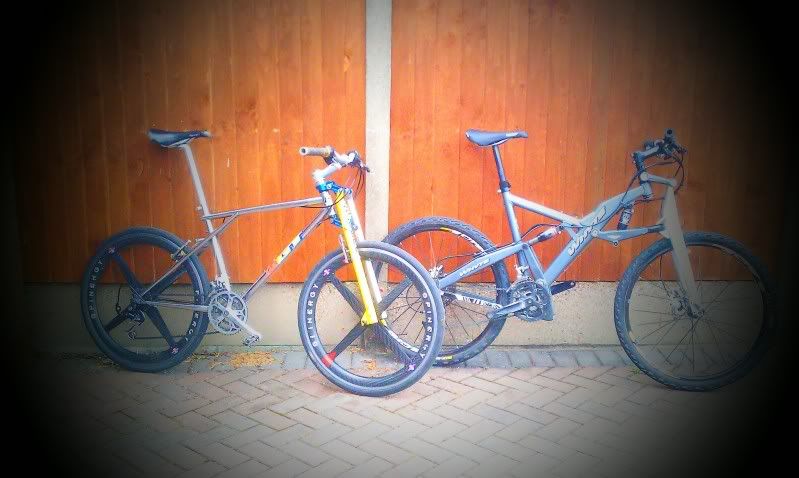 [/IMG]
I've got a PRST1 WORKS XT - LOVE IT... and ride it wherever I can.
...and a Kenisis Ultra Light fitted with some Carbon Look Fournales... check them bad boys out!
The latest steed has fox Talas 32's and somehow there not as responsive as the Whyte.
titusrider - Member
everyone who ive ever heard about the PRST-1 from said the fork dived deeper and faster than..... (insert poor taste joke here) and was therefore a complete nightmare to stop yourself going over the bars.
POSTED 4 HOURS AGO # REPORT-POST
I have written several replies to this and each time I change it,I still can't find the words for people this oh yes troll is the best term
I was going to write a considered factual reply to the reasons why we designed the Preston forks and my experience in motorbike and mountain bike suspension development my 10 patents in suspension systems but I really can't be arsed when people like this write drivel on here
Spinergy Rev X Roks
I have a photo somewhere of me gurning through the remnants of a rear wheel. TBH it is the only spinergy composite collapse incident I know of.
Ade - forgive my ignorance... did you design the PRST forks?
why we designed the Preston forks
If ya did, TOP MAN they steer and track over small & large bumps like no bike fork I've ever ridden, and I love them, they do dive a bit under braking, but not much and hey what fork doesn't !!
Nick3216 - Yeah I had heard all the horror stories, but can't find anyone that's ACTUALLY OWNED AND RIDDEN THEM HARD that's managed to destroy one! Get that photo up it'd give us a laugh!
I rode a PRSTN in the lakes for a day and offroad it was fab, but smooth stuff made it feel like a barge.
I had an Amp and it was a great bike, and good fork for xc . At the time the travel was compatible to telescopic forks of the time.
Betamax was better than VHS. It's not just if something is a better design. The whole world has to accept it. They didn't, end of.
Part of the issue with mtbs is that they have to cope with a huge variety of situations that motorbike don't. On a (road) motorbike you need to soak up small to medium sized bumps and not dive too much. On an MTB there's a lot more to contend with. Small bumps are not so important but then you've got steep technical rocky bits, big dropoffs, air time, bobbing away climbing, sprinting out of the saddle.
I've never ridden a linkage fork, so I can't really comment on how they ride!
For several reasons, and none of them to do with fashion:
- why overly complicate a design? We already have bearings at the rear, why double up the amount of maintenance and replacement costs?
- more difficult to clean.
- more parts involved means higher manufacturing costs and therefore higher prices.
- weight is an issue unless you use expensive, high-end materials resulting in higher costs, and ultimately, higher prices.
- more places to collect mud, hence higher weight due to the amount of mud collected out on the trail and higher maintenance.
Oh, and they look butt ugly.
^^ all of these reasons sound like some of the rear suspension designs many of us have. That's not the main reasons. The bike ind invested in telescopic forks and the bow wave of marketing succeeded.
I had a PRST-1 for a couple of years followed by a PRST-4. I made the mistake of fitting flat bars to the PRST-1 which made it more prone to throw you over the bars. After riding Jon Whyte's own PRST-4 I set mine up differently with the front shock very soft and as much weight as possible over the back wheel. I still regret getting rid of that bike, the best fast XC bike I ever had.
Molgrips - and a linkage fork can be built to improve performance in any situation. Separating steering from suspension leads to a stronger more responsive fork, removing the stiction from sliders improves performance, separating braking and bump loads means yo can tune a it to work better and finally you could use existing rear suspension units so all that dfevelopment of fancy damping can be used.
Mikey - need not be more expensive or heavier - remeber simpler load paths so less strength needed and its easier to use of the shelf bearings than manufacture stanchions and sliders to a high degree of accuracy.
Its also cheaper and easier to replace a bearing than a stanchion and bushes
^^ all of these reasons sound like some of the rear suspension designs many of us have.
Exactly, so why double-up the problem?
Its also cheaper and easier to replace a bearing than a stanchion and bushes
Yes, but don't forget you still have a shock unit to service, as well as all the pivots.
Molgrips - and a linkage fork can be built to improve performance in any situation
Yeah yeah we've done this before 🙂 I like the theory of linkage forks but I'm not so confident that I would back them in ANY situation without really having ridden them 🙂 However I still think the requirements for road motorbikes are different to mtbs
"there is a greater body of knowledge on how to make a telescopic fork work"
Yeh, because they all last so long without wearing out, they need so little maintenence and spares for replacing worn parts are so cheap/easily sourced
A few bearings, a couple of shock bushings and air sleeve maintenence (granted not cheap if you add it all up*) must be cheaper than if your fork bushes and stantions go. Requiring a £200+ set of uppers and now rockshox (for one) have made the lowers with non-replacable bushes, you need a complete set of lowers on top. If someone else is servicing it you're talking £400-500?
"maintenance and replacement costs?"
*Shock service sent away around £80ish (or less for less complex damped shocks) plus ~£40 for a shock shaft if needed? Plus a few bearings, cheaper than worn out forks as above?
"more difficult to clean"
But what NEEDs cleaning? Shock seals/shaft, a telescopic fork (okay not a lefty) has twice as many and many part of them are half hidden away behind the arch. Bearings should be sealed, plus once replaced are new again?
"Exactly, so why double-up the problem?"
Make it simpler still, put a rigid fork up front ..
Conventional sliding forks operate at a 1:1 ratio. Most linkage designs are at a higher ratio. Just like rear suspension, the lower the ratio, the more tunable it is.
In either issue 1 or 2 of http://www.switchbackmb.com they interviewed suspension pioneer Mert Lawill. He says that he's bringing back the Leader fork design...
url="http://img41.imageshack.us/i/p6210290.jpg/"][img]  [/img][/url][url="http://g.imageshack.us/img41/p6210290.jpg/1/"][img]
  [/img][/url]
[url="http://img196.imageshack.us/i/p6210291.jpg/"][img]  [/img][/url][url="http://g.imageshack.us/img196/p6210291.jpg/1/"][img]
  [/img][/url]
this is a hossack supermono i saw in the paddock once. Everything is made out of steel, and to quote the owner
"The front and rear 'forks' weigh 2.5kg each (about a quarter of the weight of a pair of forks and half the weight of an aluminum swingarm). This reduces the amount of unsprung mass and allows the sprung mass to be close to the centre of the bike. This allows improved suspension control, which becomes more of an issue with lighter bikes."
🙁 feels bad about making ade feel like i am trolling.
I am pretty sure i read a review mentioning diving back in the day and the people I've talked to who rode them have mentioned it. I do accept that i never rode one and as such my thoughts can be ignored!
Sorry for any offense ade and im sure you do know a whole world more than me on the subject. Would love to hear more about the design process and if there is some anti-dive going on in it.
Good answer Ade 🙂
the way I see it is simple. Linkage forks are technically better, but don't look "normal" therefore are shunned by the public.
<tries to think of smutty analogy, but fails>
From what I recall of the AMP forks I had years ago the only problem with them was they squeaked a fair bit.
Oh, and I broke them after a rather heavy landing 🙁
They were light, seemed to work pretty well and looked quite nice.
They're also the only bit of kit I've ever owned that people have shouted covetous thoughts about when they've seen them. That may not be a benefit.
Used to ride with someone who rode a prst-1. He loved it, especially since he didn't have to take the fork apart after every muddy ride, like on his last bike (some manitou things). The head angle didn't change when the suspension was compressed (apparently). He cracked the swing arm, mainframe and fork, he was a hard rider though.
I've got a PRST-1 languishing in the shed for commuter duties, IMO it was fine for XC, tracking beautifully over small bumps but when the pace was upped it would struggle and I went OTB more than once as the front plunged through it's travel.
I think that conventional tele's have had 70 odd years of R&D by a lot of manufactures and the linkage driven suspension has had hit and miss R&D over the same time. Perhaps if the same amount of money/time had been thrown at linkage systems they would not be seen as the quirky, sometimes flawed system that they can be.
Market forces/inertia have also influenced the direction/fashion of the motorbike/cycle industry.
However a 140mm travel DRCV shocked modern interpretation of a PRST would be very tempting.
In my experience of the PRST design (over 5000 miles) the weak point was the spherical bearing, on the PRST-1 I was changing them every couple of months until they brought out the rubber boot to cover it, but they never completely solved the problem. I never had the slightest problem with the other bearings.
agreed on the weak point being the spherical bearing - my PRST-4 lasted just six miles on it's original ! 😮
Turned out there was a machining fault on my lower wishbone; got a replacement wishbone couriered out the next day and it's been fine since (normal replacement schedule as I expected should I say) - That reminds me though - it's starting to exhibit the death rattle; I should get it booked in for a replacement...
BMW use them on motorcycles to great effect - both double and single wishbone systems. I had a BMW with the telelever set up. it was great and would work well on MTbs IMO
Ermmm no they don't, not for the "proper" off road 450 they had a few years back. Honestly if it was THAT much better it would be use at least in racing, where money is no object and weight matters more.
juan - Member
...if it was THAT much better it would be use at least in racing, where money is no object and weight matters more.
Not necessarily. Racing is a very conservative thing where incremental changes get made. Riders are accustomed to the feel of telescopics and having to adapt to a new system is highly risky. It's unlikely anyone is going to make the investment in a new system which has a high risk of being rejected because of the status quo. There's generations of riders who expect the front to dive when the brakes are applied hard and their riding reactions are built around that. Maybe someone stepping off a rigid bike may be the best candidate for a linkage system, but there's no top level pros racing on rigid forks.
We may see it happen in motorbike racing as the factories are all having to overcome problems with chatter in front wheels. Or more likely, even more expensive telescopic forks...
Are AMP the ones Philippe Perakis used to use back in the day?
I rode a PRST-1 for three years and I lost count of the number of "guaranteed for life" spherical bearings it consumed. In a straight line (up or down) the fork worked reasonably well but I always felt it had a tendency to "tuck in" on tight corners and throw me off.