 You don't need to be an 'investor' to invest in Singletrack: 6 days left: 95% of target - Find out more
Just took delivery of a pair of these:
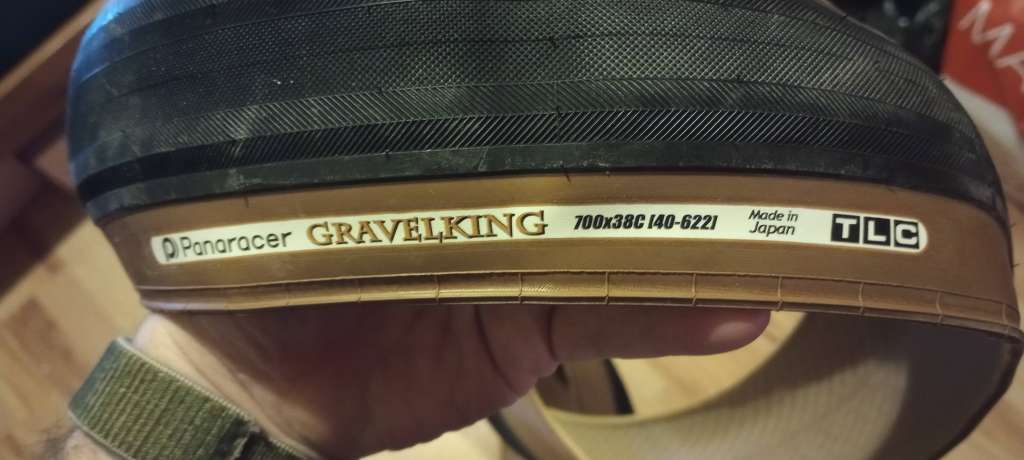
Took a bit of a flier cos they were cheap; I'm planning to put them on the dedicated "Summer roadie" wheelset, I've weighed them and they'll only be about 80g heavier than the ~28C tubed tyres they're replacing, planning to run them tubeless on 20mm internal rims initially (will eventually buy some wider rims I think). The width means I can run more sensible tubeless pressures, and they should still allow for some more off-roady short cuts (I do have a Gravel wheelset with G-one All-Rounds on for proper off-road days)...
But I'm just wondering if 38mm is a bit much to still call these a "road" wheelset? I'll still need to keep up with the other fat Dads on Sunday cake runs. should I have gone more like ~32C?
Thoughts?
You could always just fit one on the rear wheel, that is out of the wind, for extra comfort. 😉
I am running 35mm specialized mondo tyres on my winter road / gravel bike.
I really like them, nice low pressures for tubeless as I am 110kg
Prob twice the rolling resistance of a high end Pirelli or continental road tyre but loads of comfort. Enjoy
I’ve started running 50mm front and rear. It’s lovely and comfortable. They work in all sorts of situations and are fast for group rides too.
The state of the roads these days means that, at least for me, the days of 28mm are just a distant memory.
Just popped to the Garage and fitted the rear to see how it looks, seated easily, very bulb like profile but it's not utterly ridiculous looking, I'm not really concerned about teh aeroz TBH, it's a roadified Gravel bike.
I plugged my girth and my tyre's girth into the SRAM calculator (set for dry road use) and it's suggesting 48psi front / 51psi Rear which doesn't seem bonkers high for a road tyre (currently running 75/80-ish in tubed 28s on the winter bike).
Drop the tyre width to 35 and the calculator only seems to add about 5psi either end. So I think I'll give them a fair shake when the summer eventually arrives, and see if the chonk does actually translate to comfort with acceptable drag. Apparently these wear fast though, so once they're shagged if I've really found them a struggle perhaps I just stump up for some more premium, proper road tyres.
I ran gravelking 700x 47 slicks commuting a 40 mile round trip for a year. at 60psi they're not all that slower than narrower road tyres. (genuine opinion from also having a nice light carbon roadbike with 25c tyres)
They're ****ing awful tyres for punctures though. and the internal casings delaminate when run tubeless so ended up running tubes in them as the warranty procedure (zyro) is a PITA.
worst comes to worst let the fat dads get to the cafe first so there's no cake for you.
WIN WIN!
Dave's being trying 40mm
Are 40mm Tires ACTUALLY Faster? (40mm vs 30mm Test Results)
Are 40mm Road Tyres the Future? My 500km Test Results...
Once you get to this kind of size, it’s not just rolling resistance but aerodynamics, so it all depends on average speed and whether you’re solo or in a group. I used to run 38s and ride solo, but as you approach 30kph, they really do start to slow you down. In a group, it’s less noticeable. At 72kg - 32s are the sweet spot for me. I can run 45-50psi, they’re the same outer width as the rims and the tyre/rim combo isn’t overly heavy.
As a direct comparison, swapping my 40c gravel wheels onto my commuter which has a power meter, I’m about 10% slower and use between 5and 8% more power whilst going slower.
I think you might like them..
The best long-distance lightweight road bike I've ever had used 650 x 42mm Panaracer Pari-Moto tyres with paper-thin inner tubes (Pari-Motos got renamed as Gravel King Slicks). Fast A-B as long as I didn't flat. It was a bike with a decent Al frame and carbon fork but overall nothing special, it was just so easy to keep a good pace up on average UK roads and over a 5-7 hour ride the comfort mattered.
What I think will be interesting is to see how strongly 700C remains the rim size of choice as riders begin to accept tyres in the 38-40mm range. 700 x 40 is a large wheel OD andthough it's workable, compared to where we are generally (700 x 28) it's really tyre volume we need on tarmac rather than larger OD. Tyre volume for the high frequency vibrations. 650B feels quite a niche option these days but 650 x 42 managed to feel both cushy and fast on a road bike ime, a bit lighter overall too.
Day to day I'm happy enough on 30mm tyres at about 57 psi and my next road bike will be aiming at 700 x 34-38mm but I do miss that 650B road bike project build.
and the internal casings delaminate when run tubeless
That's a concerning statement...
On the flip side I used countless 32c GravelKing slicks tubeless when I was into Audaxing and never had a problem.
The state of the roads these days means that, at least for me, the days of 28mm are just a distant memory.
Same here in Suffolk, any perceived advantage of skinny tyres is swept away by my lack of fitness and the terrible roads.
I find 30c GP5000s to be the sweetest spot. Wide enough for comfort, narrow enough not to look odd on conventional Open Pros (which are really optimal for 25c on my other wheels). Very pleased with them.
Am also running 33c gravel tyres on the same rims without issues, but for road it’s 30c
I'm running 35mm GP5000s all seasons this winter. Very happy with them and ride in all conditions.
Summer I run the 32mm GDP5000s. These are on my Giant Revolt which I use as a road bike.
What I think will be interesting is to see how strongly 700C remains the rim size of choice as riders begin to accept tyres in the 38-40mm range. 700 x 40 is a large wheel OD andthough it’s workable, compared to where we are generally (700 x 28) it’s really tyre volume we need on tarmac rather than larger OD. Tyre volume for the high frequency vibrations. 650B feels quite a niche option these days but 650 x 42 managed to feel both cushy and fast on a road bike ime, a bit lighter overall too.
That's an interesting point actually, Personally I'm OK with the wheel OD increasing a smidge (10mm), and actually as I'll be running a roadified gravel bike the drivetrain will sort of compensate I'll be using a 46/30 chainset not a 50/34 so the gear inches probably shake out similar(ish) (48/32 is also an option). My goal is to achieve comfortable cruising for middle and long distances on the road, rather than outright blistering speed. I'm not keen to start mixing Rim sizes now, 622mm across the board, tweener rims hold no interest for me personally. The frame looks like it will comfortably accept 700x45C, possibly 700x50, but I don't fancy going above 40C for road or Gravel (yet).
Fag packet maths suggests the internal Volume difference between a 700x38C and a 700x28C is ~25% (ignoring tubes of course) which isn't insignificant for 10mm extra Girth/Radius and ~100g per tyre weight penalty that feels like a reasonable trade-off (IMO).
Of course for smaller riders (and I'm no giant at 5'10") I can see ~700x35C+ wheels potentially feeling a bit cumbersome and impacting sprightly handling and acceleration, perhaps 650b (x35-42C) road slicks make sense for riders who are 5'0" and under?
They’re **** awful tyres for punctures though
Exactly my experience too. They're wonderful to ride, fast and comfy, but far too thin so they just end up full of holes.
Big slicks are absolutely fine for cruising as long as you get the pressures low enough - try the Rene Herse tyre pressure calc. Once you get over about 21 or 22mph then they get noticeably slower (compared to fast road setup anyway). But on crappy roads at low pressures they are great. Big confidence boost on wet greasy corners too. If you want the very best then try some Rene Herse Extralights in summer - simply sublime. I had the 44mm and it was quite comical how fast they could be in the right conditions, especially when you're riding with folks who are getting bounced around on 28's or even 25's.
I run these same tyres in 32mm and 35mm on my road bikes and they fly along quite happily, Bicycle rolling resistance I think has the 32mm at around 1-2w slower than a similar GP5000 and from back to back anecdotal findings I'd support that.
I've never had issues with punctures or longevity but I'm only about 70kg running them at around 50psi, in fact they've lasted longer than the Conti's in terms of time simply by not perishing like the GP5000's like to do!
I'm more of a 15-18mph average speed road rider though, not 20+ so others may have different views I guess based on their speeds!
They’re **** awful tyres for punctures though. and the internal casings delaminate when run tubeless so ended up running tubes in them as the warranty procedure (zyro) is a PITA.
Just replaced a pair of 32mm GK slicks set up tubeless on my winter/audax bike. Not a single flat or issue in nearly 4 years/3500 miles.
I'm running 32mm Goodyear Vector 4-Seasons tubeless road tyres, mostly because I was given them. They feel about right tbh, reasonably fast, reasonably grippy, reasonably tough etc. The missus tried commuting on big Gravelking slicks and they flatted repeatedly. After she gave up on them, I gave them a try and flatted several times in a single ride. Maybe the larger ones are disproportionately thin? Anyway, for pure road stuff, 32mm seems pretty good.
IME the fast guys are still fast on gravel tyres and the slow guys are still slow on the most aero wheelsets, just slower or faster than they would have been.. At the end of the day the difference between the best and worst is still significantly smaller than the difference between being on the front and sitting in the group, so you just take a different ratio of turns.
My new bike has 32c's on slightly too narrow (i21) and shallow (38mm) I think rims to make them significantly aero. I don't particularly care though. I'm far from the fastest and will be more comfortable.
It's worth considering that you don't need really deep aero rims if you're running big tyres (32mm) on wider rims. A 40mm deep rim with a 32mm tyre will be like a 50mm deep rim on a 25. Again, I think 35-40mm deep rims with an ID of 25mm are the sweet spot in aero/mass/crosswind for a 32mm tyre.
What I think will be interesting is to see how strongly 700C remains the rim size of choice as riders begin to accept tyres in the 38-40mm range. 700 x 40 is a large wheel OD andthough it’s workable, compared to where we are generally (700 x 28) it’s really tyre volume we need on tarmac rather than larger OD. Tyre volume for the high frequency vibrations. 650B feels quite a niche option these days but 650 x 42 managed to feel both cushy and fast on a road bike ime, a bit lighter overall too.
I'd buy into that, especially for winter riding. It would have the added bonus of better toe / mudguard clearance.
perhaps 650b (x35-42C) road slicks make sense for riders who are 5’0″ and under?
I think JamesO's right though, there's no real benefit to big wheels on the road other than the UCI mandates them. There isn't any 'rollover angle' benefit like 29ers.
Outside of the UCI's jurisdiction plenty of one off fast bikes have used smaller wheels to gain speed. They're far more aero with smaller frontal aeras, shorter spokes, fewer spokes (inherently stronger and stiffer), less skin friction,
It’s worth considering that you don’t need really deep aero rims if you’re running big tyres (32mm) on wider rims. A 40mm deep rim with a 32mm tyre will be like a 50mm deep rim on a 25. Again, I think 35-40mm deep rims with an ID of 25mm are the sweet spot in aero/mass/crosswind for a 32mm tyre.
To some extent the whole aero thing leaves me cold.
AIUI rim depth is less significant than having a 'blended' tyre to rim profile, and it's not so important what profile the leading section of the wheel presents as the top and bottom.
A 'U' shaped rim with an external width closely matched to the tyre (say 32mm) will move through the air more cleanly than an equivalent 'V' section rim.
Of course the main thing to note is that the testing that always reports a handful of watts saved is always at far higher avg speeds than tubby middle-aged nodders like me move at (at least without gravitational assistance)...
Definitely slower than my 25mm gp5000 s on the summer bike, but can still keep up on club rides.
Of course the main thing to note is that the testing that always reports a handful of watts saved is always at far higher avg speeds than tubby middle-aged nodders like me move at (at least without gravitational assistance)…
Depends what you are measuring.
Watts saved in a group will be lower on the average Sunday bun run.
Time saved over a course will be higher because the longer time spent on the course is longer.
A ‘U’ shaped rim with an external width closely matched to the tyre (say 32mm) will move through the air more cleanly than an equivalent ‘V’ section rim.
Technically a slightly wider rim is better, 28c on a 30mm rim apparently being 'best', that's measured at the bulge not the lip. But it makes for odd cornering as the tyre is stretched out, so most recommend a tire size up or a slightly narrower rim.
how wide is too wide?
As long as they fit in the frame and fork with reasonable (most manufacturers state 6mm or 1/4") clearance all round, then it's not too wide... It's just personal preference. It's only too wide if it causes clearance issues!
Fag packet maths suggests the internal Volume difference between a 700x38C and a 700x28C is ~25% (ignoring tubes of course) which isn’t insignificant for 10mm extra Girth/Radius and ~100g per tyre weight penalty that feels like a reasonable trade-off (IMO).
Just wondering how you got to that...?
Area of a circle is πr^2...
OK so the area of an inflated tyre isn't a perfect circle, but it's pretty close...
[img] 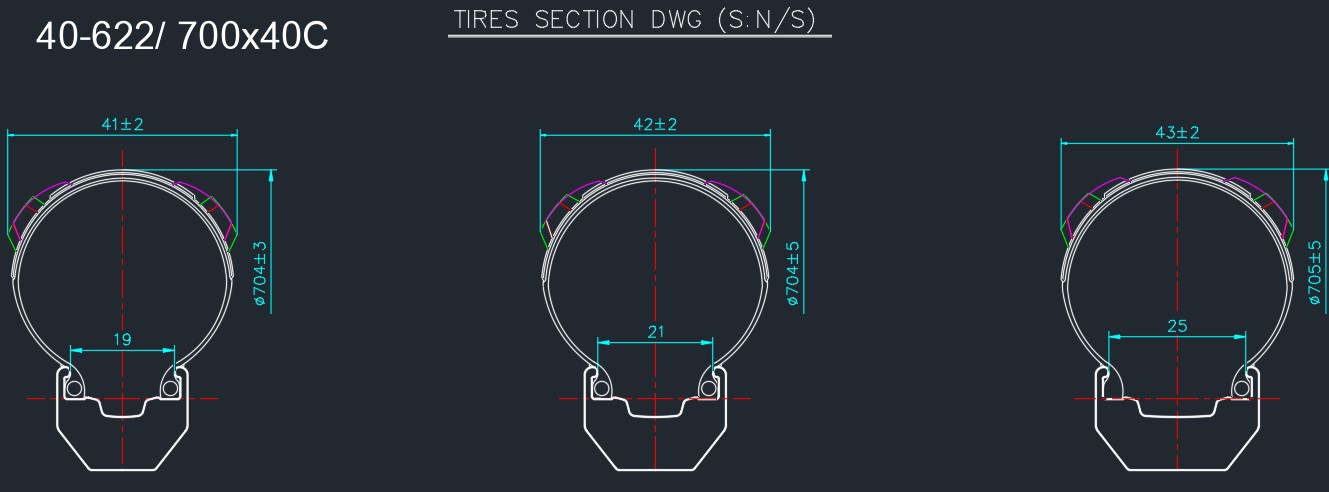 [/img]
The area inside a 28mm circle is approx 6.16cm^2, where the area inside a 38mm circle is approx 11.34cm^2... In other words, approximately 84% larger cross sectional area when going from 28mm to 38mm, and as P = F/A, you would expect to need only a little more than half the pressure inside a 38mm tyre when compared to a 28mm one.
As an aside, we have traditionally been led to believe that rolling resistance is proportional to tyre width, and that narrower is always faster. This line of thinking started to be questioned probably some 15yrs or so ago as we started to move up from 23mm tyres being the norm on road bikes, and the further that tyre technology has come on, the more that the perceived wisdom has been challenged. We are at a point now where World Tour level races are being won on tyres measuring as wide as 32mm (on tarmac, not cobbles!), and world cup level XC racers have been on 2.4" tyres for a while now and some are starting to experiment with 2.5 and even 2.6" widths right now too!
Just wondering how you got to that…?
Area of a circle is πr^2…
OK so the area of an inflated tyre isn’t a perfect circle, but it’s pretty close…
It's not quite that simple though?
The comfort is largely down to pressure, and rider weight* / pressure determines the contact area.
A 23mm tyre at 80psi has exactly the same size contact patch as a 32mm tyre at 80psi.
Where it get's weird is that tyres don't obey Hookes law. The volume is essentially too big, Which is why you can pinch flat them. All it needs is the contact patch to shrink (and a bit of a shock load to increase the force) and the 'spring' collapses to the rim. Just riding along normally though the 'spring' comes from the contact patch increasing as you apply more force (more area x pressure).
Where I think JamesO might be onto something is that the smaller the wheel the less quickly that ramps up. The more the tyre slopes up from the ground the less the contact patch will grow for each bit of downward deflection until it balances the force applied.
So the conclusion is I think that a smaller diameter wheel will feel more comfortable with the same tyre cross section and pressure because the initial spring rate is less harsh?
*technically correct, the best kind of correct after all, weight is a force.
Just wondering how you got to that…?
Area of a circle is πr^2…
Very simply, use the Rim's circumference (1954ish mm) and take the labelled width of the tyre as the diameter to work out a simple cylinder volume for each tyre, no factoring in rim width, tubes of carcass thickness.
But like I said, just fag packet maths for the sake of comparison, probably very in accurate, but consistently inaccurate 😉
Very simply, use the Rim’s circumference (1954ish mm) and take the labelled width of the tyre as the diameter to work out a simple cylinder volume for each tyre, no factoring in rim width, tubes of carcass thickness.
But like I said, just fag packet maths for the sake of comparison, probably very in accurate, but consistently inaccurate
Gotcha
Yeah the total circumference of the tyre is kinda irrelevant. The cross sectional area of the tyre is far more important here, as pictured and calculated in my last post.
It’s not quite that simple though?
For sure, I don't disagree. But for the purposes of this thread it doesn't need to be any more complicated.
Where it get’s weird is that tyres don’t obey Hookes law.
Forgive my ignorance, it's a long time since I studied A level physics... But doesn't Hooke's law describe how a linear spring behaves? Of which a tyre most certainly doesn't prescribe...
They will be slower than any other tyres on the market due to the amount of time you will be stopped fixing punctures
Forgive my ignorance, it's a long time since I studied A level physics... But doesn't Hooke's law describe how a linear spring behaves? Of which a tyre most certainly doesn't prescribe...
That's what I was getting at, reducing the diameter takes it closer to Hookes law?
Or at the very least it reduces the rate at which the contact patch grows as you load the tyre.
Smacking it into a 90' edge of a pothole would be roughly the same regardless as the size of the contact patch is just tyre crossection diameter*(tyre crossection diameter/2)^2.
But if you took an infinitely large diameter wheel and load it, then the contact patch increases an infinite amount, i.e. it doesn't give. If you took a square wheel and loaded it the opposite happens, the contact patch doesn't grow so the tyre collapses as soon as the force is greater than pressure*area.
Somewhere in the middle there's a funny shaped hypothetical wheel where the angle of the front/rear of the tyre means the contact patch increases in a way that makes the tyre mimic Hookes law. My gut feeling is it's probably closer to a 20" BMX wheel with a 2" tyre than a 700c wheel.