 You don't need to be an 'investor' to invest in Singletrack: 6 days left: 95% of target - Find out more
So how much difference does an £1 per gram really make to the very average XC racer? Is there any point buying a slightly heavier bike to save cash, or is that kinda self sabotage? Should mid pack racers be stretching funds to buy the lightest bike for the best advantage?
I kinda know the answer but thought the topic might be an interesting Friday muse…
Always a toughie. For me it comes down to realistic expectations. If a 2kg lighter bike gets you from 3rd to first then sure... If it gets you from 28th to 26th then Meh...
I wonder if a better setup bike would get you that, or a skills session would get you that...
My current race bike is just under 25lb. Which is ridiculously heavy for a race bike.
When I compare it to my race bike from 2012, it's 4lb heavier. But my results now are as good as they were then, I'm possibly even a bit quicker. So I don't think throwing loads of money at the problem helps.
I'd just buy that Vitus Rapide CRX you've been eyeing up, fit a dropper and get on with it.
To an average XC racer a KG here or there is not going to make any difference. How heavy is this average XC racer and could they be lighter themselves, more fit themselves etc,. to be not quite so average XC racer?
I used to do some XC races for fun BITD. I raced a Giant NRS with Rockshox Psylo U-Turn forks (adjustable from 80 to 125 mm travel) and disk brakes, back when weight weenies were still moaning about how rim brakes were lighter and suspension just slowed you down, etc. An 80 mm Sid was the normal XC racing fork, probably saved about 600 grams over my Psylo. I also ran 2.2" tyres converted to ghetto tubeless, when most racers were running 1.95" tyres. Being a moderately fit amateur, I always found I was faster on a suspension bike that had good brakes and decent forks. I also ran a GravityDropper post when they were the only dropper post available. The Expert and Pro racers would tear past me at impressive speed on bikes that were probably 2 or 3 kg lighter, but that was nearly all fitness and body weight. I think my NRS weighed between 12 and 13 kg. I could save a lot of energy on descents and tended to do better the longer the race. If I'd been on a lightweight hardtail, I would have gone slower because I just didn't have the fitness or bike skill to take advantage of it.
So how much difference does an £1 per gram really make to the very average XC racer?
If were talking cost v benefit ratio then I guess it depends on how enormously wealthy the very average XC racer is?
I think there's a psychological boost to knowing you have a very light bike though, even if the reality is that physiology and tyre choice are going to make exponentially more difference. Feeling you're on a rocket-ship maybe helps you push harder if you're wired that way, but it's pretty subjective.
Someone should be able to work out the physics of this. 80kg rider plus 10 kilo bike v 80 kg rider and 12 kilo bike X m of climbing at Y watts output etc
that looks to me like a under 2% advantage on climbs so in an hours climbing a minute and a bit advantage?
Needs someone with a better knowledge of an average XC race and who can be bothered to do the arithmetic 🙂
And those calculations would be based on a rider doing a solo lap surely, i..e without other people in the way meaning imperfect line choices and so on.
that looks to me like a under 2% advantage on climbs so in an hours climbing a minute and a bit advantage?
On a road bike where most of your energy during climbing goes into height gain yes. I'd say an mtb loses much more energy due to rough terrain etc, and a lighter bike won't help with that.
For me an average mtb ride is half the speed of an average road bike ride, so you're losing half your energy just overcoming friction (maybe), so I would half your estimate to 40 seconds per hour of climbing, assuming all else equal
Ofc all things aren't equal and the heavier bike might have better suspension, making up those 40 secs on the descents
Pinkbike did a test of big bikes vs small bikes and it all came down to tyres
so we need one of the racing snakes to do an hours loop with normal kit then after adding 2 kg of ballast to the bike 🙂
On a road bike on a long consistent climb, ie alp d’huez, a kilo makes about 30 sec difference
On a typical mtb course I’d say the wheel weight would be the biggest factor. You are going to be constantly accelerating, so rotational weight would probably come more into play..
probably..I have no evidence to back this up
Doesn't matter much past a certain point imho, and your bodyweight is obv a v important factor. My results wouldn't have much bearing on the decision, otoh - assuming you've been racing for some time and are more or less at your level, +/-. I wouldn't care if I was 1st or 31st, I'd get the best bike I could afford for the best race experience.
One reason MTB racing is hard AF is the off-interval you get from descents, which makes the on intervals really hard - anything that erodes your composure on descents is a major penalty that will obliterate any micro-gains from shaving bike weight.
If it gets you from 28th to 26th then Meh…
Depends who is in 27th…
For XC racing, efficiency would have a big part to play. Running the slickest tyres you can, without sacrificing speed on the techy bits.
Makes the bike nicer to ride obvs, no other justification. I bet the numbers say the same at the sharp end.
depends a lot on where and what that weight is.
weight is of course only one factor (unless you are doing experiments with lead filled water bottles) it generally doesn't just appear for no reason. Its going to give you a change in ride characteristic, which may or may not be beneficial for your specific situation/race.
most pros are on full suss and droppers full time these days, thats probably 1.5kg over a hardtail and carbon post.
of course you are then descending faster so need burlier tyres, stronger wheels etc... to truly reach the full potential of the frame and seatpost.
A fun game for the full time pro mechanic, but I imagine frustrating and expensive for the self funded weekend warrior.
I'd say naff all, given the amount of fast people on the new Scott Sparks and the "average" RC team is just under 12kg without a dropper & pedals, so reasonable to say they're about 12.3kg all in.
It's more important that you're riding a bike you're confident on, obviously you don't want to be dragging a boat anchor about, but once you're into the 10.5 to 12kg range for a medium / large sized (brands have a bad tendency to publish the weight of their smallest frameset without pedals) 100/120mm FS XC bike with a dropper you're in the ball park anyway.
My Scarp is 11.3kg with pedals, cage, (cheap ass Brand X one)dropper and 'puter mount, it's well specc'd with XTR, Hunt Proven hoops, carbon bars and decent, but 2.35" tyres (so not weight weenie stylee 600g things) and even if I dropped a kilo off it, it wouldn't make me faster.
The biggest improvements to me were the fitting of the dropper and when I put the wheels on the other week. The wheels felt nice first time out riding the Donkey at Cannock, but when I raced the Winter Classic last weekend I really noticed the difference, the bike just seemed more precise and went exactly where I pointed it and stayed there. The wheels that came off were DT Swiss XR 1700 Spline 25's, so not exactly poor OE wheels, but the difference was definitely noticeable at race pace.
In another world, that of CX, I was running Fulcrum DB600 (17mm internal - 1700g) wheels on my bikes with Vittoria Terreno Wet's and taking advantage of some of the crazy sales Wiggle had on I got 2 pairs of the Prime Attaquer (21mm internal - 1420g) wheels, same tyres mounted and the difference was night and day to me, better traction and zippier acceleration out of the gazillion corners you get on a CX course, everything else being equal.
GMBN tried it:
Id assume I’d be slower at this weekend Gorrick on my 32lb Occam than I would on my 24lb Spark. My question comes after seeing (via YouTube) one of the Elites gain a new stock bike and to profess to not to add anything to it. That bike weighs in at 25.5lb according to the manufacturer, he seems not to be bother about the bike weight in the slightest hence the question.
Depends a lot on the riders weight.
For example. A few upgrades on a low to mid spec bike can easily save 1.5kg
1.5kg to a 150kg rider is 1%
1.5kg to a 50kg rider is 3%
If you're heavy and strong; probably wont notice the lighter bike. If you're lighter and proportionally less strong; you probably will notice.
Id assume I’d be slower at this weekend Gorrick on my 32lb Occam than I would on my 24lb Spark
The answer is, probably. But it depends on a lot of things like grip, traction, descending, cornering as well as actual just weight of bike.
Without sounding too harsh here, i think you'd gain more time working on your descending/trail speed than you would from a lighter bike. If you can get your skills higher i think you'd gain more time overall.
Along with increased skills, increased fitness and lower body weight but easier to just blame the heavy bike (that's what I do)
Thing is, once you have the lightest bike you can afford what do you blame then?
The bike I ride around on road and gravel is 5.8kg so not much chance of me blaming the heavy bike for my slowing speeds.
Id assume I’d be slower at this weekend Gorrick on my 32lb Occam than I would on my 24lb Spark
Swap the tyres and I imagine it would be pretty close. Geography means Gorrick courses are like 95% tight singletrack and 30 second climbs. about as far from the ideal test conditions that you find in any youtube psuedo-scientific comparison as its possible to get.
If your bike is in the rough ballpark, for a typical xc bike, you have suspension and a dropper, then I wouldn't worry about it. Tyres matter though, so for Highlands Farm I reckon barzo/barzo or that sort of thing unless it gets really dry between now and Sunday....but that seems unlikely. Anyway, have a good race!
Without sounding too harsh here, i think you’d gain more time working on your descending/trail speed than you would from a lighter bike. If you can get your skills higher i think you’d gain more time overall.
This thread isn’t about me buying a new bike, just a general question based on the reason I added several posts ago.
A super light XC bike is such a joy to ride though, you can really feel how nippy it is.
I used to be a bit of a weight weenie XC racer, eg used Dura Ace rear mechs and cassettes as I didn't need big cogs on the cassettes. Always had the latest Scott Scale frame etc. I just really like riding super light bikes.
Bit of a blast from the past though....
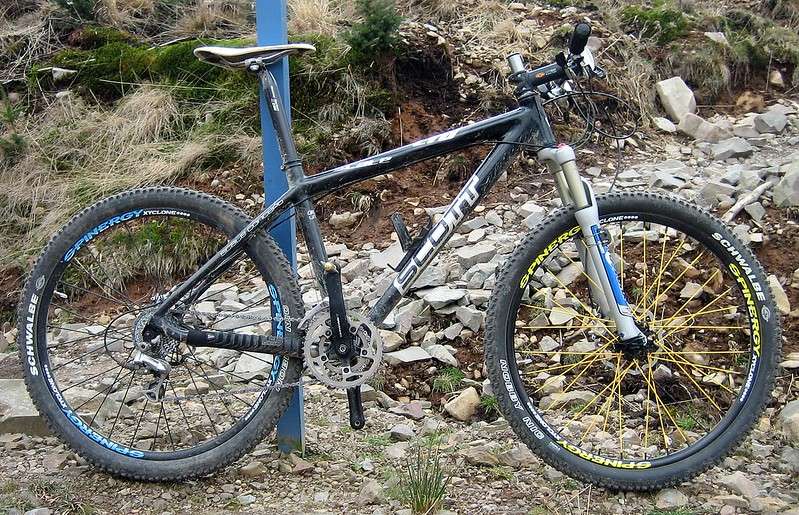
NB The steerer did get cut down.
Still use those EC-90 99gram bars on my town bike....
And those calculations would be based on a rider doing a solo lap surely, i..e without other people in the way meaning imperfect line choices and so on.
Without sounding too harsh here, i think you’d gain more time working on your descending/trail speed than you would from a lighter bike. If you can get your skills higher i think you’d gain more time overall.
My one brief foray into XC when I was fitter I concluded that if you were a second faster up the climb then you were the blockage on the descent. If you were a second slower on the climb you were stuck behind someone one the descent.
You could lose time on a descent, but it was nigh on impossible to gain anything.
My question comes after seeing (via YouTube) one of the Elites gain a new stock bike and to profess to not to add anything to it. That bike weighs in at 25.5lb according to the manufacturer, he seems not to be bother about the bike weight in the slightest hence the question.
Depends on their personal finances and sponsorship arrangements?
Maybe he can't afford to significantly upgrade an already good bike. It's relatively cheap to lose 2lb off a 32lb bike, in a lot of cases that could just be a fork and wheelset. Doing the same off a 25lb might be 5x the price.
Maybe their sponsorship deal says they can't replace "sponsored" components. So if it's a Trek bike with a Bontrager wheelset, Bontrager tyres, Bontrager bar/stem, etc, etc. And already has an XTR groupset, SC32 fork, etc, then there might not be anything they can realistically do as they don't have the unrestricted choice of the absolute lightest parts.
That bike weighs in at 25.5lb according to the manufacturer, he seems not to be bother about the bike weight in the slightest hence the question.
Because beyond the very basics i.e. not 10 kilos heavier than everyone elses bike. The weight is a good way down the list of things to worry about or that will affect your finishing position.
When I was racing weight was always a mental thing. I raced road and XC. I have actually raced similar grass courses to the one in the Youtube video above on my Trek Fuel Ex 8 running nobby nic's....(I reckon at least 15.5kgs) I can't quite remember the final result but I finished something like 24th out of 40. There was two short but steep climbs and I remember them being brutal. I would normally race on my Procaliber 9.7, massive difference (about 11kgs). I would normally finish in the region of 8th to 15th. The people I normally race against finished well ahead of me but on the same lap which was my target.
Racing on the road, I just loved having a light bike, I was 67kgs, optimal % body fat and similar to Kryton I was coached. I was never going to be an Elite, 2nd Cat for a season then back to racing 3rd Cat after a few years of not racing. A light bike just felt so much better to ride. I completely get it was a mental thing, but my race bike was a rim brake Trek Emonda with Dura Ace and 1300gram carbon wheels - weight was just over 6.2kgs. Being on a climb I would always have the confidence that the person next to me would likely be working harder to keep up (even if they weren't it was just the mental thought that they were)
I've built a L'Etape du Tour event time estimator, which is quite different to XC but comparable to XCM. Taking 1kg off the bike or rider weight takes the estimate from 6:44 to 6:40. A fair chunk of time, but that's about the most climbing dependent event I could imagine.
From my perspective as an elite-ish rider, my bikes are as light as they end up without worrying too much about it. I've never weighed my Top Fuel, but it's significantly heavier than some of my race bikes from the past, yet a lot faster. For example in 2014 I had a Canyon HT with rigid post, 2.0" tyres, rubbish lightweight rotors, 640mm bars, 11-34 cassette etc. I'm now got rear suspension, 2.4" tyres, a dropper, more comfortable saddle, massive cassette, wider bars etc, and going much faster for it.
As a junior I'd spend hours researching the weight of every little component. These days I just get whatever seems like it'll work best and is designed for XC, and assume it'll be fairly light.
That all said, my enduro bike is a colossal lump at 18.5kg - on the occasions that I've joined the XC group rides on that I've struggled.
Seen the email thanks Yak, I'll stand my Occam down 😉
So typical - 2 years of illness, then rock solid 9-10hrs a week Training from November until now and its gets cancelled! Oh well best to protect the course, it's for everyones benefit.
Similar happened to me. “Retired” from racing for a couple of years. Got the urge to train again, decided I’d get fit enough to race. A year of seriously hard work to get back to race fitness, first race planned for April 1st….and we went into lockdown!
It's not just down to tyres. On the Occam vs the Spark the geometry will be geared more towards efficiency than comfort on the Spark - getting your head down really increases how much power you can put through the pedals.
The Pinkbike tests, much as I like Seb, were a bit of a nonsense - put a very heavy trail bike (NP Reactor) against a similarly heavy Enduro bike (NP Mega I think?) on a test up a fireroad. If you put a proper downcountry bike in that test, that weight 26lb, and had more appropriate geometry you'd be quicker, but I bet if you tried the same thing on singletrack where you're accelerating and deccelerating constantly, the downcountry bike would wipe the floor with it.