 You don't need to be an 'investor' to invest in Singletrack: 6 days left: 95% of target - Find out more
The front wheel keeps coming out of alignment on my new Carrera Subway, I can tell when it has because I need to lean quite substantially to the left when doing no-hands.
So I took the QR skewer from my old Subway, which had exactly the same issue, which was resolved by said QR. Said QR is not a Shimano QR which I know is often recommended in these situations.
Thought I'd try filing the paint off to make a rough surface but that didn't work. I can unbalance the wheel without even getting on the bike despite a very firm clamping from the QR.
Wondered about getting some spots of weld and then using a pillar drill to machine it for perfect fit with the QR? Are QR clamps designed to a standard diameter?
Anything else to try? Or Shimano QR first port of call?
Steel Shimano QRs are the gold standard.
Check that the wheel is located properly in the dropout before you close the QR and that the dropouts aren't misaligned or damaged. I usually open the QR with the bike on the ground to ensure the wheel is correctly located, then close the QR again.
Check that the QR is lubed and operating smoothly.
Make sure that you are using the QR correctly. With the lever pointing straight outwards parallel to the axle, screw the nut up as hard as you can with your fingers, then close the QR lever. It should go over-center but still have plenty of clamping force.
The wheel axle should be fully seated in the dropout with nowhere to move before tightening the qr. If this isn't the case, it's probably worth trying to figure out why
Any particular Shimano QR? XT, Ultega, Deore?
Try a bolt one.
https://winstanleysbikes.co.uk/halo-anti-theft-skewer#197=9977&221=12193/blockquote >Very tempting as bike is locked outside on street when at work.
Yes I make sure the axle is seated properly before I close QR 🙂
braking forces vs QR/dropouts
Do them up a bit tighter
Never ever been a problem.
Not if you use decent QR skewers and fit them properly. Steel Shimano skewers are excellent but back in the 90s, people used to buy silly lightweight titanium skewers to save a bit of weight. Not the place to try and shave a few grams. There were also stories of people grinding off the lawyer tabs to save a few seconds on fixing a puncture in a race. Extremely stupid if true.
The main problem, I think is people not understanding how to fit the wheel correctly and tighten up the QR (not saying that's the case with the OP, just a common problem). People think the QR is a type of wingnut and use the lever to screw it tight, but leave the QR open.
There was a lawsuit recently about jogging strollers with wheels coming loose. From what I can see, it was because people weren't fitting them properly. It's easy to blame the users, but QRs just aren't a very good design for use by ordinary people with no training or experience fitting things together.
Do please check your technique for tightening your skewer. If any doubt take it back to Halfords and make sure you speak to their head mechanic, if still not sure then go to an independent mechanic/bike shop who should look at it for you. If you’re anywhere near Chesterfield I’ll look at it for you for free, I’m a qualified mechanic. Please don’t ride no handed!
I once stared at my front drop out and brake for a really long time. I convinced myself that the force generated by the brake wouldn’t force the wheel out of the drop out.
But I might have been wrong
I once stared at my front drop out and brake for a really long time. I convinced myself that the force generated by the brake wouldn’t force the wheel out of the drop out.
But I might have been wrong
You are wrong, at least for a standard QR dropout with the brake mounted behind the axle. Just try removing the skewer and slowly pushing the bike and applying the brake. The braking force will jack the wheel out of the dropout.
There are a variety of potential solutions as outlined by different posters ^^
Of the ones that you can control, a steel internal (enclosed) cam QR is better for various reasons including protection from grot. Shimano is probably the best-known example.
Fit it correctly so that the lever is on the left and isn't limited by the fork or some other component.
I've got one of the Halo allen key skewers; don't miss the bit of the instructions that detail torque settings 🙂
It's here in one article https://www.kinetics-online.co.uk/technical-info/disc-brake-safety-issues/
The brake force Vs the dropout issue is true if the dropout faces down and rearward about 10 degrees or so like a trad road dropout, if the slot is angled forward it's far less likely to happen (this was the early fix pre-TA). Many bikes do this now.
There should be lawyer tabs on an open dropout that would prevent a wheel coming out if a suitably tight QR had slipped under braking.
Another option on some steel forks is to use those hooked washers as a back up, if the dropout has a hole or can have one drilled. But it shouldn't be moving as easily as the OP describes, needs looking at.
The other point is to check the QR or allen key axle from time to time as the theory is twisting forces on the fork legs can loosen a thread - that would apply to a TA as well as a QR but TA won't have the same end result. The Kinetics article is a good one.
I used to have this on a mk2 Kaffenback using DT Swiss wheels with XT hubs and QR skewers around 2015.
I presume the space in the fork drop out was just a little too generous. It was a pain in the arse, the brake disc would rub and I could reset it by lifting and bashing down the front wheel whilst riding or usually I would have to stop and reseat it properly. I am sure there was never any risk of it coming out but it was a pain. It would only happen on long descents. The first answer above fixed it for me, bolt on conversion.
As mentioned, get on ebay for some Shimano QR's, the old skool ones. I've kept all mine and have been re-used on replacement wheelsets - I just discard the OEM skewers.
Unfortunately I don't have any spares I could send - I've given away a couple of sets to people, who were having the exact same issue.
I've never had a problem with Shimano QRs shifting.
If any doubt take it back to Halfords and make sure you speak to their head mechanic,
Might as well ask my cat, and he's been dead and buried 5 years.
Please don’t ride no handed!
Why not? Bikes pretty much ride themselves.
Try a bolt one.
Don't, they generally apply less end load due to windup in the long shaft and binding in the threads. QRs (if done up properly) can apply a lot more load.
It might be worth checking that the axle is centred evenly through the hub, and that there is an even amount of axle showing both sides, as that is the bit that actually butts up to the dropout. I seem to recall that on older/cheaper wheels, particularly if cup & cone bearings, when servicing the bearings and stripping it down, if not put back together properly, you can get the axle showing more one side of the wheel than the other.
Just try removing the skewer and slowly pushing the bike and applying the brake. The braking force will jack the wheel out of the dropout.
Yes, and if you remove the lug nuts off your car and go for a drive, the wheels will fall off.
Of course without the skewer in there to hold a wheel on the wheel will come out. But look at any dropout it isnt just 2 smooth parallel sides, theres an inset which would stop the skewer arrangement from coming off if it was too loose. Im not taking rattling about loose, just not tightened up properly.
That old urban myth again, been hearing it since the 90's
BITD forks had what they called 'No lawyer tabs' the little inset is pretty much the same thing.
@OP. you can use a coupler of bolts and nuts in the similar fashion to a dropout alignment toool to roughly check there isnt any twisting in the fork. Had a similar problem with the rear of an old steel bike that had taken a few knocks over the years and become misaligned.
Bolt up QRs usually have less force applied than a proper Shimano Cam QR as there's only so much force you can pump through a 5-6mm Hex with the surety that you can undo it trail side if needed. The cam gives you that extra leverage.
20 years ago i had some MX Comp Bombers. I put a 200mm rotor on my front wheel. The QR was very tightly done up. After a few hours and on a long and fast descent the rotor forces finally won and the front wheel came out. A week in hospital inc 36 internal stitches in my mouth, a face like a purple watermelon and my teeth straightened and bite reground.
Bolt through only these days.
thols2
Make sure that you are using the QR correctly. With the lever pointing straight outwards parallel to the axle, screw the nut up as hard as you can with your fingers, then close the QR lever. It should go over-center but still have plenty of clamping force.
^This^
But also check your frame alignment - not being able to ride no handed could be a twisted frame or the back wheel being out of line as much as the front wheel moving in the dropouts.
If nothing else this thread is a good wake up call for me to sort out my QR skewers.
I've got a couple of bikes that have external cam skewers and I keep thinking I need to get some proper internal cam Shimano ones to replace them (even if they are nicely anodized). I didn't realise you couldn't just go out and buy Shimano skewers anymore.
+1 for a shimano QR, deore, LX, XT, XTR they're all the same except XT has a hole drilled in the end of the lever and XTR is nicely polished.
But FWIW the only QR I've ever had fail was also a shimano one, it still felt like it was clamping hard, but there was almost zero force on the dropout. So be wary of 2nd hand ones.
Some Ti Qr's were an issue, I had some with delrin inserts which were useless but KCNC etc all seemed fine, I still use those on some bikes.
The only one I've ever moved was a Salsa one, but that was in a huge crash, if the QR hadn't given the wheel would probably have folded.
Bolt up QRs usually have less force applied than a proper Shimano Cam QR as there’s only so much force you can pump through a 5-6mm Hex with the surety that you can undo it trail side if needed. The cam gives you that extra leverage.
I'd be amazed if that's true. The mechanical advantage of a ~100mm allen key working on a thread is huge. The cam gives the advantage of needing more torque than the current torque to overcome the cam, so the cam force will naturally keep it from coming all the way undone, but the actual tension that you can apply with a 50mm lever being shut has got to be lower than what can be achieved with a rotational thread
A friend's son had this issue on his Trek, a Shimano QR sorted it.
Please don’t ride no handed!
Why not? Bikes pretty much ride themselves.
They don't stop themselves when the wheel moves to one side and you veer into traffic, into the canal, or into a tree. 😀
The brake force Vs the dropout issue is true if the dropout faces down and rearward about 10 degrees or so like a trad road dropout, if the slot is angled forward it’s far less likely to happen (this was the early fix pre-TA). Many bikes do this now.
I don’t have got a bike to hand but that was my memory. The combination of the angle of the slot and the position of the caliper meant the force was at right angles to the slot. The brake is above the centre of the disc. So the force from it isn’t vertical. But that was on the now removed Arkose fork
Oh yeah I'm also capable of judging when the time for no hands is inappropriate 😁
I had some 'fancy' QR's on my old MTB at one point. Were OK to start, but when I could watch the lever move on it's own as you rode down the road (it would open up), time was to switch back.
You can't go wrong with the old Shimano QR's.
It really shouldn't be possible to buy a bike with a QR front wheel with an downwards open dropout paired with a rear mounted disc brake in this day and age, at any price.
Shimano steel QR still the way to go. But this should be a fix for old bikes, not new ones.
The bolt up QR replacements work well if your dropout points the right way... ie. forwards... if not... avoid.
20 years ago i had some MX Comp Bombers. I put a 200mm rotor on my front wheel. The QR was very tightly done up. After a few hours and on a long and fast descent the rotor forces finally won and the front wheel came out.
I still run 200mm rotors on my QR Revs, never ever had one loosen off. Then again, I don't over tighten it either, there's a possibility you over tightened it and stretched it beyond its elastic limit. I tend to go tight halfway over, the cam does the rest.
Its a real issue that when all factors line up against you will result in a wheel ejecting. Precessional forces unscrew the QR then braking forces eject the wheel.
Good QRs, lawyer lips etc all reduce it and in the case of a good QR can eliminate it but QRs and discs are fundamentally a bad solution
I still run 200mm rotors on my QR Revs, never ever had one loosen off.
IIRC, a smaller rotor will actually make the problem worse because there's more leverage. A 6" rotor will still stop you fast enough to send you over the bars. A bigger rotor won't increase the peak braking force, but a smaller rotor will increase the leverage and magnify the force trying to tear the wheel out of the dropout.
there’s a possibility you over tightened it and stretched it beyond its elastic limit.
You aren't going to stretch a steel skewer beyond its elastic limit with your hands.
XTR M970 QR Skewers were the apex of QR.
The trouble with the bolt up QRs is that you can't get as much torque into them as you'd expect. They're usually waisted somewhat and when this is combined with the length of the shaft, tend to "wind up" under load and snap if you try to take them too far (don't ask). I'd be surprised if a decent, properly done up QR wasn't very close to being able to exert the same if not more pressure to the dropout.
As someone further up mentioned, always use a torque wrench.
IIRC, a smaller rotor will actually make the problem worse because there’s more leverage
You do not recall correctly. A moment is the product of force and distance therefore the greater the distance the greater the leverage.
You aren’t going to stretch a steel skewer beyond its elastic limit with your hands.
Who said it was hand tight? If you horse it up in the open position then use a pipe or something to cam it over I'd place money on it failing sooner or later.
No offense to the OP I'm talking about but people can be proper ham fisted idiots. I once immobilised an entire ship because I didn't fully disengage the (several storey) engine barring gear before winding it out by hand which resulted in a twisted mess that needed the fitter to gas axe it to get under way.
Ignorance makes people do dumb things, myself included.
Good QRs, lawyer lips etc all reduce it and in the case of a good QR can eliminate it but QRs and discs are fundamentally a bad solution
To be fair, the early days when suspension and then disc brakes were just coming into MTB, manufacturers didn't realise the potential for that issue. It was something that had worked absolutely fine on rim-brake forks for decades and then discs and suspension came along and sort of created the problem.
The forks on my old gravel bike had forward-facing dropouts, never had an issue with them.
Cotic, for a while, produced the RoadRat with a disc rotor on the right hand fork leg to reverse the forces (given that it still used a QR fork/wheel).
It's quite staggering how many people file off the tabs on forks while thinking they're such good mechanics that they don't need no American lawyer telling them what to do.
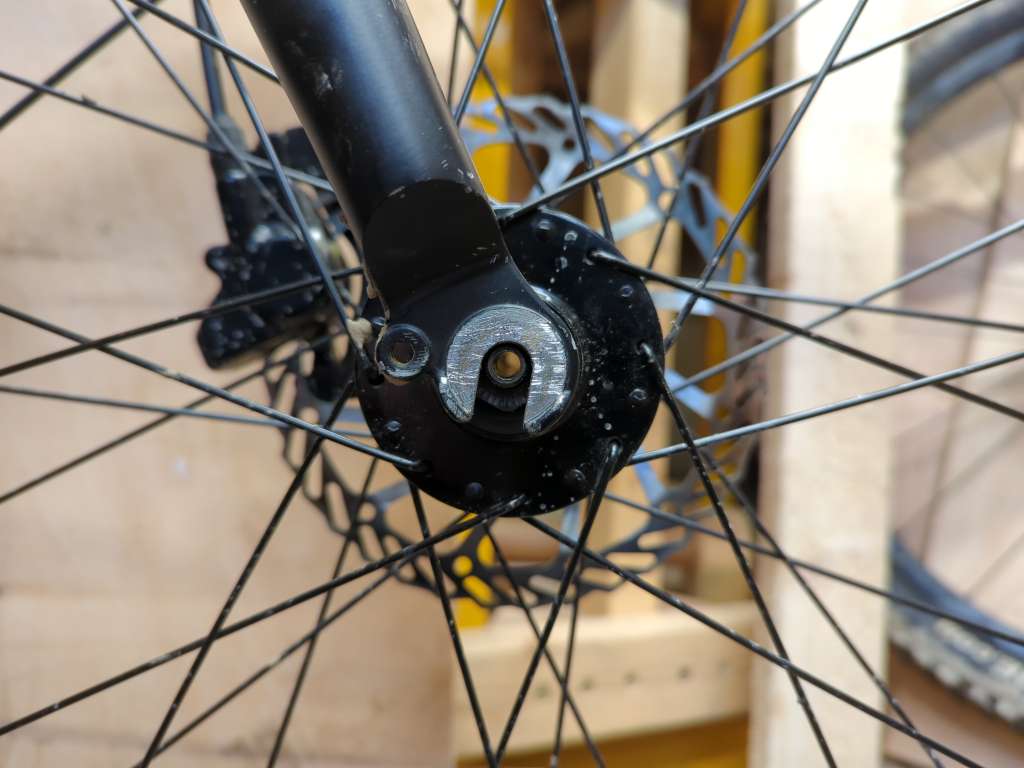
And it's a new bike? That shouldn't be on the market... in my opinion... they have had years to spec the forks with a forward facing dropout, if they can't make the money work to have a captive axle at the price point they're aiming at. Very poor. Shimano steel QR with its knurled closing face should look after you still... but, well... that fork's way out of date, even really cheap bikes should be safe. No upgrades should be required just to keep the wheels in. No excuses.
You do not recall correctly. A moment is the product of force and distance therefore the greater the distance the greater the leverage.
Not quite. The leverage is the ratio of the two distances. If you make the distance from the axle to the dropout smaller, you increase the leverage because the distance from the tyre to the dropout is the same. The ratio of the two increases.
XTR M970 QR Skewers were the apex of QR.
Very much so. And I'm still using some!
How does anyone expect new designers to work it out when the bike industry has spent 20y resolutely denying there’s any issue to address?
Goodness - even an idiot can tell that’s a bad design! As soon as you hit the brakes, the brake pinch point becomes the pivot point and the axle will try to move. In this case, is almost free to move down the slot with only clamping force to resist its motion. With a normal (forward dropout), the reaction force pushes the axle into the back/lower leg of the dropout.
Time for a visit to Halfords? Or just buy a new fork?
A point to the person who mentioned the drop outs angled slightly backwards 🙁
That is truly shocking 😯
Not quite. The leverage is the ratio of the two distances. If you make the distance from the axle to the dropout smaller, you increase the leverage because the distance from the tyre to the dropout is the same. The ratio of the two increases.
Well ****.
You know, I've never thought of the other half of the lever in your analogy.
I've literally just witnessed this!
Riding up the blue/red climb at Llandegla, less than 2 miles in, flattish part of the climb. Two young teenagers in front of me , suddenly one of them faceplanted. No warning, literally went down like he'd been shot and his front wheel bounced off into the verge.
I saw it go, the skewer fell out completely.
He was fine (thank God it happened on a slow climb!). Fortunately his Dad was only just a bit in front and he rode back so after checking him out and retrieving the skewer (couldn't find the opposite side nut...), I left them to it.
I suspect (with no real proof) that the skewer might have been done up like a wingnut.
Just lucky for him that it fell out on the climb, not the descent.
where do precessional forces come from for the qr?
I think the theory is that the fork twists when you brake because the brake is only mounted on one side and that this will tend to loosen off the QR. This is the controversial part of it - the theory is that even a properly tightened QR will loosen off over time. I've never had that happen, I use Shimano XT or Deore QRs.
The uncontroversial part is that, if the QR does loosen off, the braking forces will try to lever the wheel out of the fork. Lawyer tabs should stop it, but that relies on the user knowing how to fit the wheel properly in the first place. QRs are confusing for novices and I'm sure there a a lot of bikes around with incorrectly fitted wheels. Wasn't such a problem with rim brakes, but now even entry level bikes have disks.
Also, the braking forces on a tandem will be much higher than on a regular bike so QRs on those are more likely to cause problems.
It's not precession, it's loosening due to transverse motion of the joint due to forces being applied which are larger than it is designed for. Some smart-arse wrote a few web pages about it 20 years ago but only a handful of people suffered major (rarely, life-changing) injuries and mouth-breathers on internet fora around the world preferred to blame the victims for it so no-one cared about fixing this shoddy and incompetent design flaw.
Cannondale in particular did some utterly fraudulent testing to "prove" that it wasn't a problem. The relevant officer in the US CPSC, who just happened to be a golfing buddy of Cannondale's chief engineer at the time, then decided it was all a nothingburger and swept it under the carpet.
Move along, nothing to see here.gif