 You don't need to be an 'investor' to invest in Singletrack: 6 days left: 95% of target - Find out more
Apologies if already done.
In the latest edition of Cycle (the Cycling UK magazine) the author of ‘Cyclecraft the guide to safe cycling’ answers the question “What single thing would improve matters most for UK cyclists?” with “More self-confidence among cyclists and less exaggeration of ‘danger’. Cycling on roads is actually a very safe activity.”
I was mulling on this as I rode home tonight while I avoided a pincer movement by one van blocking the cycle lane that I was in and another turning right in front of me. Followed immediately by a car driver parked on wrong side of the road and so unsighted, pulling out on me. I’m 62 and been cycling since I was about 7. I ride pretty much 5 days a week year round and have been doing so for years. I’d class myself as an experienced and confident road user (cyclist, full motorcycle and car licence etc etc). I have lost count of the times over the years where I’ve come very close to being injured or worse through no fault of mine.
I would argue that, while self-confidence (if you have the sense and experience to back it up), is great - I don’t see it as being the ‘single thing that would most improve matters for UK cyclists. A massive cultural change where drivers are required to be tested more frequently and suffer greater punishment in court for road crimes that they have been found guilty of would be higher up the list. Tbh, I’m pretty amazed that he said that. Am I being over sensitive?

I think I agree with him that the danger of cycling on the road is a bit over exaggerated, and in the sense that I think more cyclists on the roads = slightly safer for everyone, and that it doesn't help to be putting people off riding.
But definitely agree with you that's it's way down the list of answers I'd give. Charitably, there's not a lot of space for his answer and I guess the first part of his answer he's wearing his cyclecraft cap and advocating for more training.
Yes.
He has a very good point. Too many folk are put off by an exaggeration of the dangers (often on social media). The more cyclists there are, the more "usual" it will be for motorists to see cyclists on the road and the better the infrastructire provision will become. The Field of Dreams approach (build it and they will come) has been only partially successful as it sends a message that shared infrastucture isn't for cyclists.
I totally agree with the OP
Tbh, I’m pretty amazed that he said that. Am I being over sensitive?
CUK are (or certainly were, for a very long time) really quite anti anything to do with cycle lanes, cycle infrastructure etc and had as their gospel the truly terrible Richard Ballantine Cyclist Book which advocated such gems as rolling "gently" over the bonnet of a car before getting to your feet and administering a sound thrashing to the errant motorist with your trusty bike pump.
It's a bit like asking why the zookeeper insists on all the lions being locked away before going in to clean the enclosure and suggesting that if they just had a bit more self-confidence, they'd be fine.
It's a shitty attitude and one that is responsible for a significant failing in ever increasing the number of people cycling.
It's a quick fire format interview, and he was asked to pick one thing, so I wouldn't read too much into it. I'm sure he would have more to say on the subject if he was interviewed at length.
I think one of the things that would improve matters most would be to get more cyclists on the road (and I'm including cycling infrastructure when I say "road"). If more people were cycling, it would reduce the "othering" of cyclists and make them an expected part of the transport system that motorists would be more likely to look out for. One of the things that deters many people from using a bike for transport is a lack of confidence and a perception that it really is a dangerous thing to do, so Franklin has a point.
I understand the sentiment but probably badly worded, and I'm cynical that he's plugging his book/course.
Confidence/assertiveness link to positioning on the road, and I found doing Bikeability a few years back that my positioning wasn't as good as I thought it was. Getting that right and being more proactive on the road led to fewer close passes.
And I think because we are aware of how vulnerable we are on the road, we overestimate the actual danger to us at an individual level. I know two people who've been killed while riding in 40 years. I know more who've died unexpectedly young from other causes.
Cycling is relatively safe. I have no more concerns about my kids cycling on the road than I do of them driving now they've passed their tests.
There's an excellent 2-part episode of the War on Cars podcast that dismantles those assertions by looking at the 'vehicular cycling' movement:
https://thewaroncars.org/2024/07/09/131-vehicular-cycling-and-john-forester-part-1/
The notion that we can increase rates of cycling with a bit of stuff upper lip is absurd and almost always espoused by people with a high regard for their own prowess on the road. There's a very 'if everyone was just as good at this as me we'd be fine' vibe going on that helps nobody.
Sounds like a complete fanny.
As Stevious says, plus a bit of wondering where he's cycling compared to other folk.
It’s a quick fire format interview, and he was asked to pick one thing, so I wouldn’t read too much into it.
that, plus not uncommon in those sort of situations to be asked one question but the author/editor to actually put a slightly different question in the piece when it’s compiled.
From my own experience
15 years commuting through towns and country lanes on a bicycle, 8 years racing supersport 600 and 2 years (so far) racing and play days on a 300cc enduro bike. Commuting (especially in winter) is most likely what's going to get me, and most likely at a roundabout.
I do think one of the most important things that could be done to improve safety is to increase the number of people riding bikes on the road. I live in a country that has very good cycling infrastructure and it really shows when you find yourself in a space that you have to share with cars. Drivers who are not used to sharing space with bikes all the time have no clue what the **** they are doing. The only reason more people aren't killed is because they keep the speed limits very low (Norway, if you're wondering).
I kind of see his point but at the same time, no, I don't think he is right.
I still think the best thing to do is to discourage everyone from driving as much as possible. Partially by enforcing the rules of the road more strictly for drivers (although how you do that with no police I don't know) but also make it expensive to run a car, improve public transport, limit where cars are allowed to drive, reduce speed limits, etc. All the greatest hits.
As is always the case there is no single best thing to do as it takes a thousand tweaks instead, but finding some way to increase people's confidence to ride their bikes (and perhaps dialing down the rhetoric that every time we set out on the road we almost die) might not be a bad thing.
Too many folk are put off by an exaggeration of the dangers (often on social media).
There's a section of the Twitter/X/Threads cycling world who daily post the sorts of interactions with other road users that I have maybe once every other year, they're obviously looking for clicks and likes, but holy hell, challenge them at all about why it keeps on happening to them is opening yourself to a world of abuse - I gave up on twitter because of the behavior of a supporter of a channel for this. There's definitely an element on social media who continually post that every bit of cycling infrastructure is 'wrong' where every mile is potential death trap, and every interaction with a driver is a chance for effing and jeffing, How do they get anywhere?
Those folks are not really helping.
It’s a quick fire format interview, and he was asked to pick one thing, so I wouldn’t read too much into it. I’m sure he would have more to say on the subject if he was interviewed at length.
He wouldn't. John Franklin is the vehicular cyclist. He thinks the only things kids riding to school or Mrs Miggins riding church on a Sunday morning need to be safe is the ability to ride at 30mph and the willingness to take the lane.
That approach kind of works for a fit, assertive-bordering-on-aggresive 'cyclist' but you're never going to get normal people choosing to travel by bike in any great numbers. Look at any place in the world with high, or rapidly rising, cycling modal share. Has a single one of them done it by making the cyclists faster and more aggressive?
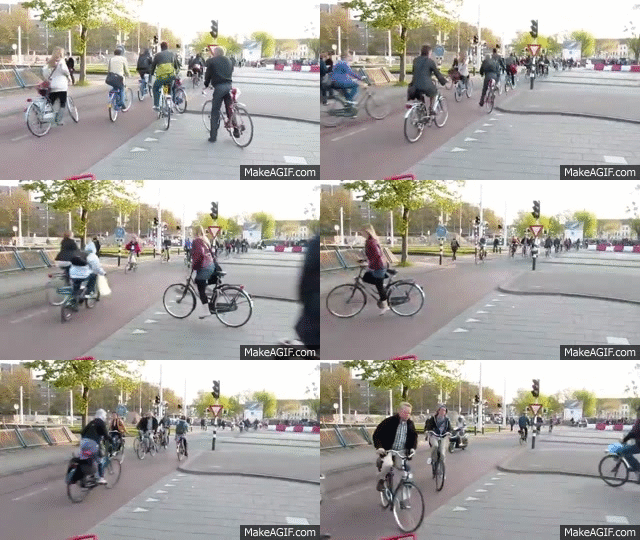
JF thinks that the scene above is bad and it would be better if everyone on a bike was on a main road dodging buses and lorries.
On my commute, most often the risky passes are the ones that save the driver the least amount of time, so I think more needs to be done regarding acceptance of having to slow down, as well as viewing cyclists not just as an obstacle to get around ASAP (at any cost in some cases), but this extends to slow drivers, slow vehicles etc.
I kind of get what he says, but it doesn't necessarily help me feel any safer. A few months ago every commute I thought about my untimely death, thankfully past that for now!
As Stevious says, plus a bit of wondering where he’s cycling compared to other folk.
It's rather telling that in the interview (if you zoom in on the pic in the OP), he says his favourite places to ride are "wild and remote, like Scotland".
The whole "vehicular cycling" thing is a load of bollocks; it's actually quite dismissive, a strong "well I'm alright Jack" attitude about it and very disappointingly it's one that many at CUK advocated for a long time based I think on the fear that if you built cycle lanes, cyclists would be "forced" to use them and they'd lose their right to ride on the road.
Sadly there's often one of these "vehicular cycling" believers in many council highways departments. The likes of John Forester, John Franklin and Richard Ballantine have put back cycling, as a viable means of travel for the masses, by decades in the UK and USA in particular.
John Franklin is the vehicular cyclist.
He also hasn't commuted to work for at least 2 decades.
Statistically he's right, isn't he? But I do agree that we're not going to suddenly convert the masses to cycling through acquiring a stiff upper lip. I think it's true that the nations and cities with high levels of cycling have good infrastructure.
He thinks the only things kids riding to school or Mrs Miggins riding church on a Sunday morning need to be safe is the ability to ride at 30mph and the willingness to take the lane.
Is he still advocating that speed, and the ability to accelerate and maintain 20mph is a basic skill? I remember reading Cyclecraft years ago and laughing out loud at sections that told me that basically I could get out of any potential crash merely by training myself to cycle fast.
I admit that I’m a bad person to comment, because I don’t commute on a bike. My thought is that cyclists experience will change dramatically depending on the roads they use, or the place where they live.
Personally, I live in a town/city (Belfast). Riding on the roads here scares me too much to attempt it! And I’m a self confident kind of guy and a competent cyclist. But roads terrify me. And not because of me!
One last thought; I work in France and drive there about 1-2 weeks a month. There are huge numbers of cyclists there in the city where I work. Many, many more than here in Belfast. But French cyclists often don’t look particularly safe to me either. The biggest factor I can think of is visibility. (Sorry - the biggest factor is careless driving - but bear with me). I don’t think there is such a thing as being lit up too brightly.
It’s a quick fire format interview, and he was asked to pick one thing, so I wouldn’t read too much into it. I’m sure he would have more to say on the subject if he was interviewed at length.
Maybe one for a cycling mag to pick up on for a longer chat? @chipps @stwhannah
One last thought; I work in France and drive there about 1-2 weeks a month. There are huge numbers of cyclists there in the city where I work
Paris in particular has had huge increases in the numbers of people cycling recently and none of it has been because the French have suddenly acquired a load of self-confidence; it's because the Mayor has enacted a lot of fast-moving work to make it that way by banning / restricting cars, building more cycle routes and generally making it a lot easier to get around by bike.
No-one is forced into doing 30mph around Place de la Concorde like the Tour de France, no-one needs to wear lycra or hi-vis or be on a £4000 carbon roadbike. It's effectively just a bunch of upwardly mobile pedestrians.
Commuting to work in rush hour is a different kettle of fish to going out on the road at weekend, or say, after rush hour. Rush hour, it's winner takes all - no-one gives a shoot about cyclists. Got too many injuries from it, more than MTB and other road cycling put together by multiples !
I know two people who’ve been killed while riding in 40 years. I know more who’ve died unexpectedly young from other causes.
Ok, to make that statistic meaningful, can you clarify:
* The number of regular cyclists you know
* The number of people you know.
Commuting to work in rush hour is a different kettle of fish to going out on the road at weekend, or say, after rush hour. Rush hour, it’s winner takes all – no-one gives a shoot about cyclists. Got too many injuries from it, more than MTB and other road cycling put together by multiples !
Definitely, although I have found the driving standard has gotten worse any day of the week since before covid.
I think the additional benefit to more people cycling on the road could be that more drivers also cycle and are therefore familiar with the vulnerability of cyclists, how they should drive around them and most importantly the need to be looking out for them and not just other cars.
How many times to we hear 'sorry mate, didn't see you'. What they actually mean is I didn't see you because I wasn't looking for you, I was just looking for cars.
As a cyclist who also drives, when I'm in the car I'm much more aware of how cyclists use the roads and therefore where they may be and where to look, particularly when it's busy with traffic and cyclists may filtering etc.
Of course drivers all should be looking out for cyclists, however I think as a cyclist you're definitely better aware of how they use the roads when you're behind the wheel.
I've had one collision with a vehicle in 53,000 miles, and I have fallen off (due to my own incompetence) about half a dozen times. Zero serious injuries in that time. Road cycling is a hell of a lot safer than mountain biking!
Is road cycling statistically safer? I don't know the numbers or indeed know by what metric you'd assess this safety. What I do know is that when a lot of folk risk assess riding on the road they're focusing heavily on the severity of the outcomes rather than the likelihood and this is a reasonable thing to do in this case. All of the 'being more confident' stuff might well help reduce the likelihood of a collision but your polystyrene hat and flashing lights don't do much in the equation of you vs car. Those of us who balance that against the risk with the rewards of cycling are very much in the minority and that is a big problem if the goal is to get more people riding bikes.
Or, to put it another way, I don't want to have to face my own mortality or prepare for battle I just want to take my kids to school and go to the shops and stuff.
I think its one of those "he's not wrong but not right either" things
Its a combination of likelihood -v- severity. Actually having an accident - relatively low; but being bounced off a tonne of tin can isn't going to go well when it does happen. There there's roadcraft - I learnt to drive before I could ride, so have always ridden the same way I drive in terms of lane positioning etc, and I'm a bolshie bastard so if I decide I'm having that bit of road, I will take it and **** you. One of the most educational things I did was start commuting on a fixie. The inability to "just stop" meant that I HAD to learn to read traffic flow much better and spot incipient wuckfittery earlier, then to flow around it. It also means my top speed is limited (anecdotally I have more self-induced close shaves on a proper roadie as I can push that much harder)
Commuting to work in rush hour is a different kettle of fish to going out on the road at weekend, or say, after rush hour.
I actually feel safer commuting in rush hour as the cars are limited in speed and manouverability by all the other cars. I'm generally the fastest moving object and can have been and gone before anyone has realised I'm there. If the road is clear, then I'll be the slow moving "obstacle" and will get passed at a much higher speed differential.
What they actually mean is I didn’t see you because I wasn’t looking for you, I was just looking for cars.
This...
But also, people, generally are just "unaware". Pedestrians, riders, drivers - so few people seem to realise their heads are attached to a very mobile joint and bother to look at, know and understand what's going on to either side, behind, hell even above and below them.
Personally I'm also not a great fan cycling infrastructure segregated from the road. For me, commuting is wasted time - get it done as fast as possible. Riding for sport is, well, sport, so you're going as hard as you can. Shared pavements are useless - I'd much rather interact with (relatively) rational and predictable cars than peds, kids, dogs all of whom have the predictability of a coked up squirrel; I find much of the dedicated "bike only" infrastructure like London has difficult to get onto if you don't know its there, difficult to get out of; too narrow to overtake if you get stuck behind a bimbler and the traffic light sequences seem to leave you sitting there for aaaages. (that gif @bails posted is my idea of hell). We have a right to use the road, we should take that and normalise it and drivers need to learn (by force if necessary) to work with and around us (and the more drivers who bike the better it will be) - but as part of that we also need to obey the rules of the road as much as drivers do - and that requires enforcement for all. (I'd say cars jumping red lights is getting almost as endemic as bikes now.)
What I do know is that when a lot of folk risk assess riding on the road they’re focusing heavily on the severity of the outcomes rather than the likelihood and this is a reasonable thing to do in this case.
Very much this ^^ and it's where all the "encourage people to ride bikes" and "tell people to walk more often" falls down because people look at the road, the (poor quality) pavement etc and say (not unreasonably) that it looks too dangerous. You can "encourage" all you want but until you actually ENABLE people to cycle (by building safe / segregated infrastructure , having safe convenient places to lock your bike, restricting car usage and so on), people won't do it.
The single thing that would improve the safety of road cycling is an improvement in the state of the roads. It's not drivers that are causing KSI's in the main, it's potholes. With better road conditions, a cyclist can be more attentive to the traffic and less to what crater they will have to dodge next. Everyone remembers the one **** that gives a close pass, but forgets the hundreds of reasonable drivers who respect road users.
23 mile commute into central London twice a week, Not particularly eventful to be honest. Treat taxi drivers properly and I've found them decent. But the roads are terrible.
He sounds like a tool, but anyway the risk of actually being hit and injured or killed is pretty low. Far more concerning is the verbal and physical abuse targeted at cyclists in urban areas. I’ve been shouted at, sworn at, called everything under the sun, threatened with violence and had all sorts solid and liquid thrown at me over the last couple of decades. Riding like the bloke from the story suggests just results in worse reactions from drivers unfortunately, staying out their way rightly or wrongly seems to attract less negative responses as much as I hate it.
a cyclist can be more attentive to the traffic
Did you really mean that the roads aren't safe cos we have to look where we going?? Maybe we don't wear enough hiviz too?
Did you really mean that the roads aren’t safe cos we have to look where we going?? Maybe we don’t wear enough hiviz too?
No, brain can only process information so fast. If half of that processing power is looking down at the road... My club mate died hitting a pothole that should not have been there. You've never swerved to avoid a potential puncture/rim breaking dip in the road you failed to notice?
Yeah, but during my daily commute I see far more vehicles than I do potholes. I think the vehicles have far more potential to do me harm (and not cos I'm staring at the road and don't see them!)
I think the additional benefit to more people cycling on the road could be that more drivers also cycle and are therefore familiar with the vulnerability of cyclists, how they should drive around them and most importantly the need to be looking out for them and not just other cars
Anecdotally, some of the worst driving I experience locally (rural Scotland) is from Dutch tourists. I think many of them simply aren't expecting cyclists to be sharing the roads with them.
Anecdotally, some of the worst driving I experience locally (rural Scotland) is from Dutch tourists. I think many of them simply aren’t expecting cyclists to be sharing the roads with them.
I can absolutely believe that. I mentioned it further up but where I am in Norway the cycling infrastructure is pretty good and generally separated.
However, if you find yourself on a road that has to be shared with cars then the drivers are absolutely clueless and potentially lethal. If the speed limits weren't so low it would be carnage.
Road cycling is a hell of a lot safer than mountain biking!
This really isn't how I perceive it. On MTB the main contributing factor to crashing is my own lack of judgement and the only things I can hit are stood still. None of the trees or rocks are being moved by someone staring at an iPhone, distracted by screaming kids or late for work because they stopped for coffee. The biggest fright I've had was after being tipped into the road off a Fiesta's bonnet into the path of a box van. Off-road these things tend to come in 1's.
It’s not drivers that are causing KSI’s in the main, it’s potholes.
"almost half (46%) of pedal cycle fatalities were in 2 vehicle collisions between a pedal cycle and a car"
So almost half of fatalities involve a car (where responsibility for the incident could of course be attributed to either or both parties). I think it is unlikely the other 54% is all due to potholes.
Anecdotally, some of the worst driving I experience locally (rural Scotland) is from Dutch tourists. I think many of them simply aren’t expecting cyclists to be sharing the roads with them.
That surprises me. About a quarter of the NL road network has segregated cycling facilities, so the Dutch are used to sharing roads with cyclists, and anecdotally, my experience is that drivers on the unsegregated roads drive sensibly and pass with care.
That surprises me. About a quarter of the NL road network has segregated cycling facilities, so the Dutch are used to sharing roads with cyclists, and anecdotally, my experience is that drivers on the unsegregated roads drive sensibly and pass with care.
I've ridden a reasonable amount in Belgium and there's a similar sort of dynamic there. Drivers are fine with you being on the road, they see cyclists regularly, they know to treat cyclists well (partly because it is such an iconic cultural part of Belgium, partly just because in any collision the driver is automatically held liable).
BUT - they also expect cyclists to behave a certain way. Neat line of 2-abreast. Hand signals. Obeying the traffic laws. Where stuff like that doesn't happen, they find it difficult to adjust and to cope.
My experience last week following a car down a hill (the car was going slower than I was so I was a few metres back maintaining my distance).
Presumably the thought process of the person in the car behind me was this.
- I am in a car
- Bikes hold up cars because they go slower
- I will overtake
- I am now next to the bike and there is no more space to go forward
- I will move back to the correct side of the road
- That cyclists seems unhappy with me. It's very strange.
Here in Norway this kind of braindead action is a daily occurrence as soon as you leave the segregated infrastructure. At least in the UK when someone is risking my life it's because they have the chance to save themselves a whole third of a second. In Norway it seems to be purely down to the fact that a bike is in the 'wrong' place and they don't know what to do so they panic and do something really stupid.
Having ridden in both places, I would say the level of bunny in the headlights panic you get from drivers encountering a bike on 'their' road is worse than in the UK.
It could also simply be that Norwegians are generally very bad drivers. It's a testament to just how much safer having quieter roads and very low speed limits makes everything.
Saying that though, they are very good at driving in the snow.
Ok, to make that statistic meaningful, can you clarify:
* The number of regular cyclists you know
* The number of people you know.
Fair point. I've known - directly or indirectly - hundreds of regular cyclists since first getting interested in bikes 40 years ago. In that time I've known hundreds of other folk through work and other hobbies and interests, and wider family contacts.
Not sure that helps or hinders my point, tbh.
Agree with the OP - whilst we would all love more people to be riding bikes, just telling people to 'be more confident' isn't going to cut it
that attitude doesn't take into account the ever increasing size of vehicles (both dimension and mass), the power outputs, and the increase of numbers of people driving, plus delivery boom, including parked cars because the average numbers of cars per household has gone up over the last 20/30 years - as well as the potholes, the attitudes of the public and the messaging
I do agree that the majority of drivers are decent but when collisions do happen the person on the bike is the one who suffers 99.9999% of the time. We need dedicated infrastructure and restriction on car speeds and sizes at the same time but i'm not holding my breath
I know two people who’ve been killed while riding in 40 years.
It's 40 years for me too.
I've had at least half a dozen personal friends, who i spoke to/had phone numbers/addresses for who have been killed by cars. Another couple killed by making mistakes on the road. Then maybe three times that acquaintances/friends or friends/people I've raced with/against. And many times that of people who've had serious injuries from impacts with vehicles.
Saying that though, probably all the way through my teens and 20's almost my entire social circle was made up of cyclists and ex cyclists, i went to their weddings, went to their birthdays, i even dated cyclists (eventually even married one). Even now, in my 50's probably 40% of my friend group are still cyclists/ex-cyclists or involved with cycling.
Hell, there are probably a couple of dozen posters on here who know me IRL or have raced/ridden with me.
came here to mention the War on Cars podcast but I see @stevious has beaten me too it
https://thewaroncars.org/2024/07/09/131-vehicular-cycling-and-john-forester-part-1/
mert - to provide some balance, of all the people who's funerals I've been to - none have ever been killed in a cycling accident. Of all the people I know who have ended up in hospital from cycling accidents the vast majority (>80% at least) have been through their own error (or at least an issue with the road surface) rather than a collision with a driver.
It must depend where you ride. I can count on both hands the number of near misses I have had. Ever. Apart from minor grazes I have never had an injury accident. I commuted by bike for a couple of decades in and around Glasgow. I have crossed the USA three times as well as a number of shorter tours.
Around Glasgow it's a mix of busy arterial roads where that is the most direct route though I avoid busy roads where there is a quiet alternate road of similar length. I use a mirror so I always know what is behind me as well as what is in front.
Most accidents are avoidable. I have once ridden of the road because my mirror told me an overtaking vehicle was going to hit me. There are few local roads I have never used because they are dangerous. Both in my opinion and objectively - one had two fatals in a few months within a mile stretch.
Nationally, road cycling is getting safer. Between 2004 and 2022 the number of fatalities per billion miles reduced from 52 -23.
With an average risk I would need to ride 43 million miles before I was killed. Seems pretty safe to me. Before you start counting the health benefits of cycling.I would like to think after 50 years riding I am better than average.
Nationally, road cycling is getting safer. Between 2004 and 2022 the number of fatalities per billion miles reduced from 52 -23.
Not disagreeing with you at all but the problem is that it doesn't LOOK safe - certainly not to a new cyclist or someone wanting to ride to school. Facts don't sway people, they go on feelings and emotions and opinions. And going back to the original article, telling them that it's statistically safe or that they just need to believe a bit more isn't going to achieve anything.
I'd be curious to know how much the decrease in fatalities is simply due to fewer drivers dying because cars are far safer now than they have ever been. Crash a 1980's car, they'd be unwrapping bits of you and your passengers from the engine block. Crash a modern car, people often get out unscathed.
Not disagreeing with you at all but the problem is that it doesn’t LOOK safe – certainly not to a new cyclist or someone wanting to ride to school. Facts don’t sway people, they go on feelings and emotions and opinions. And going back to the original article, telling them that it’s statistically safe or that they just need to believe a bit more isn’t going to achieve anything.
100% agree and all the discussion about who has been hit and who has lost friends (I have) is all irrelevant for new cyclists and even with me for example, struggling to think of any actual hit the deck moments apart from a dooring about 30 years ago and I am fifty and have been riding since I was....well abe to ride. But I have had so many near misses, nudges times I have had to ride off the road, times I have experienced road rage I was actually hit by a car a month or two back whilst stationary waiting for horses to cross the road, so perception of risk is right off the scale.
Nationally, road cycling is getting safer. Between 2004 and 2022 the number of fatalities per billion miles reduced from 52 -23.
This is a really impressive reduction but it's a bit cherry picked if we're talking about overall safety. Right next to that in the report you linked is an increase of 21% of serious injuries - these and the slight injuries are surely an important part of the risk perception of cycling.
The broader point that it's getting safer does remain true - the total number of reported cycling casualties per billion vehicle miles was 63% of the 2004 rate. That's a good thing!
My sense (less well evidenced) is that those improvements have nurtured the sportier side of cycling and the real big gains will be seen when cycling becomes safe enough to be a truly mainstream mode of travel. I'm thinking of people like my sister who drives her SUV 2 miles to the shops because there's too many cars on the road for her to hop on an ebike instead. True she probaby wouldn't die or even be injured if she did that now but it certainly doesn't feel that way riding through her town.
"Not disagreeing with you at all but the problem is that it doesn’t LOOK safe"
Depends what you compare it with. It will never be anywhere near as driving belted up in a steel cage with crumple zones. That isn't a case of looking more unsafe it is more unsafe. Possibly balanced out by the health benefits but that is a hard long term sell to non cyclists.
Compare it with other things we do and it looks better. I knew four people killed on the hills. One drowned crossing a river. One avalanched. Two falls. Another guy died in a scuba accident. Another guy tripped while carrying a large box downstairs while wearing flipflops, banged his head and died. I don't know any cyclists that were killed. Most serious cycling injury was a guy I worked with who ended up needing a stick to walk after a long recovery. How did it happen? Went into the back of a stationary bus. Many, though not all, bike accidents are avoidable.
Then of course before anyone drives they have probably dozens of hours of one to one instruction and need to pass a test. Anyone can ride a bike.
Apart from minor grazes I have never had an injury accident.
..
I have once ridden of the road because my mirror told me an overtaking vehicle was going to hit me.
You've only had to dodge certain death once so that's alright then. 😀
"You’ve only had to dodge certain death once so that’s alright then."
In over 50 years cycling. Only once having to take quick action to avoid it seems not bad. Every time we stop on the kerb to let a bus pass we are avoiding certain death.
Other than the fact it was an appalling bit of driving it was no big drama. In the Nevada desert. I saw him coming. Saw oncoming traffic would stop him using the other lane. Saw he didn't appear to be slowing. Stopped pedalling and looked for a spot on the gravel shoulder. Once he was 3 seconds away I was down to under 10mph and rolled off onto the gravel shoulder. Stayed upright and went back onto the road after he was past.
Why I use a mirror.
Isn't cycling statistically very safe?
(I struggle with long sentences)
Every time we stop on the kerb to let a bus pass we are avoiding certain death.
I don't count not stepping in front of a bus as being the same as being run off the road while I'm pedalling along.
Why I use a mirror.
Reminds me of a post I saw on the CTC forum many years ago. A bloke was ranting about helmets & complaining that they added to the perception that it made cycling seem unsafe. He then went on to add that a real safety device was a mirror & he personally always road with an eye on his mirror to check every passing car so that he was ready to ride off the road should one be about to hit him. Ermmm...
Isn’t cycling statistically very safe?
I think it is and it seems to have been getting broadly safer (depending on how you measure 'safe') for the last 20 years. The question is who is it safe for? Here's some data from cyclingUK:

You can look here to see similar trends in the rest of the UK: https://www.cyclinguk.org/statistics
It's pretty clear that cycling is a male dominated activity in the UK and the more you look the more you see how narrow the demographic of regular cyclists is. There's a lot of chat on this thread about the specific things that would improve cycling for the folk who are already out there on their bikes al the time and I think that these are good things to do. I don't think they're enough though, because I think far more people should be able to access the joy and freedom that riding a bike brings. It's not hard to find studies like this one from London Cycle Campaign that asks women why they don't cycle more - some of it is grim reading about the kind of treatment women get from drivers.
In that report women overhelmingly ask for better infrasturcure that feels safer to use. For what it's worth, so do I - I just want to go about my business without having to think about the van that probably won't but still might crush me and my kids to death if we make the wrong move. I don't hink mansplaining that 'well actually you're statistically unlikely to die on a bike' will cut it if we really want to see things improve.
Just going by milage isn't a great measure of anything when comparing different groups of cyclists.
A average "proper roadie" will clock up more miles* on a winter sunday fun jaunt than most commuters or urban car-free people will do in a whole week.
*of course, according to The Rules, they will measure in km.
There’s a lot of chat on this thread about the specific things that would improve cycling for the folk who are already out there on their bikes al the time and I think that these are good things to do. I don’t think they’re enough though, because I think far more people should be able to access the joy and freedom that riding a bike brings.
Agree with everything you've written. The challenge with discussing infrastructure (and this goes back to the article in the OP and many comments on this and similar threads) is that infrastructure is not designed for the people who are currently riding. It's designed for the people who would like to ride but who feel (rightly or wrongly, no matter how statistically safe they *should* be) that the current provision is insufficient and unsafe.
And a lot of regular cyclists can't understand that. But it's fine for me?! But I do it every day! What do you mean you won't ride on that road?!
None of that (or being told to "just get a bit more self confident) has ever got more people riding bikes.
I don't personally think encouraging more confidence is about telling people to "man up and dominate the road". I'm a big fan of properly designed and maintained cycling infrastructure, but there are a lot of potential UK cyclists who won't even consider using that. If people are lacking the basic confidence to give it a try, the cycling infrastructure that is being built won't get used.
I think it is very unlikely we will ever have comprehensive NL style cycling infrastructure in the UK. The Dutch have been engineering their network for around 50 years, and it is baked into their national transport and planning systems because voters demanded it. The UK doesn't even have the consensus to start doing something like that. We will get more dedicated cycling infrastructure, and it will be good, in places, but it will never be as ubiquitous or joined up as the NL, and the failure to satisfy those two requirements is a huge blocker to getting more people cycling.
In the meantime, to get more people using the imperfect cycling infrastructure that we do have, I think encouraging confidence and a realistic appreciation of the risks involved is part of the solution to more bums on saddles.
Just typing cos there's no-one else to share this with! This morning, drove to work cos out out tonight. So I'm sat in a queue of cars with a shared bike/bus lane on my left (one I use everyday on the bike, only problem usually is people in the queue stopping to let others out of or into the side roads, ignoring the cyclists), but this morning I witness a bus going up the lane - there's a woman cyclist in front of it on a sit-up-and-beg. The bus squeezes past between my queue and the woman. I mean, by the time the rear went past her it was almost touching her handlebars! Not only that, but a literal bus-length later, the bus lane ENDS! ... the bus has to join the queue... so he scrapes past her, then ****ing STOPS! But hey! the busdriver **** was wearing a fancy Christmas jumper! So seasons greetings eh?! Christ, I was incredulous.. if he'd done that to me (he probably couldn't as I'm not usually as close to the kerb as the woman was) I would've tracked him down. "Safe"?! Hey, don't go down the nearside of busses and lorries, you pesky cyclist idiots!
Sorry, that's all.
I would argue that, while self-confidence (if you have the sense and experience to back it up), is great – I don’t see it as being the ‘single thing that would most improve matters for UK cyclists. A massive cultural change where drivers are required to be tested more frequently and suffer greater punishment in court for road crimes that they have been found guilty of would be higher up the list. Tbh, I’m pretty amazed that he said that. Am I being over sensitive?
I sort of agree with you, cycling "Confidence" comes from accumulated experience for the most part, to get that there's no real substitute for actual time spent riding which of course comes back to Franklin's point about the narrative around cycling on the roads being "dangerous". The narrative that cycling dangerous puts people off riding (and it's one I see spread by people who claim to be into riding bikes as much as those that don't), hence people never gain that cycling experience and the associated confidence (it's a vicious circle).
There's something to be said for where and when you ride too of course, weekday, rush hour in a busy town or city your experiences will be very different from someone who only ever takes rural Sunday spins. Both environments have their risks and benefits for cyclists (speed vs density of traffic for example) but perceptions of risk will be very skewed by what you've experienced/seen on the roads you use most often.
But ultimately you are right OP, it's our national culture that is broken and still puts cars and their drivers well before everyone else on the roads and seeks to absolve drivers of as much responsibility as possible, fix that and the rest should follow.
@desperatebicycle It’s astonishing the amount of plainly dangerous driving I see from supposedly professional drivers, who you’d expect would drive very carefully as their livelihood relies on them having a license.
See also pillocks who drive badly in a liveried works van.
It’s astonishing the amount of plainly dangerous driving I see from supposedly professional drivers, who you’d expect would drive very carefully as their livelihood relies on them having a license.
Nah, they just claim exceptional hardship.
"Please don't ban me m'lud, it's my entire income and livelihood, I have 12 children dependent upon me earning an honest crust as a hard-working taxi driver"
Oh OK, we'll ignore the fact that you already have 18 points on your licence and allow you to carry on driving like a ****.
I hate cycling in town, glad I've figured out the quiet routes through it, to mostly avoid/limit my exposure to, nutters in motor vehicles.
Came out of the office this evening. First junction is Oxford street and Tottenham Court Road. Stopped for the red light as always. The sheer number of people on bikes fighting their way through the swarms of pedestrians rightly crossing was astonishing. I turned and looked at the taxi driver next to me and his and my look said it all.
Three rear lights and two on the front, nice kit. Reflective ankle bands. Bike with a rack with a pannier. Helmet. No black balaclava. Says I’m a proper cyclist. And to be honest I get treated well by traffic. But I’m just embarrassed by what passes for bike riding in London.
Three rear lights and two on the front, nice kit. Reflective ankle bands. Bike with a rack with a pannier. Helmet. No black balaclava. Says I’m a proper cyclist. And to be honest I get treated well by traffic.
So you're saying if everyone just spent more money on their kit, drivers would suddenly develop a new found respect for all people on bikes?
Personally, I still think if there was a silver bullet to cycling safety it would be to get a critical mass of people riding their bikes everyday. People who refer to 'proper cyclists' and spend their time telling people it's there own fault if drivers take liberties with their lives are definitely one of the barriers to achieving this.
One of the smaller barriers, but a barrier none the less.
None of that (or being told to “just get a bit more self confident) has ever got more people riding bikes.
The aim of the folks that espoused the vehicular cycling mantra was not to encourage more folks to ride though. Their whole view point was "If you can't cycle the way we say you should, then you have no business being on a bike"
This is basically a conversation about the dissonance between 'statistical safety' and 'vulnerability'. One suggests cycling is relatively safe as an activity, the other that when things go wrong, it's very much not very 'safe' at all. It follows that the best way to make cycling 'safe' in both senses, is to find ways of keeping cyclists away from other traffic.
My take, fwiw, is that there are clearly real benefits from good 'cycle craft' - I think the term is a steal from 'roadcraft', term used by advanced motorcyclists and probably drivers - but it's also a way of reassuring yourself, as an experienced, thoughtful cyclist, that you have some agency over the risk you're taking. Possibly more than you actually have?
In part I think there’s are massive cultural and practical differences between people cycling for recreation and people cycling for transport - a 14yo cycling to their mate’s, or someone nipping to the shops, is likely to benefit far more from protected infrastructure from someone commuting 15 miles each way in all weathers, or someone doing 100 miles every Sat/Sun. The problems are:
- People on bikes are seen as one homogenous community, when they aren’t; many people on bikes don’t see themselves as cyclists
- Adequate infrastructure isn’t for ‘avid cyclists’, it’s to encourage people who don’t cycle now, because they don’t feel safe doing so - and it works (not just in the Netherlands/Denmark, see more recent examples in London/Paris
- Hi-viz etc is victim blaming, and doesn’t work if drivers are looking at their phones instead of the road.
I’ve said before it’s worth getting involved in your local active travel campaign group, even if that’s to stay on the mailing list and send the odd email. If you’re in Greater Manchester, Walk Ride GM can be found here (this is the umbrella group for local groups across the city).
...I’m a proper cyclist...
Indicates part of the problem that is articulated here:
Personally, I still think if there was a silver bullet to cycling safety it would be to get a critical mass of people riding their bikes everyday. People who refer to ‘proper cyclists’ and spend their time telling people it’s there own fault if drivers take liberties with their lives are definitely one of the barriers to achieving this.
As much as our main cultural problem is with cars, their ownership and excessive use, the various ways that cycling is 'gate kept' by those who've already seen the light reinforces the problem.
The point is a fair one, poor "cycle-craft" is a real issue and it's worth noting the risks it poses to pedestrians as much as those on bikes. At the same time central London is precisely the sort of place where we need to be encouraging people on bikes (rather than "cyclists") as well as on foot, and the looking down and sneering at those who haven't sunk as much money and a bit of their own personal identity into a mode of transport is counterproductive...
Its very safe right up to the point where a close pass or lunatic piece of driving goes wrong and knocks you off your bike.
Its also very scary at times as you dont know the driving god status of the dick who has just frightend you, so they can end up one place forward in the line of standing traffic.
A very special thank you to the person driving the campervan, who was 100% parked on the pavement and launched into the road without looking. I was driving a red car with day lights, so not invisible, I don't give much for the chances of any cyclist they is near.
Luckily most people try to drive safely.
No I think people should obey the Highway Code. That’s all. And just as cyclist tar every motorist with the same brush. motorist assume that every cyclist breaks the rules all the time. Some of us do not. Until you’ve ridden in London you’ve not seen just how poor cycling standards are.
Proper cyclists are cyclists who obey the Highway Code. They use appropriate lights when necessary they give signals, they heed pedestrian crossings. They give way to traffic. Generally they obey Rule 1. What they wear is up to them.
God I hope I never become a 'cyclist' (proper or otherwise), I'm just happy to be a person on a bicycle 😉
Isn't that what a cyclist is, a person on a bike.
See also motorist is a person driving a car.
I see your point though, I am not keen on the tribal allegiance either.
Proper cyclists are cyclists who obey the Highway Code. They use appropriate lights when necessary they give signals, they heed pedestrian crossings. They give way to traffic. Generally they obey Rule 1. What they wear is up to them.
What's your definition of a 'proper' motorist?
While we're at it, what do you reckon makes a 'proper' pedestrian?
Is there such a thing as a 'proper' public transport passenger?
And what happens if someone doesn't live up to your expectations of what makes a 'proper' person going about their day?