
@Chainline I never stated an offset I wanted. Mojo are putting together a 36 with a 20mm axle. Would you recommend ordering a certain take?
[img] 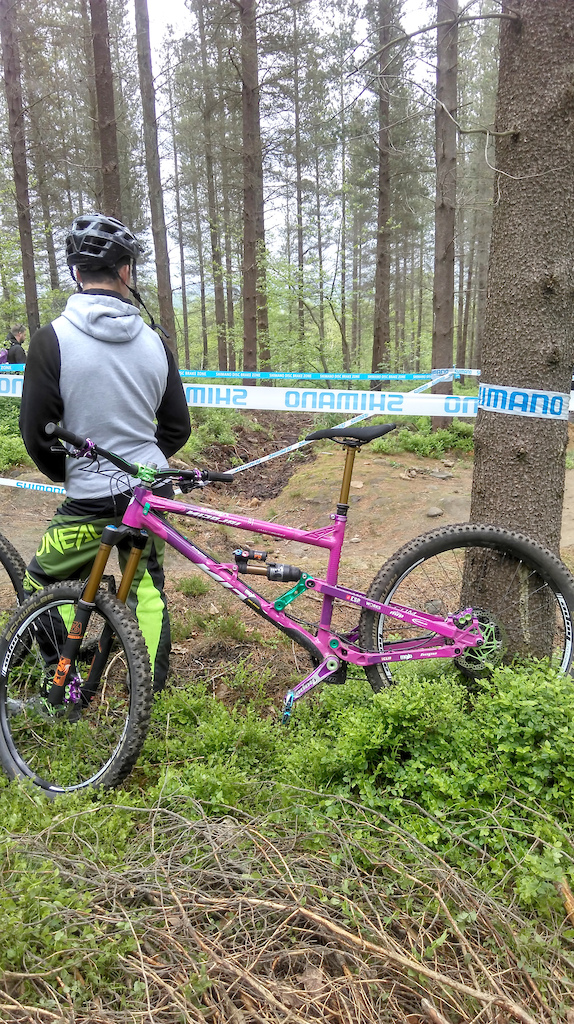 [/img]
I was perving on this yesterday at the Steel City race. It looked mint so I thought I'd share the picture.
I still love the look (and the theory) of these bikes but to be honest you've all blown my mind with information.
I just want someone else to design the bike so I can ride it without thinking about it. I honestly can't be bothered to get the rulers and protractors out and start adding and subtracting millimetres from everything. I just like big jumps and massive skids.
I'm not convinced that's really the case. When you're standing the position of the front of the bike is determined by the fork length and offset, the head angle, the head tube length and the reach, with the rear of the bike determined by the chainstay length, and the stack and BB drop dealing with the vertical aspects.
+1
Tom, Chiefgrooveguru, but you can't separate the ETT/Reach relative to seat angle.
The front of the bike is indeed fork length and offset, the head angle, the head tube length (kind of as stem and spacers can compensate for HT) and the reach but the reach is typically a function of the ETT and bike size hence why I said relative to the same ETT. Two bikes with the same ETT (typically the bike size indicator along with ST length not necessarily the best indicators) but different ST angles will have quite different reach and balance.
Reach can be described by basic Euclidean geometry. It's a function of the stack height and a straight line from the BB that intersects a horizontal line drawn from the centre of the head tube.
Now I'm not entirely sure, but I'm fairly sure it has nothing whatsoever to do with ST angle. I'm 95 percent sure that whoever told you that ST angle did have an effect on reach, was off their ****ing rockers on shrooms.
[img]  [/img]
Moving the ST forwards or backwards, won't do shit to the geometry of that triangle.
If however, you mean that the weight distribution of the bike when statically sagged as opposed to sagged with a rider on it changes - then yes, ST angle will change the weight distribution of the bike - but it will be utterly negligible with the rider on top of the bike.
Also, this kind of misinformation puts me off listening to bike shops and even Mojo - I'd rather go the full custom route - or even knock out my own design on some CAD software and get someone to weld it up in steel. I've slowly come round to the crazy long is better philosophy - but some of the stuff in this thread is just plain odd.
That's not quite true as it has a bearing on the overall geometry. with a steeper ST, the whole front of the bike is pushed forward relative to a given ETT and CS length, making it longer and changing the weight distribution,
This is absolutely true, I think maybe you guys have misunderstood. Chainline specifically said "relative to a given ETT and CS length". If you change the seat angle but not the ETT then it does change reach. As Tom says, basic geometry.
I think Chainline's taken a weird way to look at it frankly but he's not wrong.
Yeah, I think I get the way he's trying to describe it - I think we all actually agree in a very roundabout and contrived way. If you're keeping the ETT the same but pushing the ST angle orward that is going to increase the reach.
I feel I need to draw a diagram to clarify this for everyone. The way I see it is we have three separate groups of parameters.
The fundamental group which affects a bike's handling is the chassis. The numbers that matter for this are wheel size, BB drop, chainstay length, reach, head tube length, axle-crown length, fork offset and head angle. You don't need any more than that to determine the exact static relationship between contact patches, axles, bottom bracket height, wheelbase, front centre, trail, etc.
The next group which affects steering feel is the bar width, rise and backsweep, the stem length and rise and steerer spacers.
The final group which affects seated weight distribution and seated reach (effective top tube length) and pedalling position is the seat tube angle, seat height and seat post offset / saddle position on the rails.
It could be that the final group affects your standing behaviour but it really shouldn't - when you drop your saddle and descend where the saddle was shouldn't affect the position of your hips.
The steering group also affects weight distribution but much less than the rider's own behaviour does.
I don't look at effective top tube lengths when sizing bikes, I look at reach, stack and seat angle.
But that was my point. The ETT, which is a function of SA on most bikes unless the horizontal intersects the top of the ST, if unchanged on two equivalent bikes but one bike has a steeer SA it impacts the reach. If the reach is different, the weight distributionof the rider is different.
Tom, Feel free to design, or go, or listen to whomever you wish it's a free country. We all see and explain things differently which is why they teach my daughter 5 ways to divide stuff these days.
One thing missing there Chiefgrooveguro is that the bar width etc has an effect on the riders position which in conjunction with reach has an effect on how those contact patches work depending on terrain and particularly how a bike initiates turns and changes direction, it's not just steering feel. You can change weight distribution and CofG with a bar width change markedly.
Actual (not virtual) seat tube angle and ETT affect where the end of the saddle is in relation to your tender body parts when the saddle is dropped. A measurement that might be felt in certain situations.
Edited to be gender-neutral, apologies to any lady cyclists who read the original.
Chainline - MemberBut that was my point. The ETT, which is a function of SA on most bikes unless the horizontal intersects the top of the ST, if unchanged on two equivalent bikes but one bike has a steeer SA it impacts the reach. If the reach is different, the weight distributionof the rider is different.
I think it's mostly a matter of reference points tbh. I think some people think of the frame geometry as being a load of tubes connected together at certain angles, which fits how you describe these changes- changing the seat tube angle pushing the headtube forward.
Whereas others think of it as a collection of points, connected together with tubes of the appropriate length- so steepening the seat tube would shorten the top tube rather than pushing it forward
I can make both work in my head but the latter seems more intuitive- you don't start out with a top tube X length then decide what angle to make things so that it fits, you start out deciding where you want the key points and that determines how long the top tube is.
. But maybe it also depends on how you work with these things? I suppose my thinking's like redrawing a single line on a sheet of paper where everything is static, yours is a bit like dragging a point on a screen and having other points move in relation.
What Northwind said - I didn't get the way you were describing it Chainline. You're describing the same thing as us but in a different way.
I apologise for being rude.
But that was my point. The ETT, which is a function of SA on most bikes unless the horizontal intersects the top of the ST, if unchanged on two equivalent bikes but one bike has a steeer SA it impacts the reach. If the reach is different, the weight distributionof the rider is different.
I think the point I'm trying to make is that ETT and SA are a distraction when thinking about designing a bike to handle well when cornering or descending. Lay the chassis out correctly, then apply the appropriate seat angle to get a comfortable seated fit and good climbing performance. Seat angle does not affect standing weight distribution and if you're saying ETT does then it's only because reach does.
One thing missing there Chiefgrooveguro is that the bar width etc has an effect on the riders position which in conjunction with reach has an effect on how those contact patches work depending on terrain and particularly how a bike initiates turns and changes direction, it's not just steering feel. You can change weight distribution and CofG with a bar width change markedly.
No, I did mention that in my penultimate paragraph:
"The steering group also affects weight distribution but much less than the rider's own behaviour does."
If you're still convinced that ETT and seat angle affect standing handling (assuming reach is constant), then you can test the theory by sliding your saddle backwards or forwards on the rails. I'm very fussy about where my saddle is and very sensitive to the minutiae of set-up (it's very annoying because I'm actually not that keen on bike fettling!) and I've never noticed a difference from moving my saddle when it comes to descending or cornering. Yet when climbing or pedalling on the flat even a 5mm change in saddle position is obvious.
arghhh
[img]  [/img]
cheifgrooveguru...I agree. It is clear we are agreeing! I was never convinced SA and ETT affected static handling, merely that altering the former whilst maintaining the latter...which was my original point about the Starling, alters the factors you previously mentioned and thus does....but Rorschach has a point above there 😆
I'm now mostly looking forward to getting my youngster and some other not so tall peeps out on the recently arrived not so long now, I think that will be interesting.
Well that and putting the G13 back together now I also have another front 29 to use on the G16.
It's as if all the different tubes and angles on a frame are somehow connected to each other
On a different note, put a set of 34 29" floats on the G16. Different to what i've ridden before, but it certainly went quicker. also the back end seemed to snap round to where you wanted it. That's my small input.
paul J, that would be consistent with the feeling I, CP and others have in terms of steering at the rear. I can't say its faster or not having not timed it.
Turning radius of the rear wont be any different to a 27.5 both ends bike, but it feels different definitely, obviously relative to the front radius.
A few guys were running 29 fronts earlier on but i think with shorter forks and no tweaking of BB heights for obvious reasons.
Hi Chainline, So now waiting for Paul to ship out my G16 longest with 44mm offset 29r fork and 222mm shock 😀
Will I need a -1 headset to get the magic 61.5 HA, or will stock achieve that ?
This thread is now utterly impenetrable.
I might stick with the hardtail for a while.
What is the weight of a longer G13 with a trail type build?
Shark attack. That is a shame. Can you elaborate. I am trying to use it to give advice and to feedback riding impressions and what is possible and to help facilitate people getting answers or the right service.
Also to feedback comments/views to CP and to use myself in thoughts of what could be improved going forward.
How'syourdad depends on $$$ but 30-32lbs
Assumes 36 or similar upfront. lower end is a non piggyback rear shock.
Wheels and tyres used make a big difference.
Bars and saddle are easy and lowish cost weight wins.
Cassette makes a big difference.
[img] http://https://www.flickr.com/photos/151193523@N05/shares/pQ5b1z [/img]first shake down of the new steed
enzocycling, fixed the link, not sure if flickr lets you share photos as images on forums, not used it in a long time.
https://www.flickr.com/photos/151193523@N05/34155774044/in/shares-nmrs1C/
This thread is now utterly impenetrable.I might stick with the hardtail for a while.
If you have a specific question just ask and you will get an answer. Or just get in touch with Mojo they will make sure you get the right bike for you.
cheers chainline. i really considering the g13 next spring. wondering if it will be updated to metric shock perhaps. enjoying this thread
also, are there demo Days in sweden?!? 😀
Sir HC. thanks
howsyourdad1 well that might be more difficult! It could depend on the air fare, driveable tho....you could always take a cheap return flight to the Uk and do a day here 😉
Here you go enzocycling, click the share button and copy & paste the BBCode 😀
[url= https://c1.staticflickr.com/5/4228/34155774044_354e593d1e_c.jp g" target="_blank">https://c1.staticflickr.com/5/4228/34155774044_354e593d1e_c.jp g"/> [/img][/url][url= https://flic.kr/p/U3egDW ]20170530_213820[/url] by [url= https://www.flickr.com/photos/151193523@N05/ ]Leo Copeman[/url], on Flickr
Oh, and I have actually ridden one, the longest 650b version at the Cannock demo day a while back. I was amazingly surprised at how nimble and and poppy it felt for such a long bike with 160mm of travel. If you/they ever decide to go with a shorter travel model, 130mm rear 150mm front say, I'd be very interested.
@chainline, no way I could tempt you here then with a couple of Nicolai bike in tow? there would be guaranteed interest!
[img]  [/img]
[img]  [/img]
Wellll, hmmmm, maybe, I'll chat with Chris 😉
excellent . my cunning plan is working Pole are doing a demo day here in July , but obviously the Nicolai is my preferred choice 😀
Shark attack. That is a shame. Can you elaborate. I am trying to use it to give advice and to feedback...
You're doing just that mate, and unbelievably well. I just don't know how you've got the patience for it. I hope Mojo are paying you overtime for looking after this thread!
If you/they ever decide to go with a shorter travel model, 130mm rear 150mm front say, I'd be very interested.
This ^^^^^^^^^. In a standard 27.5 model rather than the custom £500 upcharge
Sharkattack. Mojo don't pay me at all, but Chris is a good friend and it means I get to do testing, feedback and development and help people to get what they want. I love doing that. I pay the mortgage with the day job 🙂
Rik. Noted.
😀
Enzo, that's a stunner mate!!
So we have the frames now, two in fact, the GeoMetron Bikes Not-so-long small persons and kids design .
Jack Readings young riding buddy has thrown a leg over the demo frame built up as you can see in the pick, thanks to Instagram, GeoMetron bikes and Jack for positing this, he clearly loves it and is very rapid.
I am building the second frame up with a test specification for kids/smaller lighter rider full build and will post some pics and specification once I've done that.
We intend to make this a production bike. Headlines are GeoMetron geometry and features but with a 73mm BB for narrower Q factor, 145mm to 160mm rear travel and an ideal front of 160mm to 180mm, the full build will run 34's and a DPS rear, 150 or 155mm cranks, light high quality wheels and a light cassette with 11spd drivetrain and Hope brakes.
Standover is 668mm/26", seat tube is 350mm/13.5" which should allow for a 125-150m dropper even for smaller folk with a 150 or 155mm crank.
Hoping to get lots of riders on these two frames, novice, fast, young and not so young, boys, girls men and women to get feedback.
[img][url= https://c1.staticflickr.com/5/4259/35007411176_d7400faa94_b.jp g" target="_blank">https://c1.staticflickr.com/5/4259/35007411176_d7400faa94_b.jp g"/> [/img][/url][url= https://flic.kr/p/Vku8GL ]Untitled[/url] by [url= https://www.flickr.com/photos/the_pilot/ ]Phil[/url], on Flickr[/img]
that is rad.
What sort of air pressure are people riding on the 36 180s for the Geometron relative to Fox recommended? Ever since I got my Geometron the rear shock X2 felt incredible but the forks felt harsh. After lots of setting changes I finally dropped the recommended air pressure from 83psi to 60 psi, what a revelation. Now the forks feel like butter even on the roughest of Lake District descents. Seems odd that the charts should be so far out and it's not like I am not hammering the bike. Wish I had done this a year ago!
Have you got many volume spacers in suit. They make a big difference I found. I'm 80kg loaded and run. About 65psi with 2 blues.
72 psi seems to be my magic number with 2 blues at about 90 kHz. Shockwiz agreed. 1 click low speed no high speed.
I do wonder if a revalve to put me in the middle of a lower range of compression might be a good thing
The geometric is a bit rich for me, but I'm positively dying to try one of these;
[img] 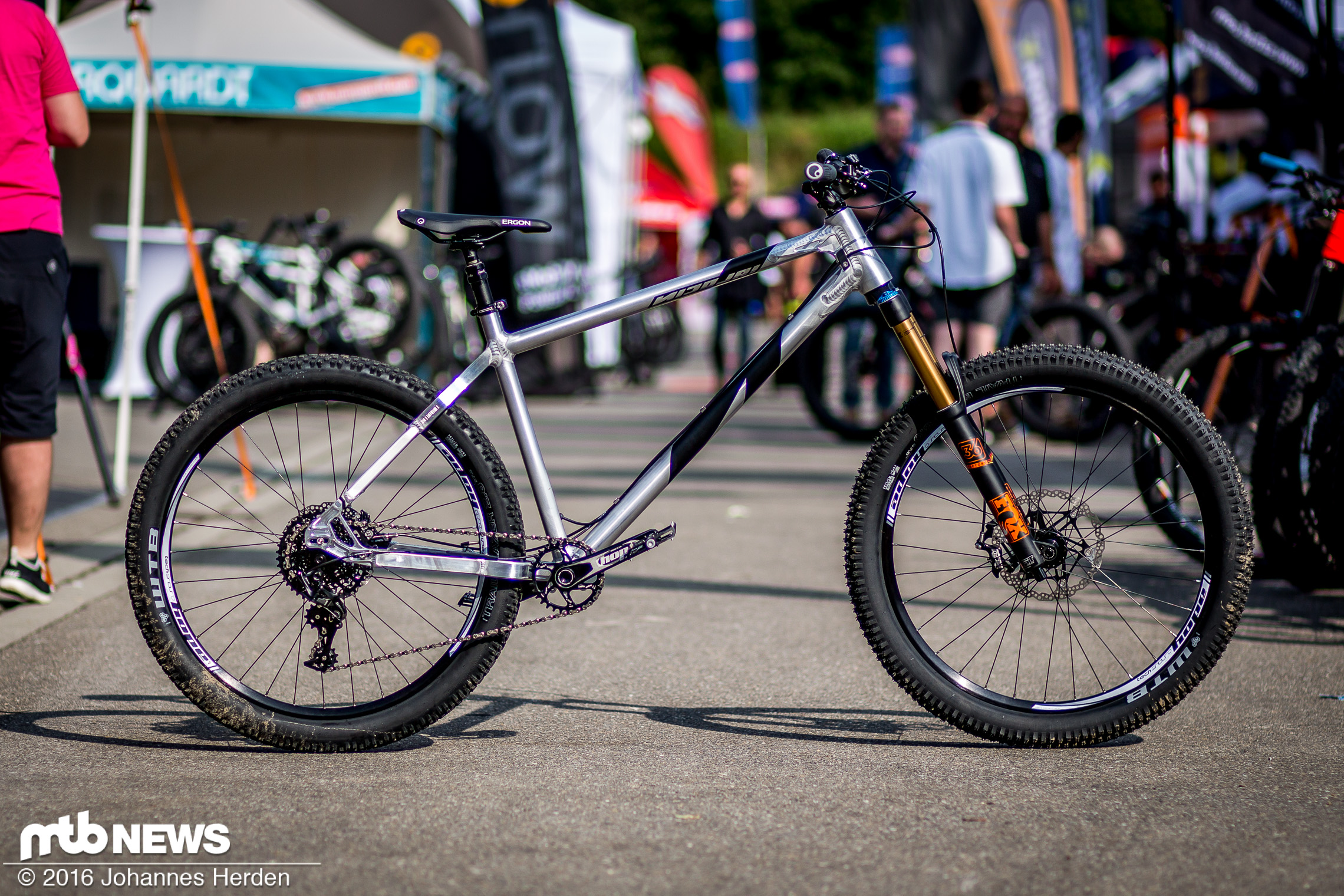 [/img]
That said, a 27.5 "trail" geometron say 140rr/150fr with great climbing would be an interesting proposition indeed.
One blue spacer as specced by Mojo. I am around 93-95kg in riding gear and I have had to lower the pressure to 60psi for the forks to feel how I expect them to. No compression used either. Now getting almost full travel with big hits but mid stroke support is spot on. Still don't think I have set perfectly, would love a gadget to log data or a day with Mojo!
That said, a 27.5 "trail" geometron say 140rr/150fr with great climbing would be an interesting proposition indeed.
I said the same a while back, a 140mm travel lighterweight Geometron would be an absolute winner especially for massive mountain days.
The weight reduction would be insignificant, 200g at best in a 20mm shorter bike.
You're better off fitting non piggy back shock and lighter wheels & tyres you could run 160mm 34's as we will on the not-so-long if it's an all day bike.
Much bigger savings than a shorter travel frame with the same forks etc just less travel.
On a Mojo bike that's gives a 63 HA.
You've lost 2.5lbs right there with very little compromise for the purpose.
Try a shockwiz duir. I haven't but if honourablegeorge has had a go might be worth it.
For the record if you're riding gnarly stuff I get it. In Spain last year I had a dreadful setup for 2 days as I kept letting pressure out. I couldn't believe it (on my 40's) I ended up a hair over 55psi relative to 75pso start point. Just due to the terrain being much rougher than my normal trails, also had to take a spacer out. Was lovely then. Chris was with me and said pretty normal.
Got back home and it was not good on my normal trails...
Have you given the lowers a good service. The bushes can go off and make them much stickier I've found.
Having a lighter bike is not always the main goal with a 140mm trail bike. I (and it looks like others do too) don't want 160+ mm of travel bottomless travel even if it might weigh the same.
130mm would be my preference (but most would prob go 140mm) as it's keeps you on the edge more, and brings far more smiles than plowing through everything with little regard for line choice like you can on a 160-170mm bike. Even if your speed is ever so slightly less it's still more fun.
Have you given the lowers a good service. The bushes can go off and make them much stickier I've found
Recently done by Mojo. I think you have maybe hit the nail there Chainline, it's just so rough in the Lake District and descents can be very long. I have not tried without any spacers yet so may try that but pretty happy with how they are now and can still feel my arms at the bottom!
With the 140mm front and rear it's not so much about weight but the bracing could maybe go and lighter tubing? It's more about having a really snappy trail bike for massive mountain days. I take your point about lighter wheels and shock but I would still ride a 140 Geometron how I ride my 180/155 and the descents would be just as rough so wheels or tyres not a place to compromise up here. Reckon a 140mm front and rear Geometron would sell like hot cakes in the UK.
For the record if you're riding gnarly stuff I get it. In Spain last year I had a dreadful setup for 2 days as I kept letting pressure out. I couldn't believe it (on my 40's) I ended up a hair over 55psi relative to 75pso start point. Just due to the terrain being much rougher than my normal trails, also had to take a spacer out. Was lovely then
Interesting - my 36s are currently running at 140mm without any spacers. I was expecting to add one or more back in Spain last week but there was enough ramp up anyway (I'm guessing with the fork at lower travel the air chamber is smaller so ramps up more anyway?). Mid stroke support is so good on the 36 - don't get fazed at all when it gets really steep.
Howsyourdad1 where's that?
åre bike park , Sweden. Opening weekend this weekend!
I do wonder if a revalve to put me in the middle of a lower range of compression might be a good thing
Paul at Mojo has just revalved and put a lighter oil in my 36 for me.I had both high and low speed compression adjusters wound all the way out and while it felt good on mid and big hits it was way to stiff on small chatter.
The difference now is night and day.
I've gone from 64psi to 85psi to get the same amount of sag.
Also running a couple of clicks of highspeed and 12 lowspeed.
It now works as well on the chatter as it does on the mid and big stuff.As a bonus the comp adjusters have now become useful again instead of just being an ornament.
That sounds like what I'd be after Stu.
Speak to Paul then. 🙂
I am in the process of ordering a G16 and was planing on running with 29 wheels with a 160mm fork. Though I have been questioning myself if this is the right design and with all the conversation about travel is somewhat similar to what I have been thinking over the past week. Would the G13 with a 140mm fork be more inline with what I do.
some back ground for context.
I currently ride a stumpjumper with 140mm of travel. I currently don’t find myself “underbiked” to often. however part of my reason of looking at a new bike is to improve and push myself further than I currently do/capable of. My suspension tends to work hard as I am over 115kg fully kitted and my riding style is more straight line than perfect line. which lead my to the G16 with its beefier suspension. It will be my only bike so will have to deal with bridal path rides with kids through to days a away at bpw/alps etc.
I would be interested to here others thoughts on the G16/G13?
BlakeC. If you run 29 wheels it will be 155mm rear anyway so not hugely more than your stumpy given your intended use. If you run the front fork 150mm you will have nice angles and only a little more travel than your current bike. Try both first somewhere you know, definitely the best option.
I ordered a G13 as I never felt I needed the bigger travel. Still intrigued to try the -2 degree angleset you suggested Chainline.
So far I am loving the bike though and glad I went for it.
BIGMAN, yesss, a no lose position!
I enjoy the G13 on my local stuff and general trails, but I do miss the travel when on rougher trails and pushing it (pushing for me anyways) but I am old and my body is broken 😉
Chainline bigman.
Thanks for the responses. I am Going to go with the G16. Will just need to get fitter.
The angleset on the list to try for sure. Loving bike in current guise but I will slot one in soon.
On an unrelated note I find myself running the x2 at 250psi to get the correct sag for 85kg.
Are other people finding the same?
90KG and running 180 PSI here.
thats is pretty high for 85kg. Volume spacers? Different ratio tho if on a G13
These bikes do seem to need to be set up with pretty high shock pressures. On my G13 with volume spacers in the Float X I have to run the shock around 300 psi to get the correct sag. I'm just over 100kg fwiw. I'm not sure the ratio on the G13, as much as I love the geometry of mine, is quite right for heavier riders. I can't remember the exact volume spacer set up as Toby swapped them over but I like a decent amount of ramp up so there is a fair bit in there. Might experiment with more when I get a chance as it does feel like it still blows through the travel too easily on rough stuff. Still tempted by a coil and its a shame they didn't design it to fit the X2.
I agree Gotama...Some of us suggested a number of changes, including the X2 capability, before it went into production...
http://linkagedesign.blogspot.co.uk/2016/09/nicolai-ion-g13-29-2017.html
have seen up at 300kg when setting up friends over 100kg. Worthwhile checking the volume at that. The G13 is progressive overall though.
Chainline I was looking at the dirt review of the G19 and they were saying that the large G19 is 10mm shorter than the shortest Geometron. Although this is still longer than most DH bikes.
I have assumed from reading the stuff on here and the reviews / posts elsewhere on the net that one of the main reasons the trail bikes were so long was to improve the descending, and one of the critical comments from people who've ridden the trail bike is it can be too long for twisting trails. So what's the thinking behind the G19 then? Did it come before or after the trail bikes and does that mean there's a school, of thought the trail bikes are too long?
The G19 came mainly from Nicolai's geolution concept, interpreting the Mojo initiated Geo rather than being driven by mojo, mainly around HA and front centre. Similar but not the same applied to the G13. Hence we see the differences in ST angle on both bikes and other small differences the Mojo and indeed Nicolai version of the G16, some discussed on here.
There are a number of factors but descending on tracks as steep as WC tracks and/or the purpose of descending only there is a school of thought there is less requirement to drive grip on the front on flat(er) terrain/ corners or redistribute weight for climbing. Thus bringing the bars near(er) to the rider, is ok for handling.
There is more than one way to achieve that as a measurement, Nicolai chose the conventional way with a slack ST but a similar length TT.
I've not had anyone who has ridden one for any length of time say the trail bike is too long for twisty trails?
Chris rode his XL on some crazy tight stuff in Spain last year without any issues. I've never had any problems on my Longest? It's a different technique, but interestingly when our guide who rides the trails all the time adopted the same technique as riding the GeoMetron he was faster on his normal bike too.
It might be worth building one the other way to see the impact...hmmm. The Mojo GeoMetron has the same geo apart from the reach and the same BB config. The DT is slightly lighter as it doesn't officially support the 40/200mm.
Ah that makes sense thanks Chainline, the twisty comment is based I the inference from some of the people who've sold the bike or didn't get on with it, but they seem in the minority by a long way.
I thought the interview with Chris Porter was really good and explained his thinking, he came across so well!
Interestingly Danny H rides a size larger on the Summum, which is already long compared to most other DH bikes. You can see how forgiving that is on some slo mo and if you watch closely last year on his winning streak. big, unexpected hits and small mistakes he is able to compensate for because of the room and still maintain front end grip. Clearly the whole thing is a balance/compromise tho and very rider dependent too in DH racing.
Mr Gwinn proves that often.
No mate, I've seen how big Danny H's big looks with him on it or next to it. Granted though he's not a big fella! At 6'2 sizing up isn't an option for me off the shelf really! I'm just interested at how proportionately short the G19 is in comparison to the G13/16. Granted it's still longer that most of the DH bikes.
I'm sold on the idea behind the trail bikes, I'm enjoying my Transition at the moment which is he longest MTB I've ridden and it's allowing me to have a great time on the trails and push myself more. The plan is next summer arrange a test ride with MOJO on the Geometron to see if I suit it and it suits me! Fingers crossed!!
I have my longest geometron for sale (g16) frame only no shock really good condition fully maintained comes with spare hanger 142x12 back end anodised black or age graphics. £1450 ono based in north Wales I will leave it built if anybody wants to come and check for size.
I'm 6'1" in the longest.
I'm around till a week on Sunday before I leave for the next two world cups or I'm at Rhyd y felin for the bds this weekend.
Plecostomus, i've PM'd you re the frame. Cheers
I do wonder if a revalve to put me in the middle of a lower range of compression might be a good thingPaul at Mojo has just revalved and put a lighter oil in my 36 for me.I had both high and low speed compression adjusters wound all the way out and while it felt good on mid and big hits it was way to stiff on small chatter.
The difference now is night and day.
I've gone from 64psi to 85psi to get the same amount of sag.
Also running a couple of clicks of highspeed and 12 lowspeed.
It now works as well on the chatter as it does on the mid and big stuff.As a bonus the comp adjusters have now become useful again instead of just being an ornament.
You just described the issues I was having, maybe this would be a better solution than 20psi less.
Stu, what weight are you?
Replied back to you cheers