The life of a World Cup cross-country mechanic isn’t quite as rigid as it might seem. Chipps catches up with Aaron Mc Cann from Trinity Racing.
Words and photos Chipps
Hey, this feature looks even better when viewed via Pocketmags; you get the full graphic designed layout on your device FOR FREE! It’s not quite as beautiful as the paper magazine but it’s better than a basic webpage.
The days of cross-country bikes featuring rock hard shocks and tyres are gone. Nowadays, the teams of mechanics crossing the globe in support of World Cup cross-country racers are as likely to reach for the USB charger as the shock pump.



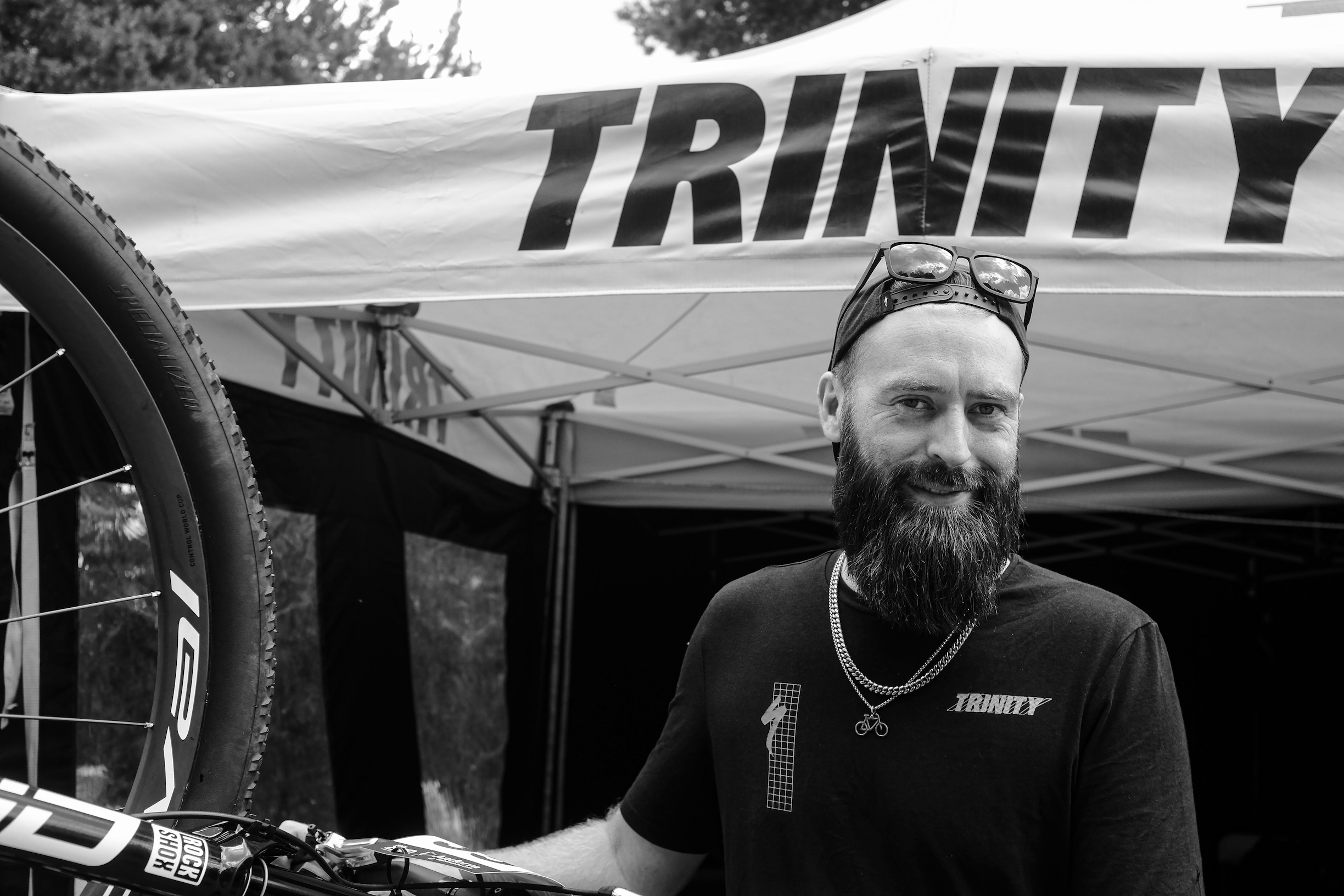
Aaron Mc Cann is an imposing character. Six foot something, with a ZZ Top beard and chunky gold chains around his neck, he looks like a figure that you’d find quietly, but very firmly, escorting you from a bar after you’d had a couple of pints and danced on a table or two. Yet this scary-looking Irishman is bike fixer, confidante, bottle holder, line choice sage and solid grounding for several young and upcoming riders on the Trinity Racing Team as they take on the UCI World Cup cross-country races around the globe this year.
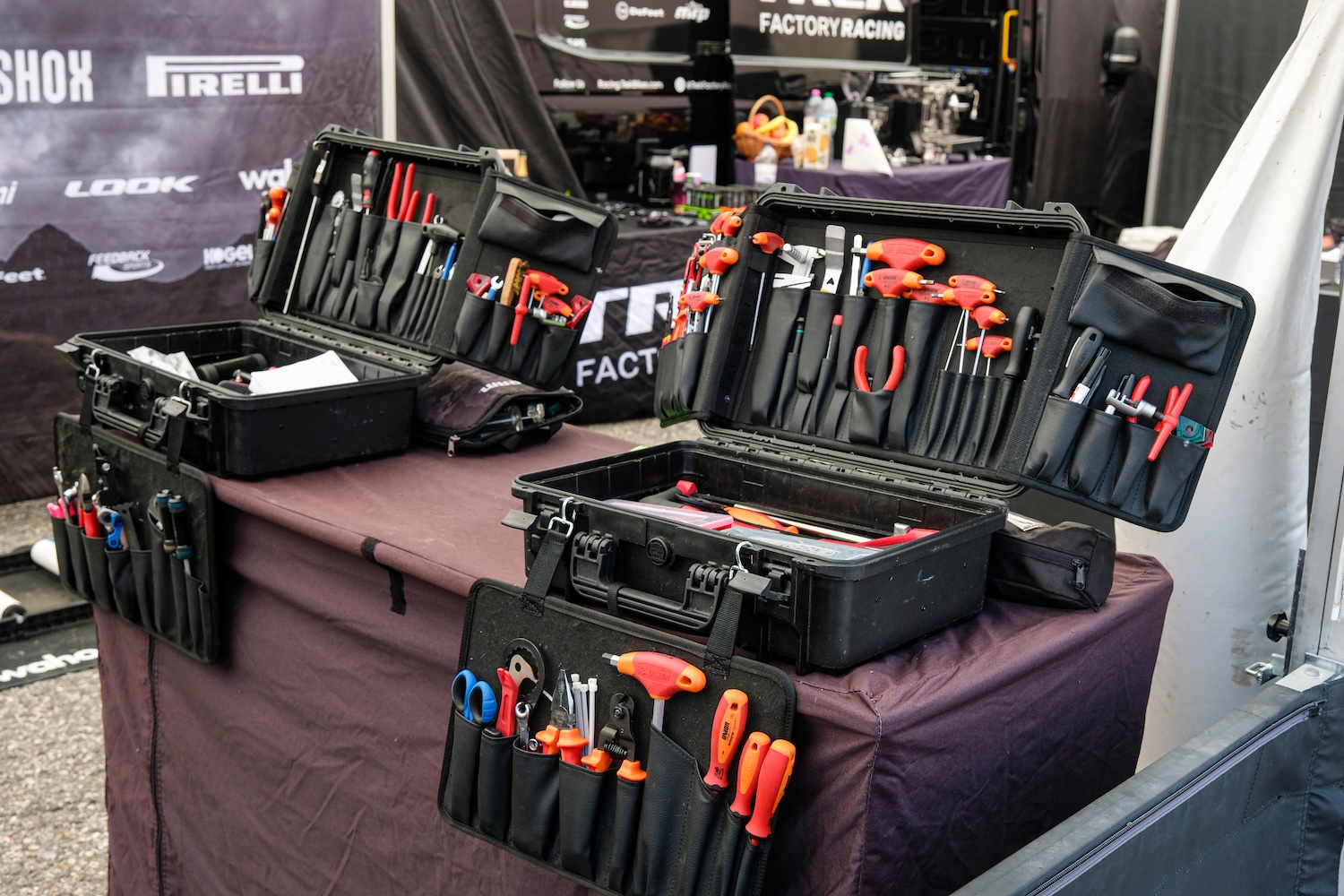
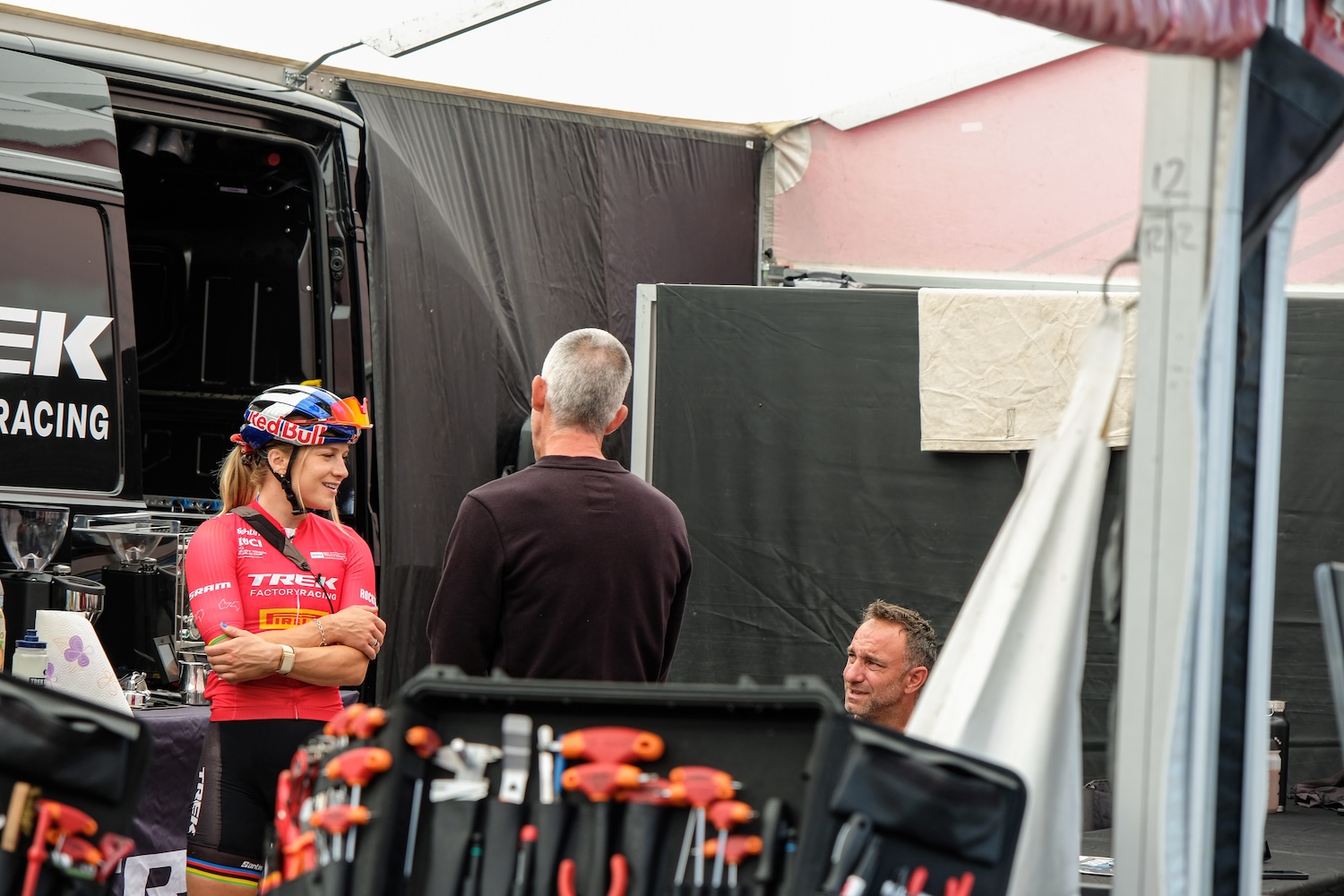
I’ve always had a great deal of respect for World Cup mechanics; usually working out of a suitcase toolbox and EZ-Up in a side carpark just away from the main arena, they’re always the first to show up, as the race village sets up around them. While the winners are still drinking Champagne out of their Crocs, these hard-working men and women are cleaning bikes and re-packing vans ready for a day off (if they’re lucky) before heading to another different part of Europe to do it all over again. And those are the easy rounds – we’re not even talking logistics of getting team bikes, toolboxes and people to South Korea or Brazil…
‘Same shit, different car park’
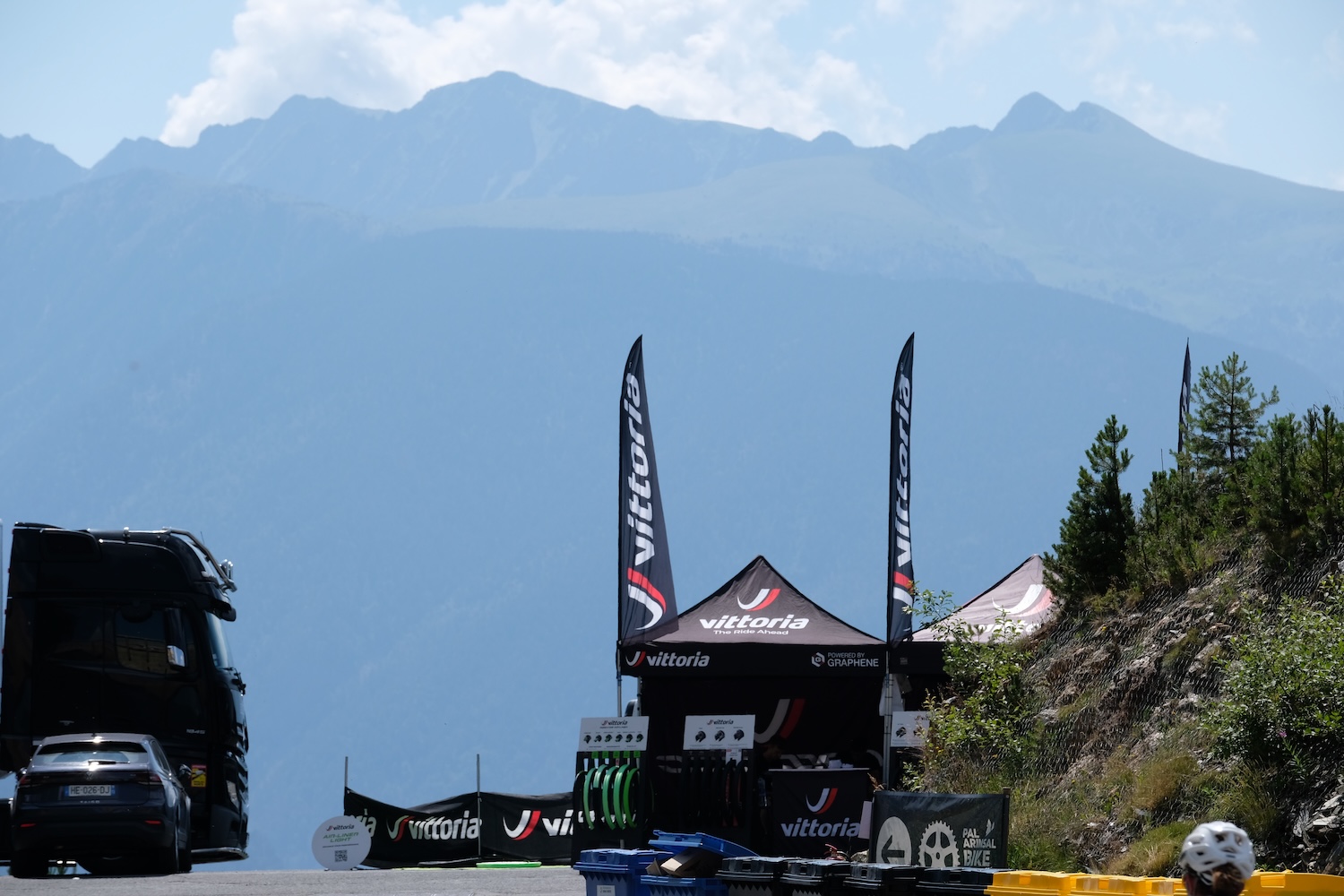
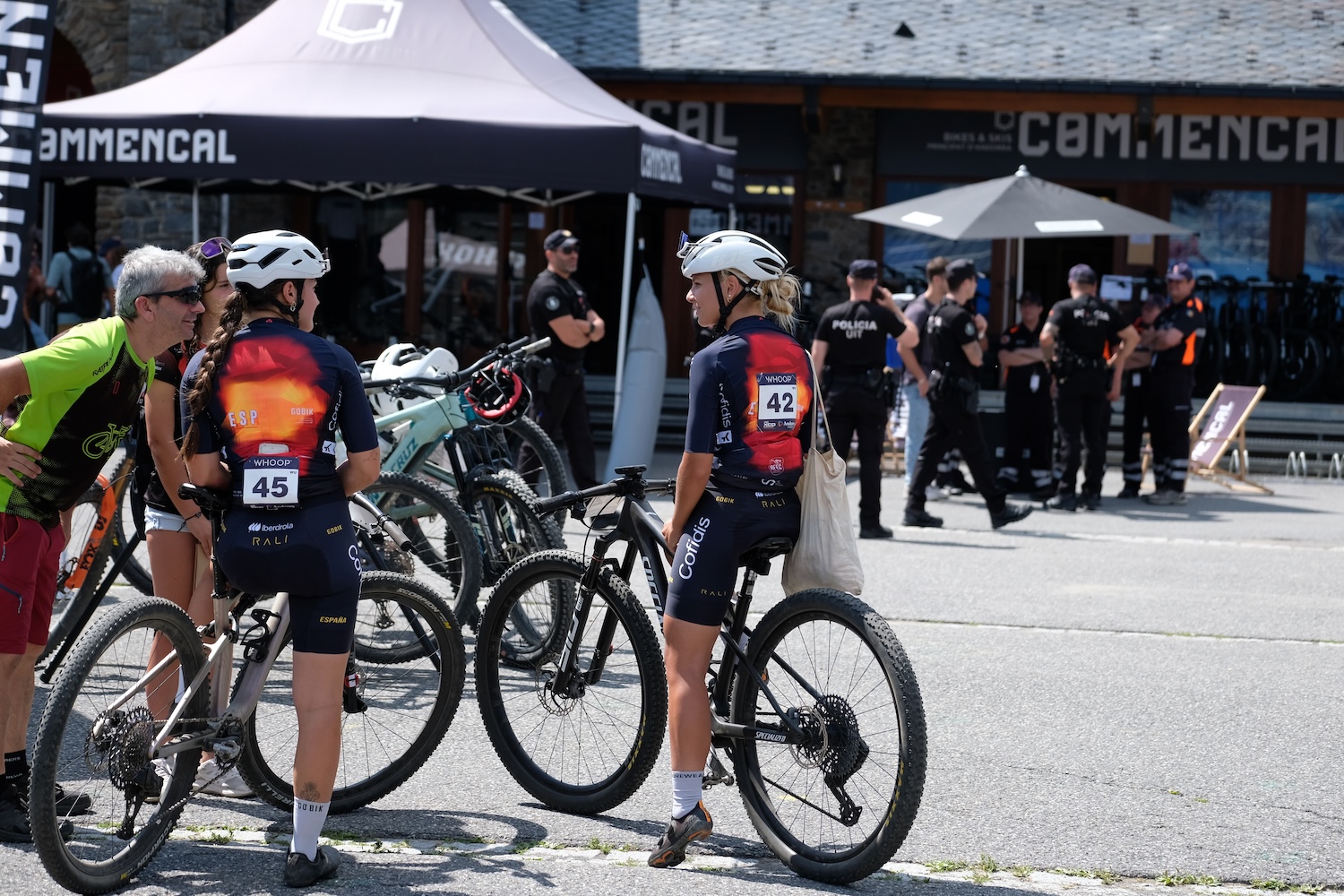
We’re in Pal Arinsal, for the Andorra round of the WHOOP UCI World Cup Series. This cross-country and downhill venue differs in that the race arena, logistics and everything else are already high up the mountain, way above the town below, rather than at a resort base at the bottom of the hill.
In between swapping chainring sizes and cleaning Trinity Racing’s Specialized Epics to a gleam, Aaron and his fellow mechanic, Isaac Mundy, were kind enough to field my questions about the daily lives of a bike mechanic, their favourite tools and the constant search for USB power. We started, though, with the cliché that cross-country racers just get on and go flat out, with shocks pumped to max, regardless of the bike and the technology.
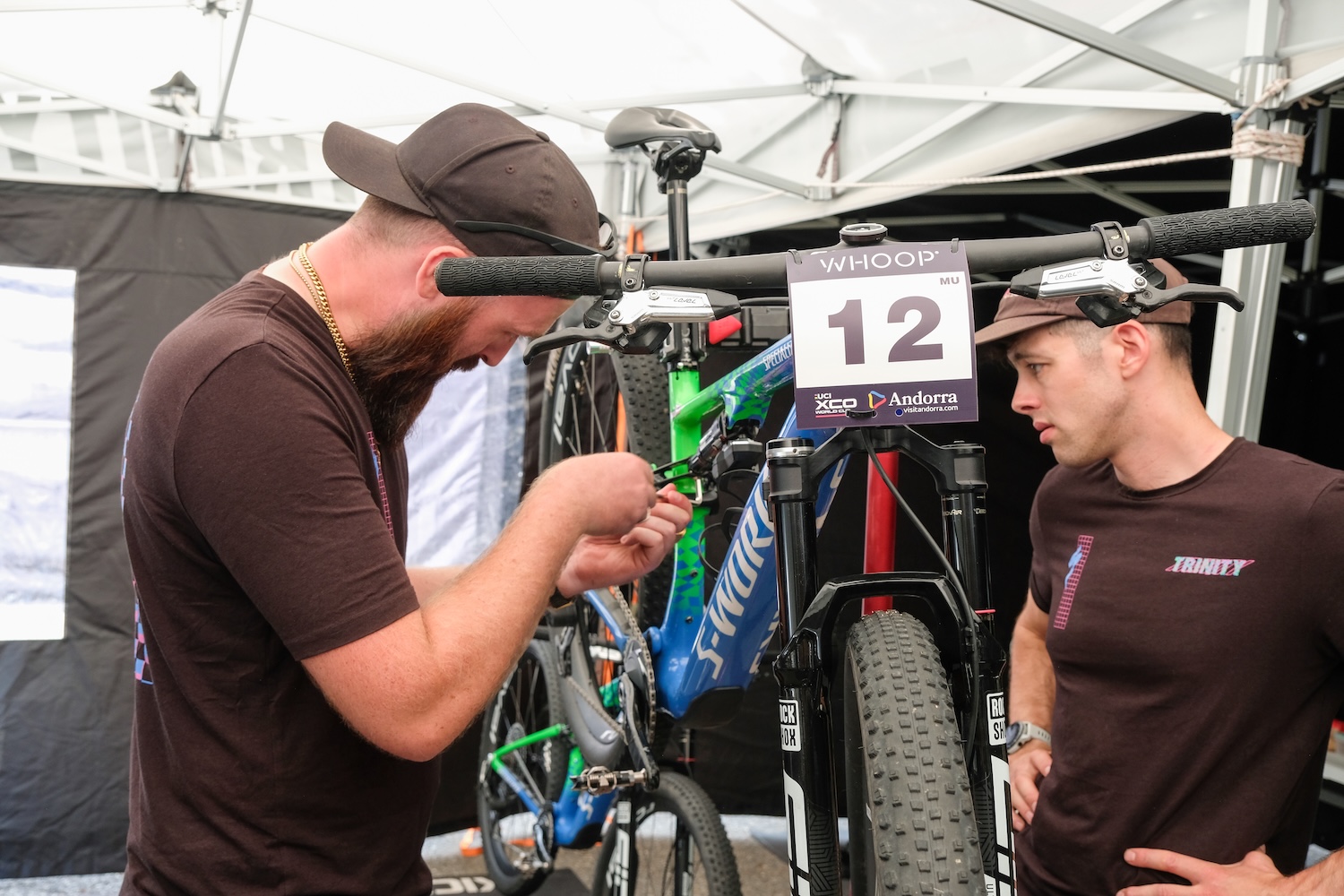
What does that button do?
Do you have riders who are completely knowledgeable about their bikes? ‘I’ve got some mid-stroke harshness I need to remove’ or do you just get fast riders who just get on and ride until you tell them to stop?
“Absolutely. Dan English and Coran Carrick Anderson are very good with their bikes [and both National Champions – Ed]. Dan in his off-season is working in a bike shop and is very into his bikes and technology. He doesn’t hassle us, but he’ll ask why we did something. Or he’ll show us stuff that he has figured out. He’ll take the bike home [to the States] after a couple of weeks in Europe and strip it down. He’ll send photos of the bike fully stripped on the table. Shocks, forks, dropper…
“And then at the other scale of things… some riders are pretty good at not giving a damn and some are bad at it. Some are just hard on bikes and are a nightmare as they don’t know what’s wrong, and others just don’t care. Getting information out of them is hard, especially as we’re a development team… we were checking pressures today. They’ve been home for three weeks and they’re riding every day. I’ll ask ‘Did you adjust your suspension?’ Some will say ‘No, I never touched it’ – whereas the other guys have a huge thirst for knowledge.”
All that tech
How hard is it to keep up with the new tech? Like, how is all the Flight Attendant and wireless shifting? Easy to get up to speed?
“Coming [back to MTB] after three seasons of working on the road racing team to electronic shifting and shocks has been different, so there was a bit of catching up to do, but there are friends around who can give you a hand. It’s an amazing system. The more time you spend on it, the more you notice how good it is. It’s an intelligent system, so it spends something like 20 hours adjusting to the rider’s style and it’s constantly giving itself feedback to improve. There’s also a trade version of the consumer Flight Attendant app where you can really fine-tune it to your liking.
“Also, it’s easier to build up bikes than it was in the past. You’ve not got cables.”
“We both worked on the road together [Trinity used to also have a pro road team] and we’d say that by Stage Three of a road race, everything would be mint. First day a bit of a rush, second day, fix all the problems and by stage Three, everything is spotless.
“MTB is different. At Val de Sole… That was a shift after the first day. We changed all the suspension, all the wheel bearings, bottom brackets, three headsets… at the end of it we sat down at 9pm. We didn’t even get a beer as everything was shut – going ‘Wow, if you priced what we did at a bike shop, that would be two, three grand, just in labour, not to mention the 20 grand in parts. But it took us until that round of the World Cup to get to that stage with the bikes. Three or four races in. But it took us that long to get all the bikes dialled.”

Do you just get weirder mechanicals now? Loose bottle cage bolts?
“There’s a bit more maintenance or upkeep, but fewer problems. You’re not straightening derailleur hangers any more, or tweaking barrel adjusters or shortening cables. But it’s all getting higher performance. It’s a lot simpler than it used to be. Well, it’s a lot more complicated, but it’s like cars, it’s not your job to fix that bit. You can’t do anything but replace broken parts.
“You spend more time chasing smaller stuff. You see that more in the bigger teams. All the telemetry and playing around with settings. But there’s still loads of work to do.”
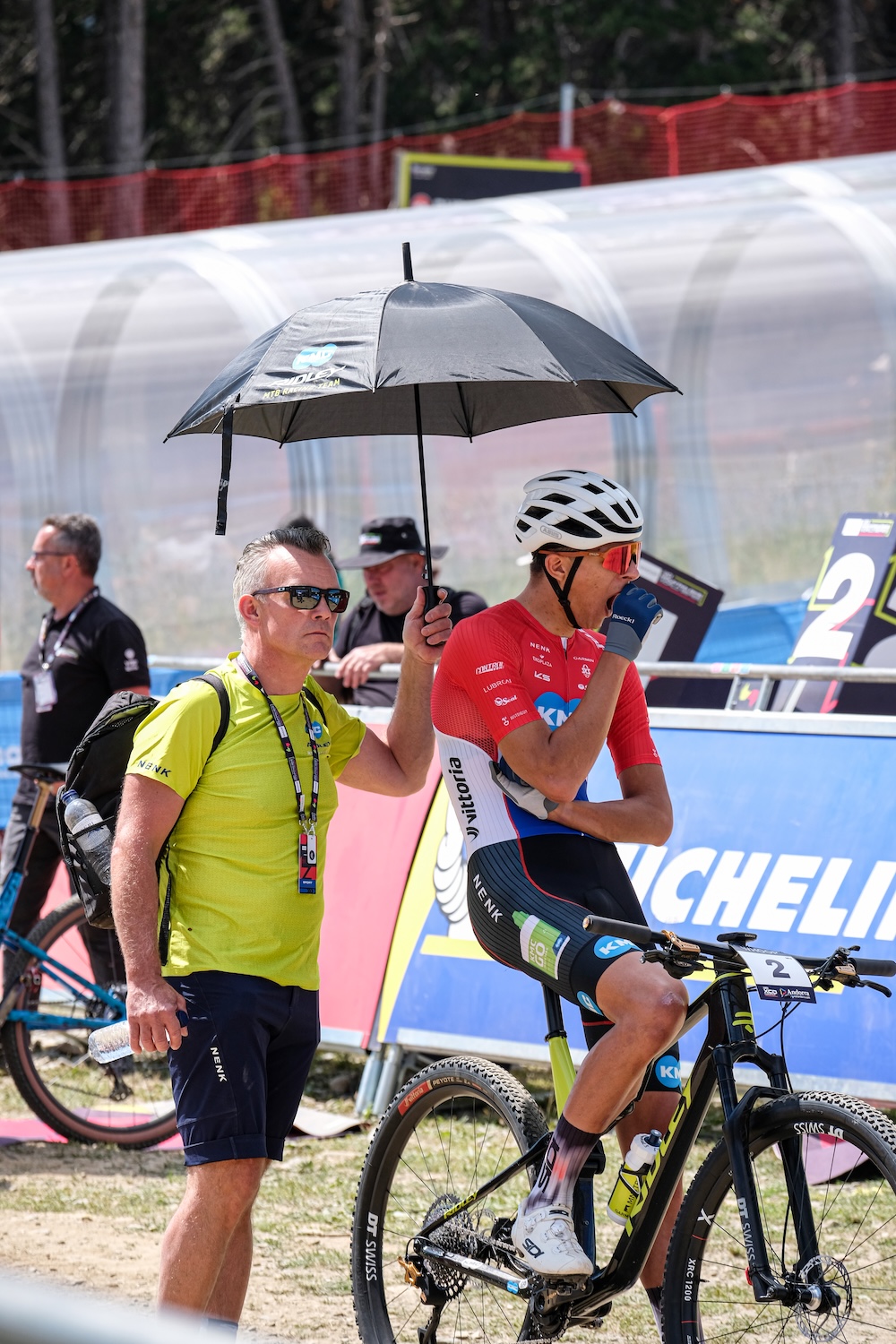
Does that mean a bigger demand for USB sockets?
“Oh, that’s it! You clock into a shift of changing batteries throughout the night. I was lying in bed today at 7am and Isaac got up to have a shower, so I shouted ‘Change the batteries!’ – and you hear four or five coming in and out. It’s just a sea of batteries in the mechanics’ hotel room.”
Swapping Rear Mechs
In some ways, the march of technology in bike tech is helping the mechanics. With just about every pro cross-country team running wireless shifting these days, there are no longer any cables to feed through, clip, tension and adjust. Gears work seamlessly, assuming there’s battery power. But that tech comes at a cost of complexity in setup and in mid-race replacements. On a short track race, if you have a major mechanical, your day is likely over, but on a longer cross-country race, there’s still hope to fight your way back up the rankings. And so, replacing wheels aren’t a race stopper.
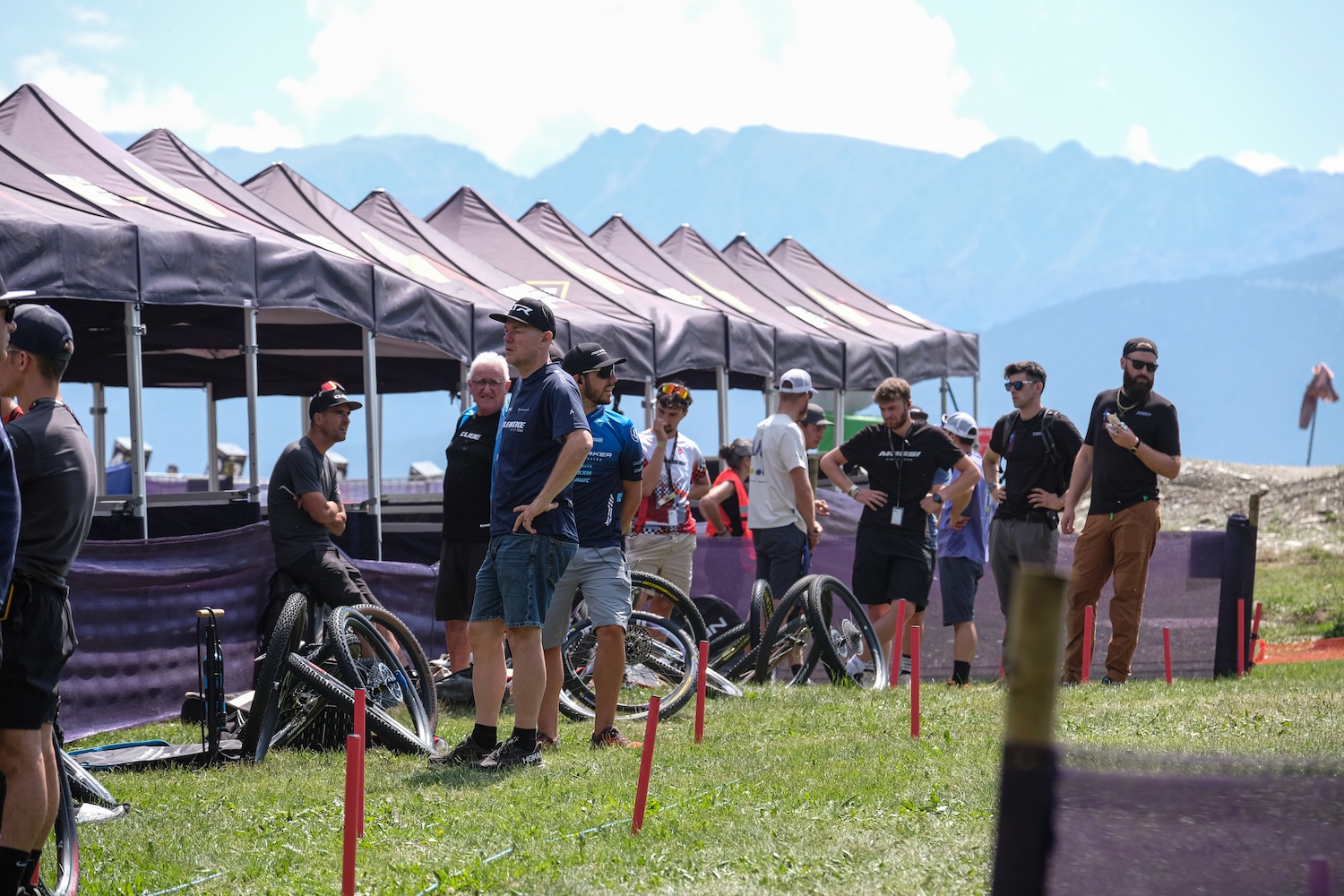
But what about if you smash a rear mech? As Trinity is running SRAM’s wireless AXS Transmission groupset, there’s no longer a hanger to snap off, but what if you munch a derailleur cage? I joked with Aaron about having to boot up a Wi-Fi hotspot in order to watch a Youtube installation video to set up a new rear mech in the field.
“These [SRAM XX] mechs are pretty bulletproof. The only thing that’ll break is the cage. And those twist off and on. So you don’t swap mechs and then have to pair it with the wireless shifter as it’s the same brain.
“The only slow problem is if they were to crash and break a saddle. We have a rigid post ready, one for the boys and one for the girls, with all their seat heights marked on them. Now with wireless droppers and RockShox’ Flight Attendant, if you put a new dropper on mid-race, you would have to either add a second remote paired with the post, or you put a new dropper in and run next to them to pair everything up again, which takes too long. So, I prefer using a hard post to get them on their way, especially if they’ve raced some ‘cross, though some new kids are ‘What? There’s no dropper!’”
Let’s talk tyres
I already know that the cliché of narrow, hard, tyres is probably done these days, apparently there is still a place for the overinflated skinny tyre – and that’s usually on the Short Track course. The courses are generally smooth and fast, without many obstacles, so what tyres for Short Track?
“Short track we would run a 2.2in. The (Specialized) Factory Team are testing gravel tyres and that sort of thing. I’m not there yet. It’s just too risky. So we use 2.2in and they sit really narrow, like an old school 1.95in. There might be a couple of loose corners, but you sacrifice a bit of grip there.
“For cross-country racing, tyre choices are now simplified. We mostly run an Air Track 2.5in (which isn’t on sale yet). Technology on the rubber has got so good, you can run a big volume at 16-19psi – and as low as 15psi. The bike, these new wheels and the tyres these days are just streets ahead. You can see from the Pro categories.”
There’s a misconception that everything is just pumped up hard and nothing moves. Yet these days you expect to get full travel on the team’s bikes?
“Yeah, and we expect to do so, even with 120mm front and back on the Specialized Epics. This bike is that good now that it can descend and climb so well that unless the track really, really suits the [100mm/75mm] Specialized World Cup bike we use it all the time. This covers so much across the board. The likes of the dummy, rigid, shocks we’ve seen in the past aren’t really happening any more.”
Cameraderie of mechanics
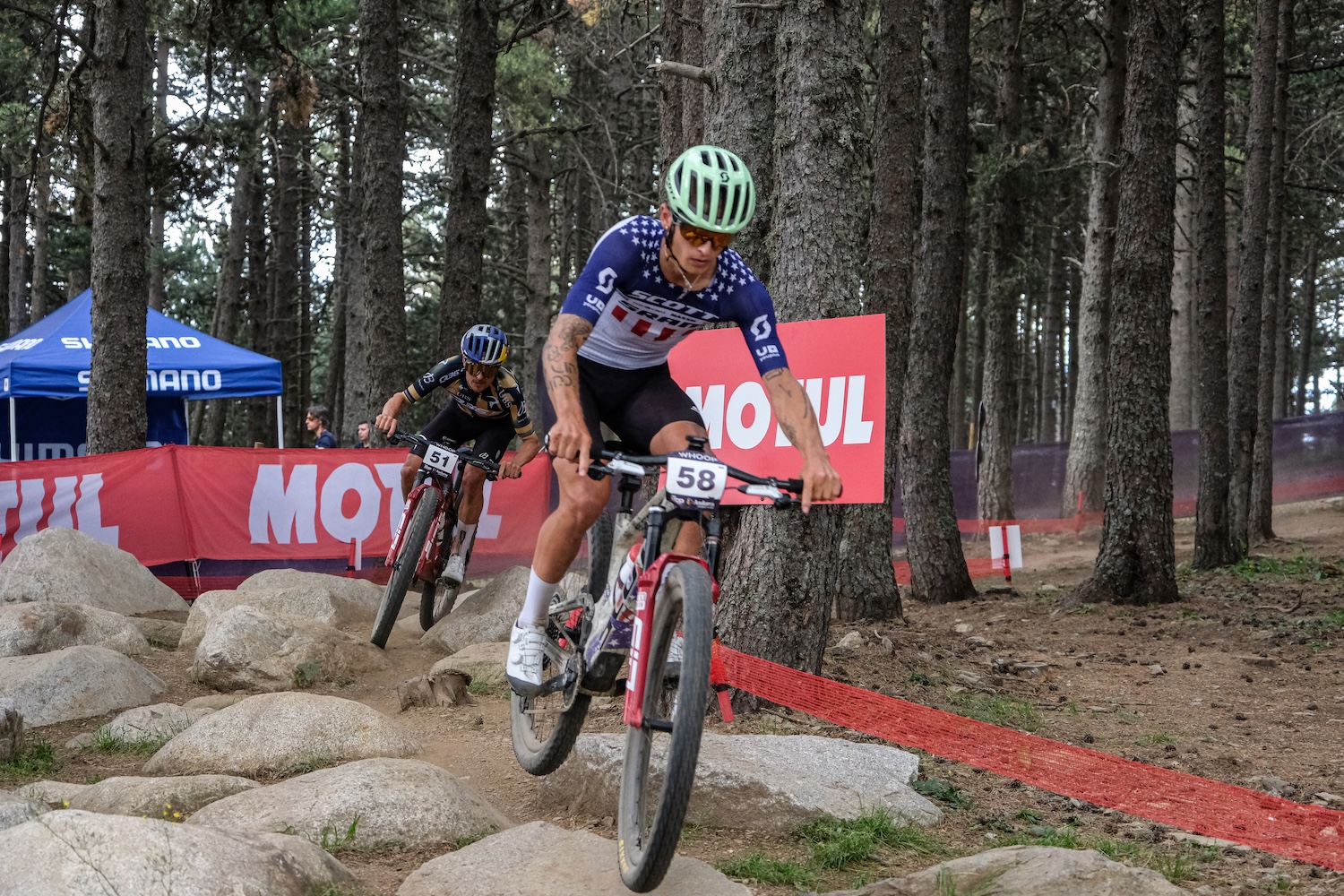
“We’ve support from SRAM, so I can take forks off, take them over to the RockShox truck and they’ll sort them out overnight, which is good as you’re not getting bogged down doing a job for an hour when there’s only two of us. Bigger teams have a mechanic for each rider, while we’re trying to do four or six between us.
“All us mechanics all get on. Coming from the road side, it’s different there. Everyone’s in their separate hotels and no one really mixes. Here in mountain biking, we’re all in the same car park together. Usually Thursday evening, there’s one team tent, word of mouth goes round to go for a beer and catch up. You’ll have your little pockets of friends where you can go up and borrow spares to make everyone’s lives a little easier.”
Set up, race, tear down, drive…
While spectators might only see the race for a day or two, the run-up to race weekend is a long one. Here’s Aaron’s schedule for a typical week.
Normally Wednesday
We normally arrive Wednesday (though Andorra was different as everyone needed to be on site by Tuesday due to the mountaintop location.)
Give the van a good wash, give the cars a good wash, so everything’s nice and clean to start the weekend. It’s about presentation here. You see the big trucks at the mountain bike World Cup and you have to try to make it look like you’re competing with them, even if you don’t have the same budget.
So, we set up the tent and the bones of the stuff Tuesday evening. On Wednesday, we managed to get out on a ride. It’s important when you’re in these beautiful places to make the most of it. When you get to the end of the year, it’s great to tot it all up and see where you’ve ridden.
It’s very important to ride the course. We usually take turns to go out because you have riders coming back with feedback on the course. It’s good in your own head to know about gearing or suspension. You can then direct them on bike setup. We get out on the ebikes for a couple of practice sessions. Then the rest of the staff arrive Wednesday night. A quick look over the bikes and get everything ready to train on for Thursday.
Thursday
Thursday is when we do our big work. Up early in the morning because the women are out on course at 9am, having flown in the night before, and they’re always keen to get out. So we’re up at 6.30-7am, and up here for 8am to start getting wheels and stuff ready for the pit. One of us might stay here to make changes for any of the boys coming over while the other might go over to the course and get feedback from the girls about the different sections. If they want, we’ll grab a helmet and an ebike and go out and do a couple of laps if there are lines they want us to look at. Isaac’s a brilliant rider, so he’ll do a lot of line selection with them, whereas I’ll go out and see how they want to change their bike setups.
Thursday lunchtime, the boys will go out and then they’ll come back and then it’s two or three bikes for us each. We have six riders on the team and we’ll just go through them one by one, strip them, clean everything, check frame bearings and so on. All the heavy work is done on the Thursday evening up to about 8 or 9pm. You’re kind of wrecked but at least you know you’ve put the big shift in – as you never know what might happen on Friday. Someone might crash and all hell will break loose. So it’s good to have everything cleared out of the way.
Friday – Short Track
Friday is Short Track race day. Usually first thing in the morning. It suits us quite well as we can get the bikes washed and put away early as there’s training again tomorrow. If we finish early, we’ll go out for a ride.
Saturday
They’ll all be out on course training today. We don’t set up loads of wheels and tyres until after lunchtime on Saturday as you want to wait to see the weather. We set everything up, give everything a shine and polish. And you’re leaving time in case there’s a disaster to fix.
Sunday – cross-country Olympic race day
Full gas. It depends what time you’re racing. You’re here early in the morning. Over and back to the pits. You go to the start and then there’s the feed and tech zone. I’ll give the soigneurs a hand with the bottles and stuff. I know how they work and what they need. If you’re just standing around waiting for a puncture, it’s going to be a long day, so you chip in and help out with the start line and the rollers and stuff. Spares – you’re covered for every eventuality. You’ve got a rear mech, cage, chain, quick links, chain.
After racing finishes, you’re usually in the paddock until 4-5pm until you can pack up. The race is the easy bit of it: everyone finishes the race but you’ve still got four or five hard hours of work ahead of you. You’ll get back and people could be flying here there and everywhere. They could need bikes, they could need wheels for regional races. Stuff has to get packed into bags, riders want parts to take with them. So you’re doing all your logistics on Sunday evening, packing up bike bags. And then you have strip everything down and pack it into the van.
If you’re ambitious, you start driving, but I’ve learned now that that is stupid. You get two hours down the road and think ‘I am exhausted!’. You might think on Sunday morning that you’ll get it all packed up, but come Sunday night – it’s just beer, pizza, sleep. An extra half an hour spent loading the van will make a difference to the start of the next race. Sunday is probably the hardest day – and then you do it all again the next weekend.
And with that, they were both off to finish washing and cleaning bikes and prepping things for the next day’s action – and searching for more USB sockets.