Does Northern Soul come in a bag? The Carradice Adventure Range tested.
- Brand: Carradice
- Product: Bowland bar bag, Odyssey saddle bag & Bagman support rack
- Price: Bowland bag £104.95, Odyssey bag £122.95, Bagman front rack £69.95, Expedition rear rack £79.95
- From: Carradice
- Tested by: Kevin Fahzure Dwyer for 5 months
Pros
- Absolutely waterproof
- Support the home team!
- How much more black could they be?
Cons
- ‘Floating’ lids would be better
- Racks not mounted as directly as I’d like
- No shoulder bag attachments
Our rating
When I arrived back in the UK after many months in Utah winter sun, I was absolutely tickled that SIngletrack heard my pleas to be incorporated into Northern daily biking culture.
While this culture exhibits many hallmarks: fenders; wider and knobbier than average tires year-round; reflective waterproofs; lighting systems with rave mode; search for the ever elusive perfect winter glove, probably the strongest indicator of damp and dreary bicycle obsession is the Carradice bag (pronounced Care-a-deechey).



The Carradice bag is a, “Hell yeah!” to train–bicycle adventures; tow path commutes in the dark at 3 PM; and, a stuck seat post at least once in your life. Why not look like you are part of the Rough Stuff Fellowship on a daily basis, if bare survival is sometimes how riding feels?
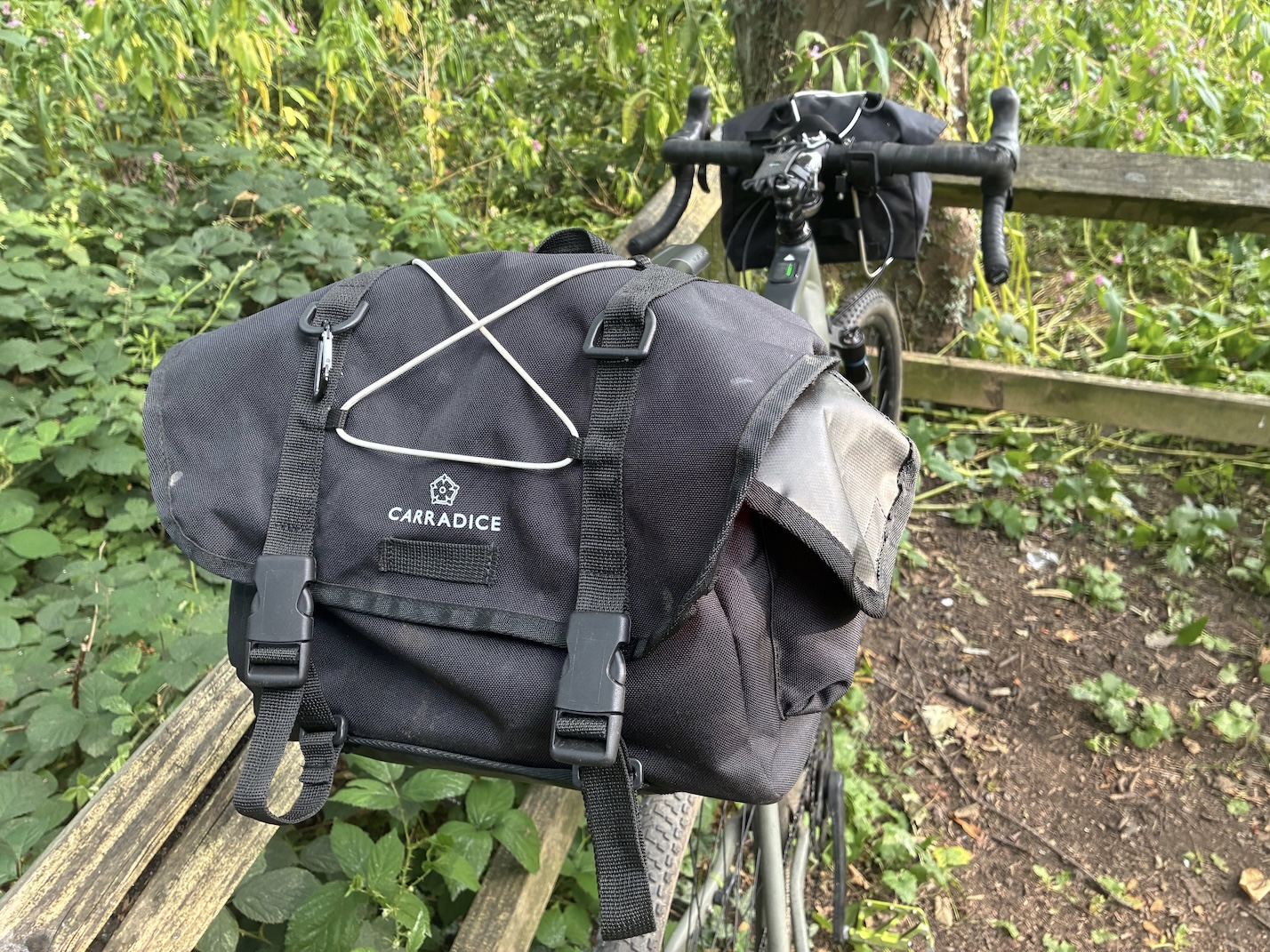
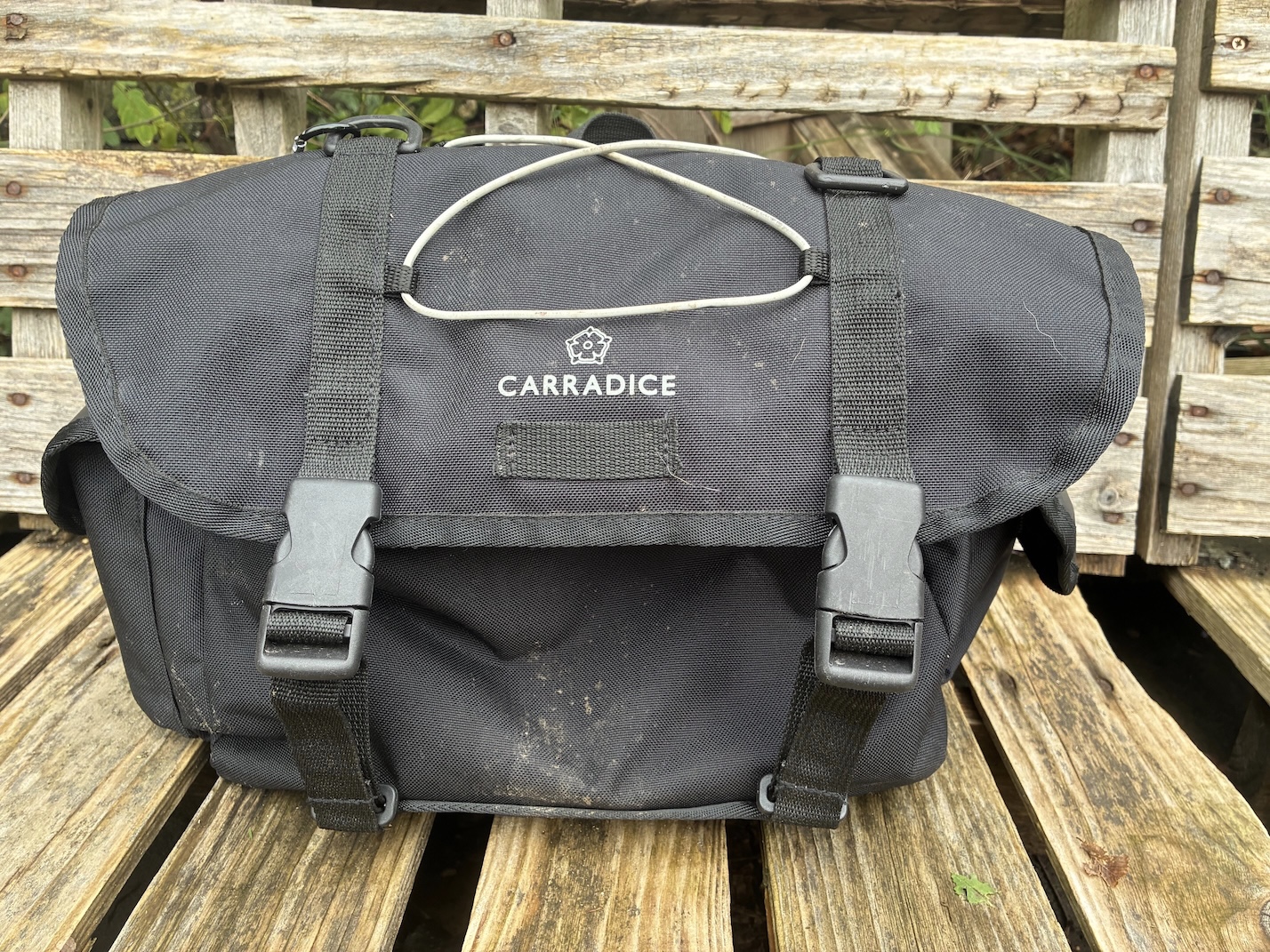
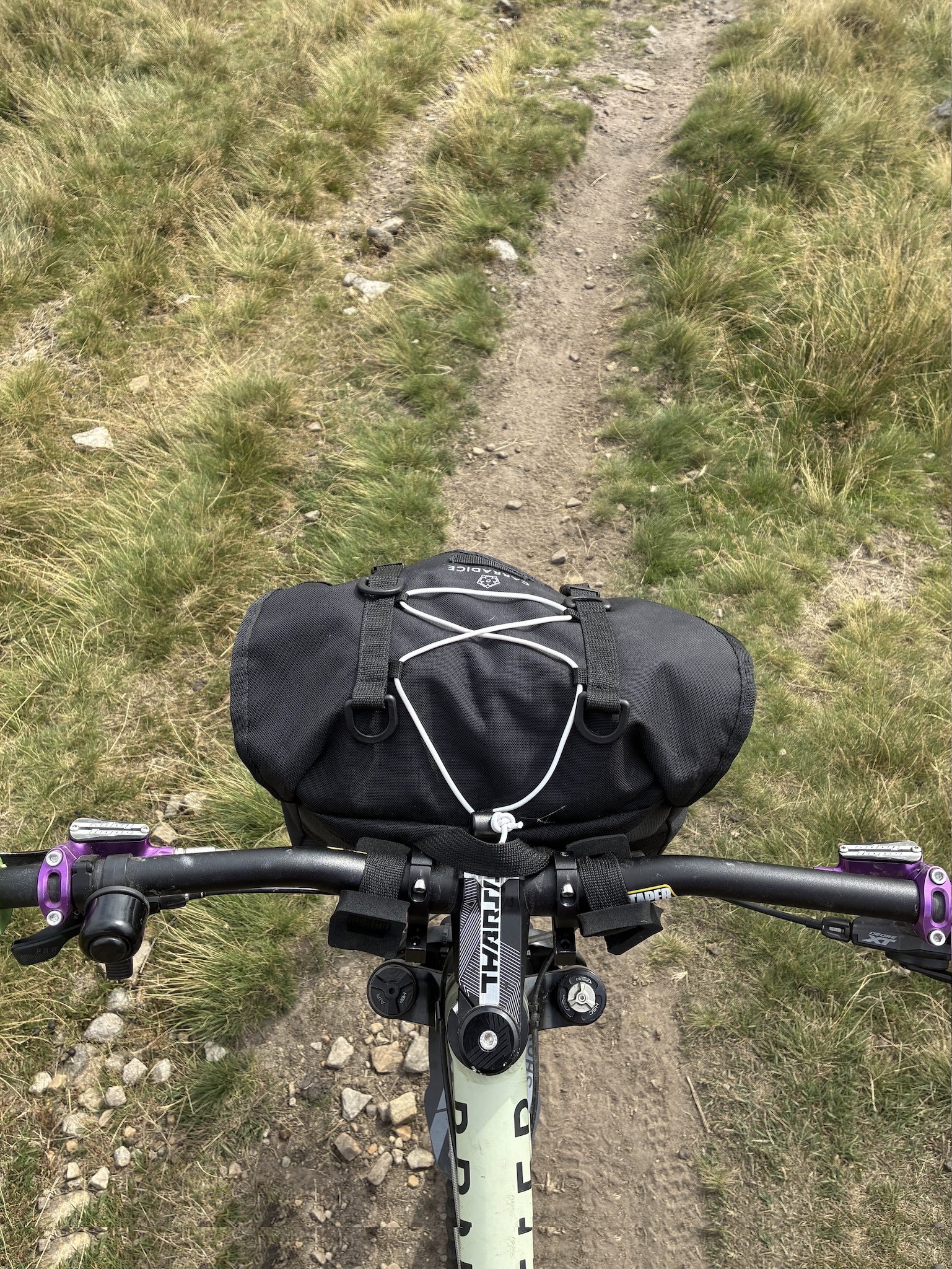

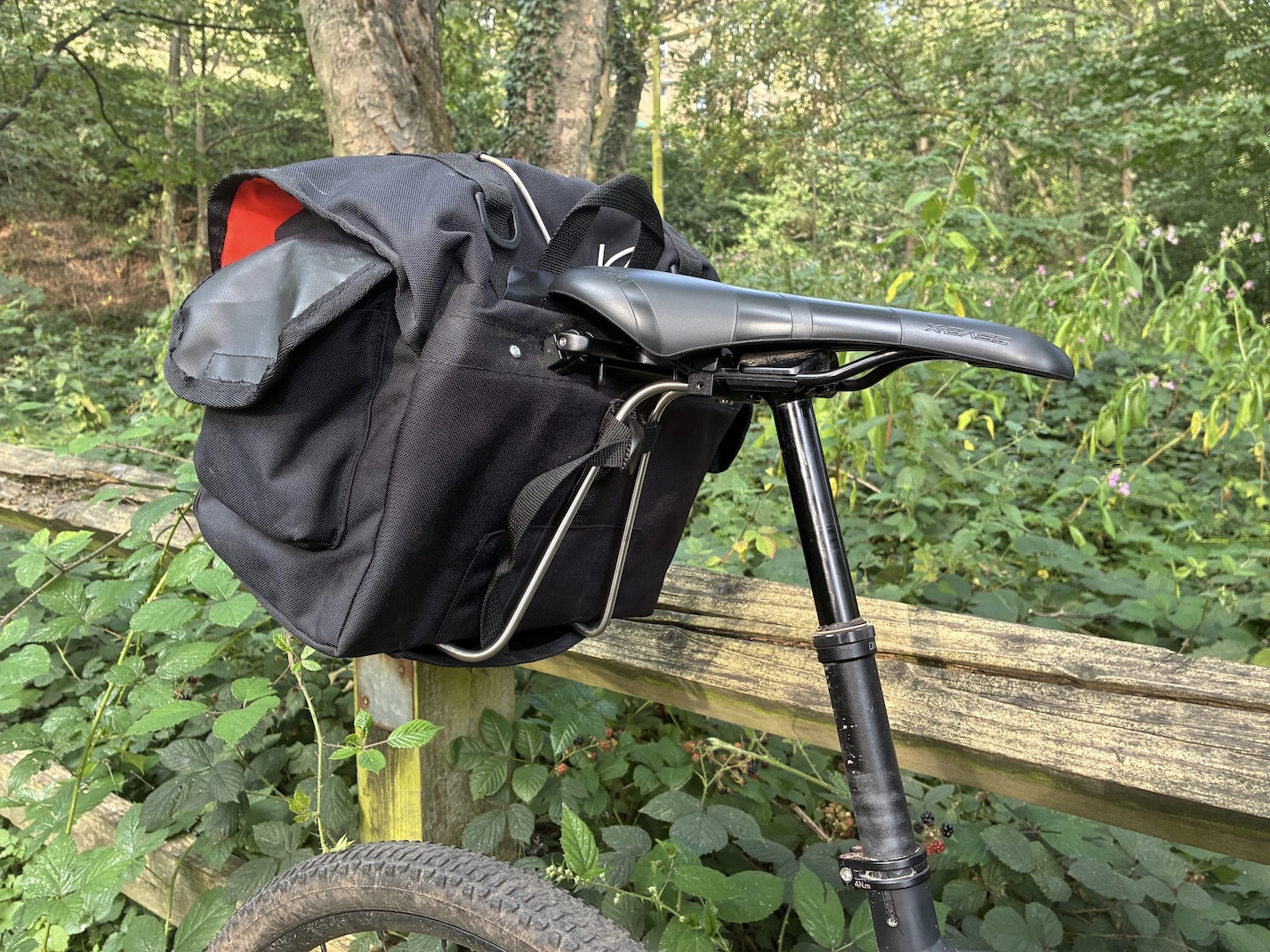
Thus Singletrack requested that I put on test the Bowland bar bag and matching Odyssey saddle bag, both of which integrate into their Bagman support racks, with the Odyssey on test utilizing the quick release (QR) system to attach the bag near and below the back of the seat.
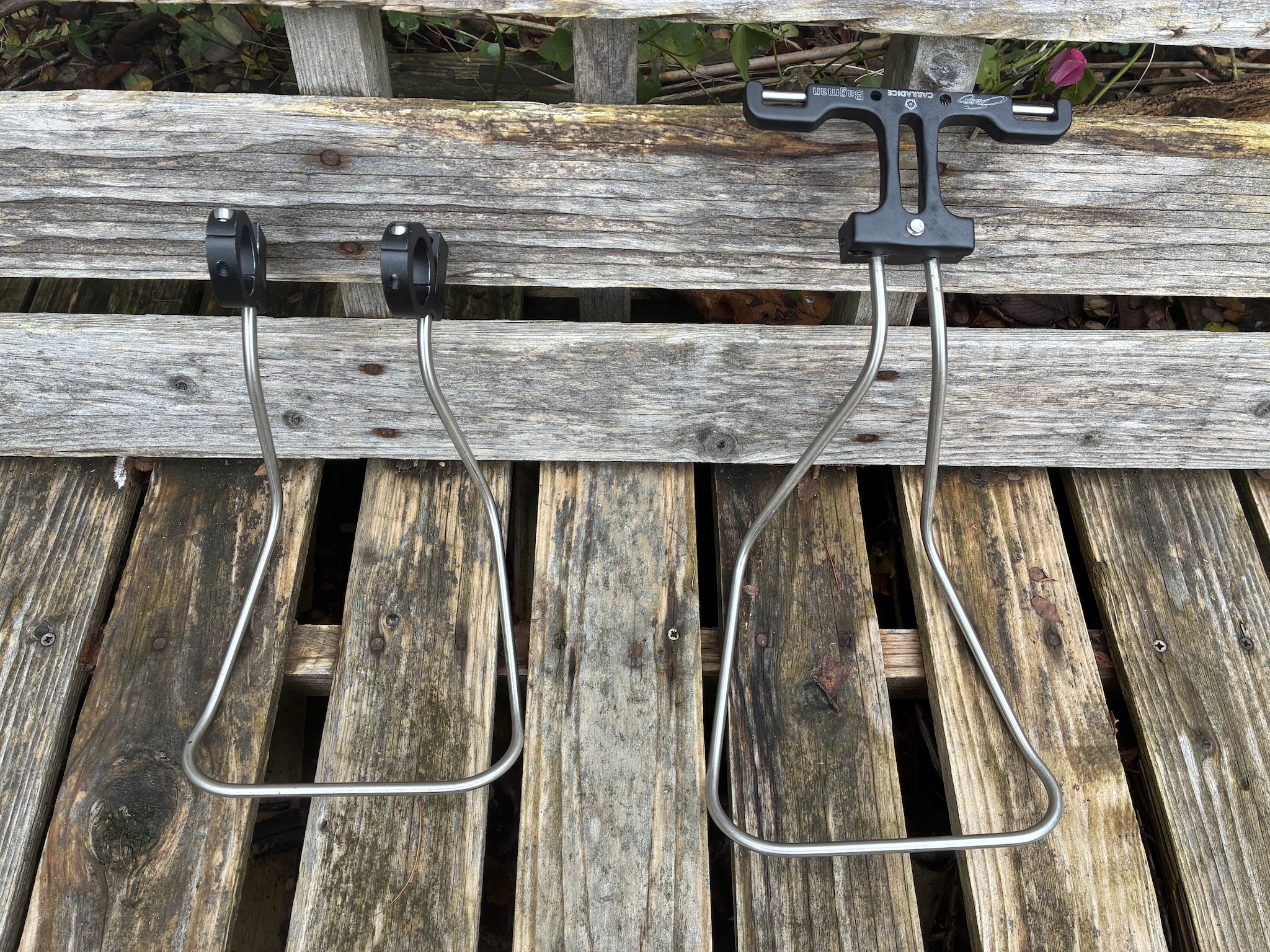
These bags feature similar design, murdered palette and identical materials, including heavy duty nylon strapping and hardware, roll top closures, 1000 denier Cordura, a taped and waterproof orange lining, webbing grab handles and plastic impregnated fabric on the bottom that integrates with the Bagman rack. Both the front and rear Bagman racks are made of a one piece stainless steel rod bent in a sort of “U” and anchored into aluminum mounts which, in the case of the Bar Rack, clamps to the handlebars, and in the case of the Expedition QR Saddlebag Support Rack attaches to the seat rails.
Of course, much of the value in these products lies in their Nelson, Lancashire origins and pride in craftsmanship, which is evidenced by tags signed off by the specific maker of the bag (the bags I had on test were made by two different people).
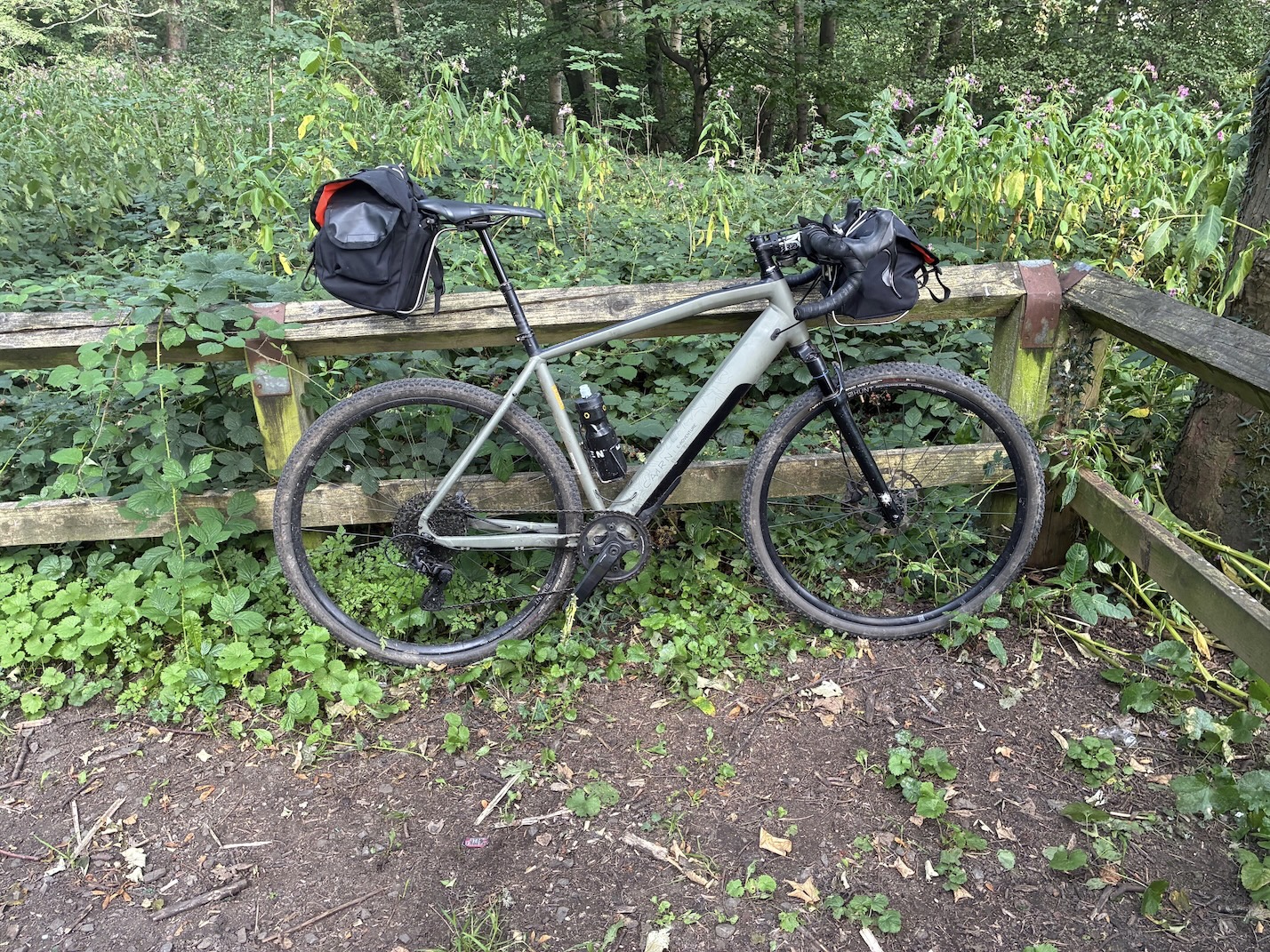
Both bags are part of Carradice’s Adventure Range, which is designed for “off-road riding, from gravel paths to rugged trails.” I utilised the bags onto two different bikes, predominantly on a haute category Cairn eLite-gravel bike with tire liners, a suspension fork, double wrapped bars and dropper post and supplemented the testing on and an above category Privateer 141. Website descriptions and imagery suggest that these bags have a wide range of usage, including “bike packing, touring, and every day adventures,” and are shown on both drop and flat handlebar bicycles of the rigid and suspended varieties. I found the system to have much more limited application.
Most of the limitation arises from the Bagman rack which utilizes a chunky aluminum clamp system into which the stainless rod is anchored by a small allen set screw. These are high mount racks, altering the center of gravity on the bicycle substantially. In the rear, this makes the bike difficult to mount and dismount, especially with a taller load, and tippy. On the front, the weight affects the ability to quickly change directions and, again, makes the bike tippy, something I noticed when trying to park the bike.
On the handlebar, the clamps can be mounted in such a way that the rack extends from the bottom of the bar or the top of the bar, lowering or raising the rack, whereas the Bagman expedition seat rack clamps to the seat rails with a single 6mm Allen headed bolt, with the quick release mechanism placed where the rack bends down behind the seat post. The rear rack has a claimed maximum load of 10 kg, while the front rack claims 6 kg.
In my experience, the handlebar clamps, especially combined with the Bowland bag attachment strapping, took up an excessive amount of space on a drop handlebar. Furthermore, the close-to-the-bar positioning that the rack puts the bag in causes the bag to sit against your hand and can make access to stem or bar mounted accessories difficult.
On the MTB, with the clamps carefully checked for tightness and with a load of 6 kg, I could not ride down stair height trail ledges without the rack clamps rotating on the bar which ultimately caused the bag to bottom out and bind against the bicycle head tube. And, like with the drop bar, the close spacing of the rack and bag to the bar and substantial size of the Bowland made for significant brake, dropper and shifter housing interference for (800mm) flat bar controls.
While the interference situation is better when in low mount position, depending on your front end metrics (smaller riders beware of minimum distance, center of handlebar clamps to tire is about 200mm), you may find that your front tire rubs the bottom of the bag (or in compressions with a suspension fork).
Overall the bar clamps are chunky, not very hand or cable friendly and with one clamp bolt awkward to reach for mounting and adjustment, resulting in a rack that weighs more than many front fork mount mini-racks, but comes in at an affordable 70 quid.
The rear Bagman expedition rack is similarly affordable, with the quick release model that I tested coming in at just 80 quid (are the racks loss leaders?) and the non-quick release model just £50. Like the handlebar Bagman, the saddlebag support rack has some specific use cases.
Critically, if you don’t have 250mm between your seat rails and tire/fender, the bag will rub. This makes the rack not an option for smaller riders, slightly larger riders with fenders, and most riders who rely on dropper posts. I found the rear rack oscillated when loaded over bumps and made dropper actuation much more difficult leading me to believe that, in the long run, the side loading will wear on dropper post components.
For both racks, the larger allen bolts provided a secure connection, but the small set screws on the saddlebag rack were prone to loosening.
Like the racks, the bags share materials and construction, here, resulting in highly reliable, durable and waterproof containers. The robust plastic materials (which begs to differ from its Rough Stuff Fellowship era look alikes) are certain to hold up and perform as they did when new for decades.
Notably, both bags have a roll top construction with a lid, rack attachments made of plastic impregnated fabric, a blinky light loop and a bungee lattice on the outer top. The rear bag additionally has two small side pockets with impregnated fabric lids, and the aforementioned quick release mount comprised of a plastic bar with two tabs that lock into the Bagman rack spring loaded QR pins which slide in channels on the aluminium bracket and are actuated by pinching together to small handles. It’s a simple, quick and reliable system that has an audible click when the bag is secure.
I tested the 26 L Odyssey and the 12 L Bowland, whose stated capacities are deceiving, as those volumes do not allow for the roll top to close, much less the lid to cover the extended bag. The Bowland does come in a 20L version, but that much volume is likely to push beyond the Bagman rack and any slow speed or technical steering precision limits.
Which brings me to some of the misses for these bags and the Bagman system.
Because of the roll top system the bags use a lot of fabric, like the racks they are heavy by comparison to other options. The rear-mounted webbing grab handles cause the bags to tip at angle when carried making them awkwardly wider, prone to spill their contents and harder to locate items while reaching through the extended roll top.
Furthermore, the fixed lid does not work well when the bags are extended, and provides an inadequate place to mount a shoulder strap, which synergizes nicely with the QR system. That QR system can be very difficult to operate if you have a conventional padded saddle, which, unlike a Brooks-type saddle, has rails which slant up toward the saddle base at the rear. The lack of offset between the QR mount on the saddle rails and the back edge of the saddle causes interference between the bag, especially with large or heavy loads, which tug on the bag mount. On a Brooks saddle the seat rails are at more of a right angle, allowing the bag mount to be closer to the saddle edge and extending locking pins past the interference point.
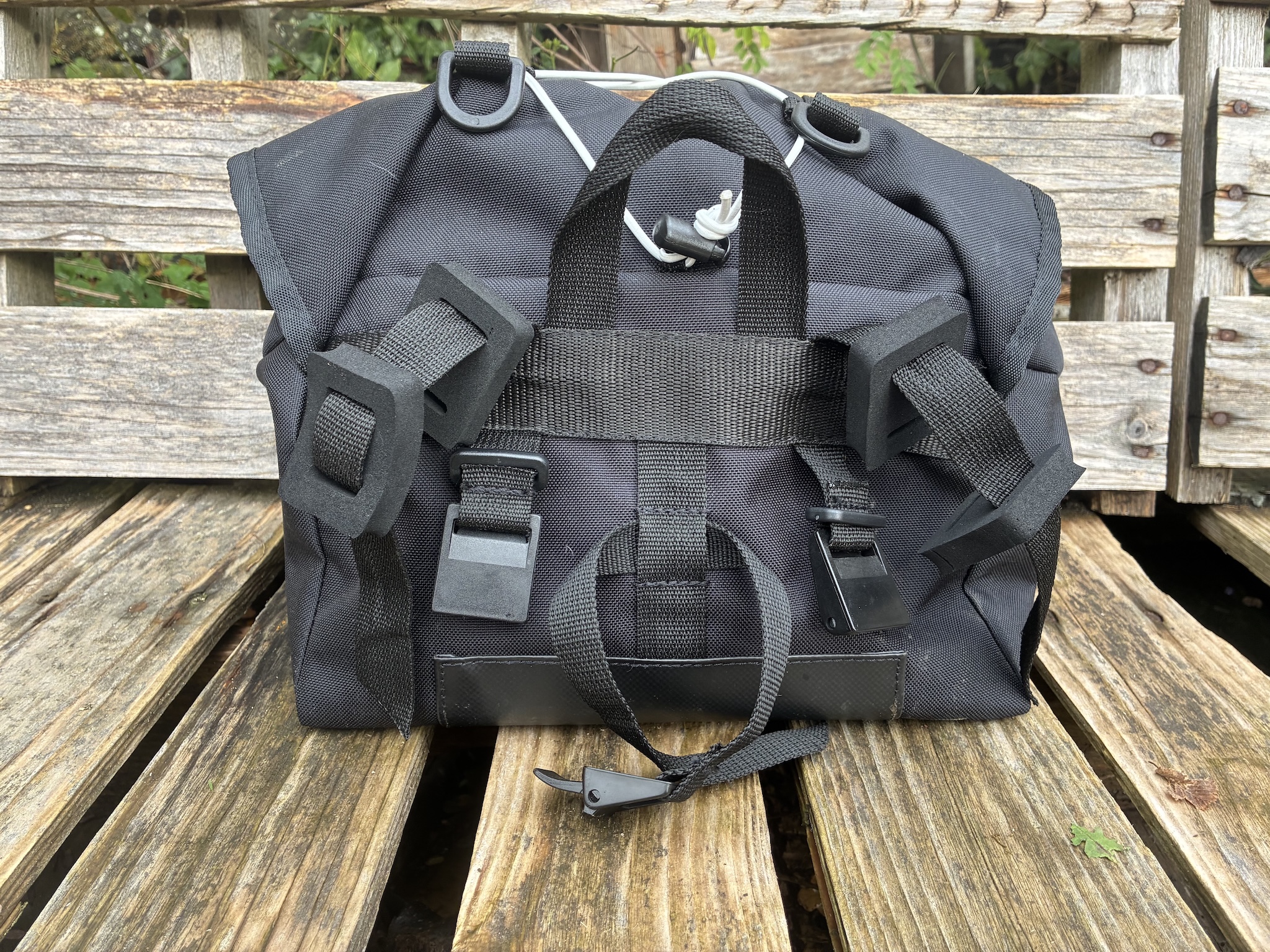
The front bag is decidedly non-quick release with three webbing camlock fasteners and a Velcro catch flap for the rack. I found the front bag to be well constructed with appropriate seem allowances, bar tacking and burly hardware, but the foam handlebar pads seemed to tear easily.
Conversely, the Odyssey bag had inconsistent seams, missed stitches, skipped stitches and a number of pokey plastic bits, part of the reinforcement of the QR system and bag bottom, which oddly had an upper rack sleeve reinforcement patch that did not extend to the edges of the pocket where the rack rests.
Overall
Right then, who is this system for? Likely, they are 170cm/5’7” or taller, unlikely to remove the bags for round town wanders and prone to doing lots of rainy road or gravel riding. I would rule them out for trail riding due to their effects on center of gravity, bounciness, ill effects with a dropper post and steering and compatibility compromises for flat bar MTB. For commuting and grocery-getting the Bowland could be useful in addition to panniers and the Odyssey might be good for longer, commuting, non-technical gravel and road/audax riding.